
Curated Guides > Syllabus > Art Appreciation Syllabus
Art Appreciation Syllabus
Looking—deep, careful looking—is not as simple as it seems. This syllabus will help you develop the important skill of close looking, introduce you to art history tools, and provide you with an overview of global art history. There are also units on materials, on where we find art, and about works of art that have been looted, displaced, repurposed, and destroyed.
 Open All
 Collapse All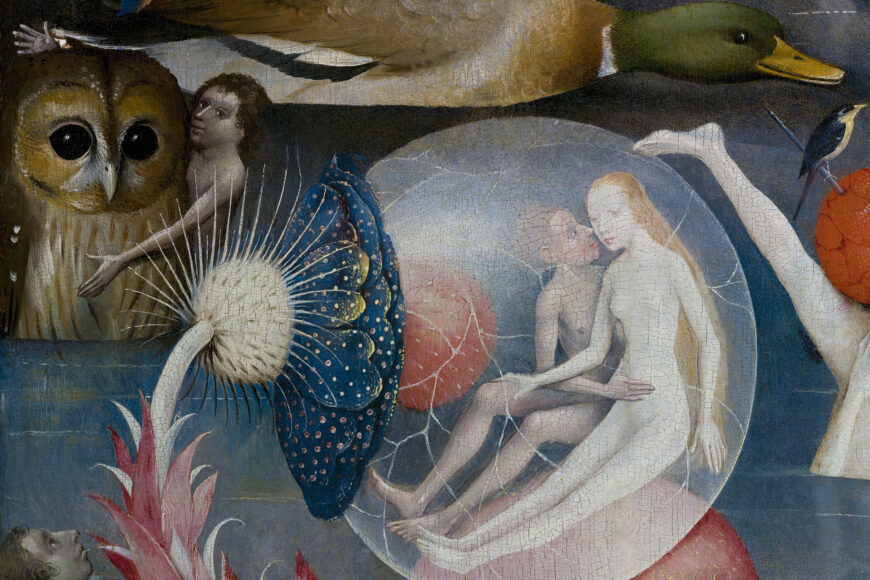
Detail, Hieronymus Bosch, The Garden of Earthly Delights (center panel), c. 1480–1505, oil on panel, 220 x 390 cm (Museo del Prado, Madrid)
- Introduction
- Why art history isn’t like math

- Introduction to Art Appreciation
- Why art matters (why look at art?)

- Must art be beautiful? Picasso’s Old Guitarist
- Elements of art
- Line
- Shape and Form
- Color
- Space
- Texture
- Surface and Depth
- Light and shadow
- Principles of Composition
- Balance, symmetry, and emphasis
- Proportion and scale
- Three kinds of paint: watercolor, tempera, and oil
- Making green: tempera versus oil
- Renaissance watercolors: materials and techniques
- Why should you care about art?
- Why can’t art be explained?
- How does art history encourage empathy?
- contour lines
- organic and inorganic lines
- implied lines
- geometric and organic shapes
- Primary, secondary and tertiary colors
- Complementary and analogous colors
- warm and cool colors
- value (tint and shade)
- saturation
- contrast
- linear perspective
- atmospheric perspective
- symmetry
- hieratic scale
Key Questions
Key Terms
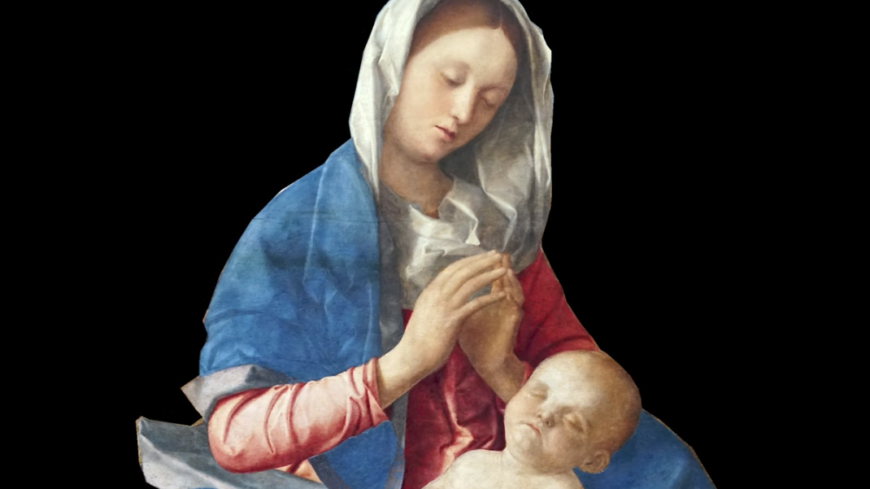
Giovanni Bellini, Madonna of the Meadow, c. 1500, oil and egg on synthetic panel, transferred from wood, 67.3 x 86.4 cm (The National Gallery, London)
- Tools for looking and interpreting
- How to do visual (formal) analysis
- Introduction to understanding art
- Iconography and iconographic analysis, an introduction
- Practicing looking and interpreting
- Stefan Lochner, Madonna of the Rose Bower
- Art historical analysis with Goya’s Third of May, 1808
- On looking closely: Giorgio Morandi, Still Life
- Describing what you see: sculpture
- El Greco, The Burial of the Count of Orgaz
- Seeing the passage of time
- What is art provenance? A Getty Research Institute case study
Getty Conversations
- The conservator’s eye: Marble statue of a wounded warrior
- In full color, ancient sculpture reimagined
- Vincent van Gogh, Irises: the search for violet
Getty Conversations
- Why is visual analysis important?
- Why is the historical context of a work of art important?
- Why would a museum show only a fragment of a sculpture?
- How do works of art change over time?
- Should we restore works of art to their original appearance?
- Visual (formal) analysis
- Composition
- pictorial space
- three-dimensional / two dimensional
- style
- subject matter
- iconography / iconology
- medium
- Geranium Lake
- historical context
- provenance
- Michel Eugène Chevreul
- Charles Blan
Key Questions
Key Terms
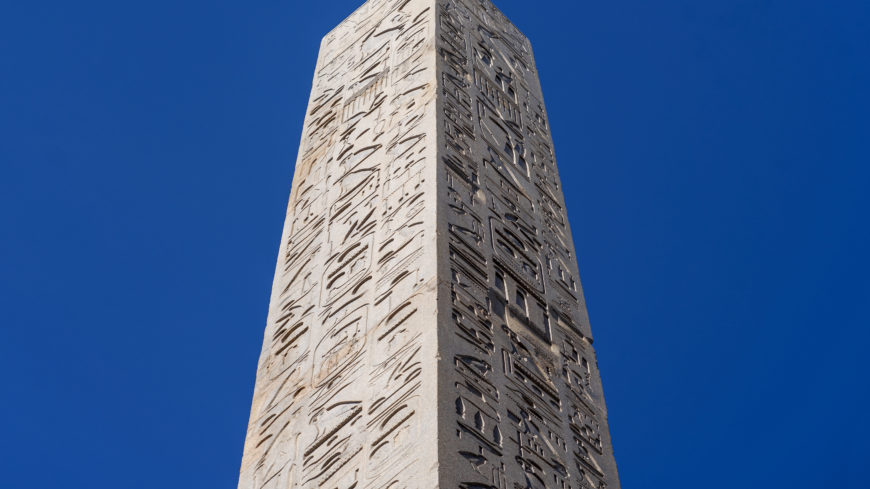
Lateran Obelisk, c. 1400 B.C.E., originally erected at the temple of Amun, Karnak by Thutmose III and Thutmose IV at a height of 32 meters; now roughly 4 meters shorter), monolith of red granite, 28 meters high (moved to Alexandria by Constantine, and later erected in the spina of the Circus Maximus in Rome by Constantius II in 357 C.E., re-erected at the Lateran in 1587 by Domenico Fontana for Pope Sixtus V)
- Moved
- Lateran Obelisk
- The Temple of Dendur
- Removed, looted, and seized
- The Benin “Bronzes”: a story of violence, theft, and artistry
- Nazi looting: Egon Schiele’s Portrait of Wally
- Who owns the Parthenon sculptures?
- Repurposed
- Hagia Sophia as a mosque
- Introduction to religious art and architecture in early colonial Peru
- The Great Mosque of Córdoba
- Survived
- Statue of a Victorious Youth
Getty Conversations
- The Cathedral of Notre-Dame, Paris
- Piero della Francesca, Resurrection
- Destroyed
- Bamiyan Buddhas
- Ai Weiwei, Dropping a Han Dynasty Urn
- What can we learn by researching a work of art’s provenance?
- What is an obelisk and why would a Roman emperor expend enormous resources to bring one from Egypt to Rome?
- What are some of the negative effects of looting?
- Why were the Benin bronzes attributed to the Portuguese?
- What was the effect of World War II on works of art in Europe?
- Describe some of the ways that works of art are endangered and what has been done (and can be done in the future) to protect them?
- provenance
- repatriation
- restitution
- looting
- Benin City
- Acropolis
- Lord Elgin
- encyclopedic museum
- minaret
- Ottoman
- Cuzco (also spelled Cusco)
- Inka
- mihrab
- cultural heritage
- hypostyle hall
Key Questions
Key Terms
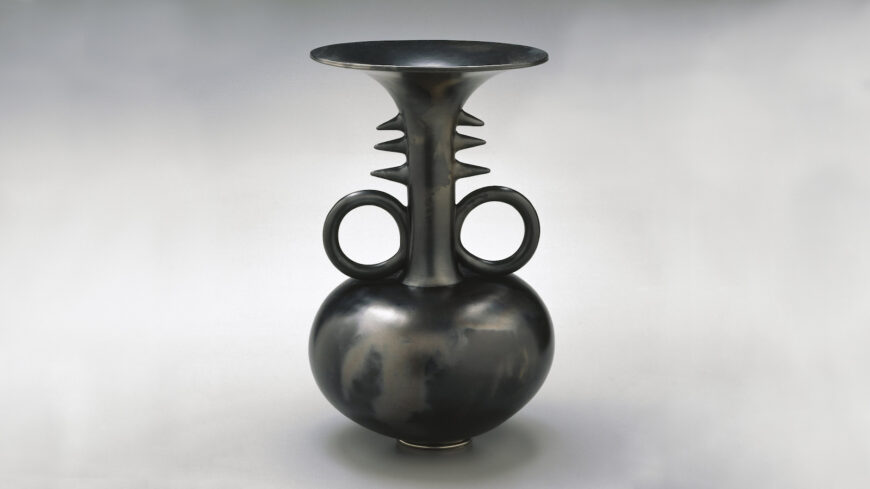
Magdalene Anyango N. Odundo, Symmetrical Reduced Black Narrow-Necked Tall Piece, 1990, terracotta, 40.6 x 25.4 x 25.4 cm (Brooklyn Museum, New York) © Magdalene A.N. Odundo
- One of the most ancient arts: ceramics
- What is ceramic art?
- Moche Portrait Head Bottle
- Rembrandt and the Mughal art of India
- Exploring color in Mughal paintings
- A Mughal masterclass: how to make paint pigments from stones
- Using the most expensive pigment: Ultramarine Blue
- The story of ultramarine from the Silk Road to Renoir
- The Wilton Diptych
- Sculpting in marble: Donatello
- Donatello’s marble carving technique
- Donatello, Madonna of the Clouds
- Stained glass in the Renaissance and modern world
- Brian Clarke: The Art of Light
- The conservator’s eye: a stained glass Adoration of the Magi
- Printmaking: Goya’s dark vision of humanity
- Printmaking in Europe, c. 1400−1800
- Francisco Goya, The Sleep of Reason Produces Monsters
- Which mediums do we value more than others? Why?
- What is the advantage of a medium that allows multiples?
- What are the unique qualities of stained glass?
- Moche
- burnishing
- Mughal
- Shah Jahan
- lapis lazuli
- ultramarine
- Enlightenment
- etching
- aquatint
- diptych
- relief carving
- pot glass
- silver stain
Key Questions
Key Terms
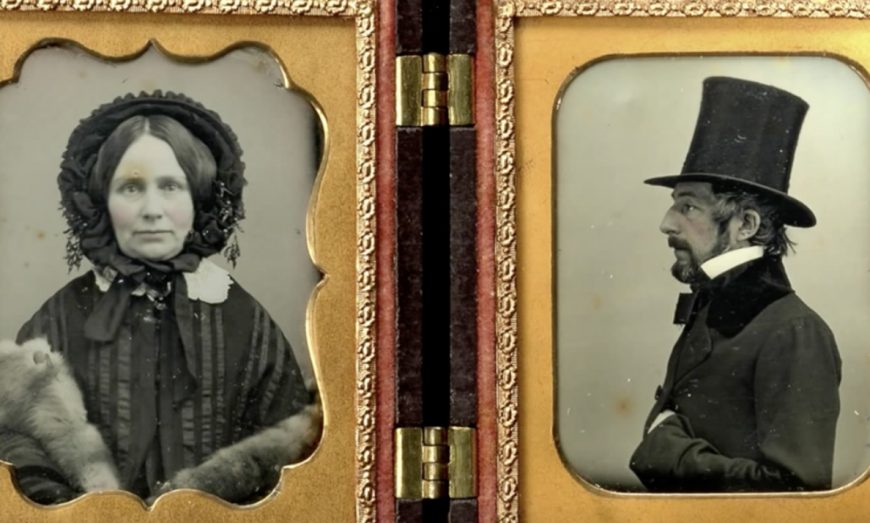
Couple, c. 1950, daguerreotype (George Eastman Museum, Rochester)
- The earliest photograph: the Daguerreotype
- The Daguerreotype
- Louis-Jacques-Mandé Daguerre, The Artist’s Studio / Still Life with Plaster Casts
- Textiles across cultures
- Moses Quiquine: homage to my ancestors
- Clarissa Rizal, Resilience Robe
- From 14th century to the 20th: embroidery and needlepoint
- A rare embroidery made for an altar at Santa Maria Novella
- Judy Chicago, The Dinner Party
- Expressing the spiritual with gold, enamel, and gems
- Medieval goldsmiths
- How was it made? Enameling a brooch
- The Holy Thorn Reliquary of Jean, duc de Berry
- Photography: Gordon Parks and the effects of segregation and racism
- The Gelatin Silver Process
- Gordon Parks, Off on My Own (Harlem, New York)
- Performance art and feminism: Mierle Laderman Ukeles
- Performance art, an introduction
- Mierle Laderman Ukeles, Washing/Tracks/Maintenance: Outside (July 23, 1973)
- Some art forms (mosaic, glass) are frequently part of an entire architectural ensemble. How does that change how we view and experience them?
- How do assemblage and collage relate to our modern world?
- How is performance art similar and different from other mediums?
- What are the challenges of including performance art in a usual museum gallery?
- What are the challenges of conserving video art?
- daguerreotype
- gelatin silver process
- performance art
- repoussé
- enamel
- reliquary
- Chilkat weaving
- formline design
- altar frontal
- Maintenance Art
- Institutional Critique
Key Questions
Key Terms
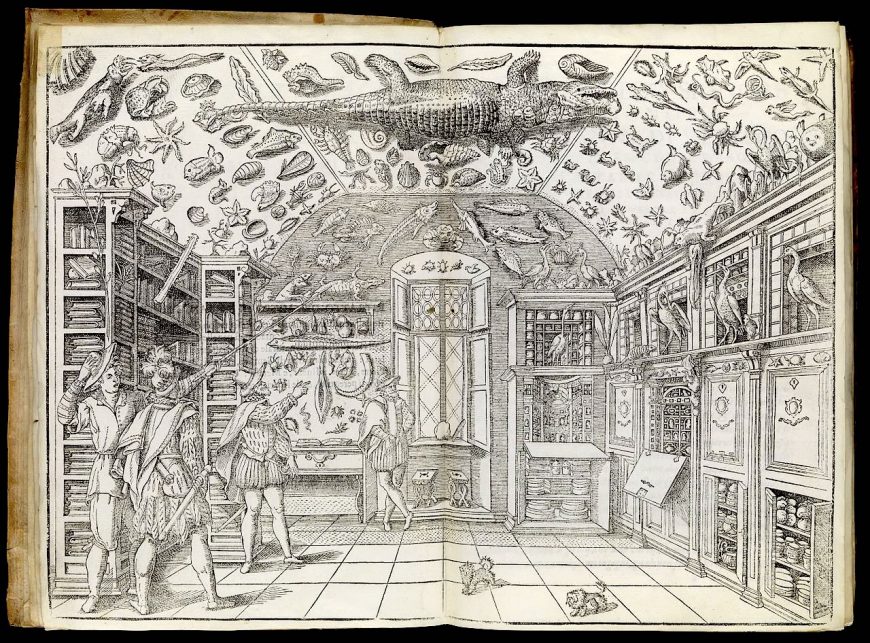
Woodcut of the Wunderkammer room, from Ferrante Imperato, Dell'historia naturale... Libri XXVIII (Naples, 1599) (photo: Wellcome Collection, CC BY 4.0)
- Museums
- A brief history of the art museum
- Looking at Art Museums
- Bodies
- Four-cornered hat
- Bark cloth from Wallis and Futuna
- Caves
- Chauvet cave
- Longmen caves, Luoyang
- Parks
- Maya Lin, Ghost Forest
- James Turrell, Skyspace, the way of color
- Tombs
- Newgrange, a prehistoric tomb in Ireland
- The Terracotta Warriors
- Cities and commercial spaces
- Ola Ka Wai, Ola Ka Honua: sovereign flows on and off the wall
- Diego Rivera, Detroit Industry Murals
- Places of worship
- Early Dutch Torah Finials
- Wheel of Existence
- What are the different ways that museums organize objects? What are the pros and cons of each?
- Where do you prefer to see art? Why?
- Do you recognize art only when it's in the museum? Where else can you see art in your everyday life?
- wunderkammern, or cabinets of wonders
- Enlightenment
- paleolithic
- Shakyamuni
- Bodhisattva
- relief sculpture
- Tlingit
- caldera
- modern / modernism
- native sovereignty
- Great Depression
- Torah
- finial
- karma
- samsara
Key Questions
Key Terms
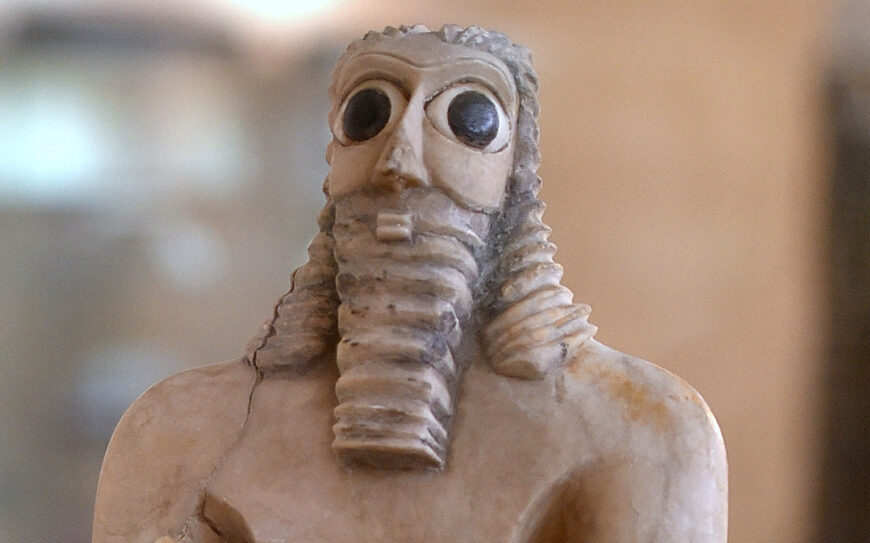
Votive figure from the Square Temple at Eshnunna (modern Tell Asmar, Iraq), c. 2900–2350 B.C.E. (Early Dynastic period) (The Iraq Museum, Baghdad)
- The human body
- Standing Male Worshipper (Tell Asmar)
- The Priest-King sculpture from the Indus Valley Civilization
- King Menkaure (Mycerinus) and queen
- Anavysos Kouros
- Polykleitos, Doryphoros (Spear-Bearer)
- Haniwa Warrior
- Olmec Colossal Heads
- Architecture
- The Treasury of Atreus
- The Pillars of Ashoka
- Ancient Greek Temples at Paestum
- The Pantheon (Rome)
- Petra: The rose red city of the Nabataeans
- The Colosseum
- What are the different functions of sculptures of the human figure during this period?
- What are the different functions of architecture during this period?
- Describe the differences in the experience of a space constructed with a post and lintel system versus a dome.
- Tigris and Euphrates rivers
- Mesopotamia
- Indus Valley Civilization
- triad / dyad
- Giza plateau
- contrapposto
- kouros
- symmetrical
- naturalistic
- Olmec
- terracotta
- post and lintel
- corbelling
- Doric
Key Questions
Key Terms
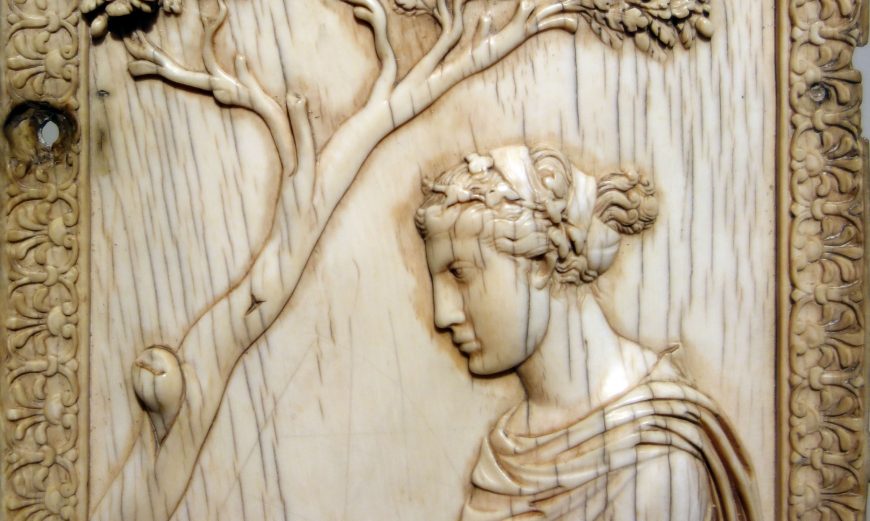
The Symmachi Panel, c. 400 C.E., ivory, 32 x 13 cm (Victoria and Albert Museum, London)
- Early Middle Ages
- The Symmachi Panel
- Basilica of Santa Sabina, Rome
- Hagia Sophia, Istanbul
- Sutton Hoo Ship Burial
- Bifolium from the Pink Qur’an
- Monasteries and pilgrimages
- Buddhist monasteries
- Myōe Kōben, Dream Record (Yume no ki)
- Codex Amiatinus, the oldest complete Latin Bible
- The Book of Kells
- Skellig Michael
- Islamic pilgrimages and sacred spaces
- Pilgrimage souvenirs
- Why do people go on pilgrimage?
- What was the purpose of monasteries for Buddhists and Christians? What kind of art and architecture supported the life of the monastery?
- What is the purpose of pilgrimages for Christians and Muslims?
- pagan
- basilica
- Constantine
- Eastern Roman (Byzantine) Empire
- Northumbria
- interlacing animal style
- cloisonné
- Qur’an
- Dharma
- scriptorium
Key Questions
Key Terms
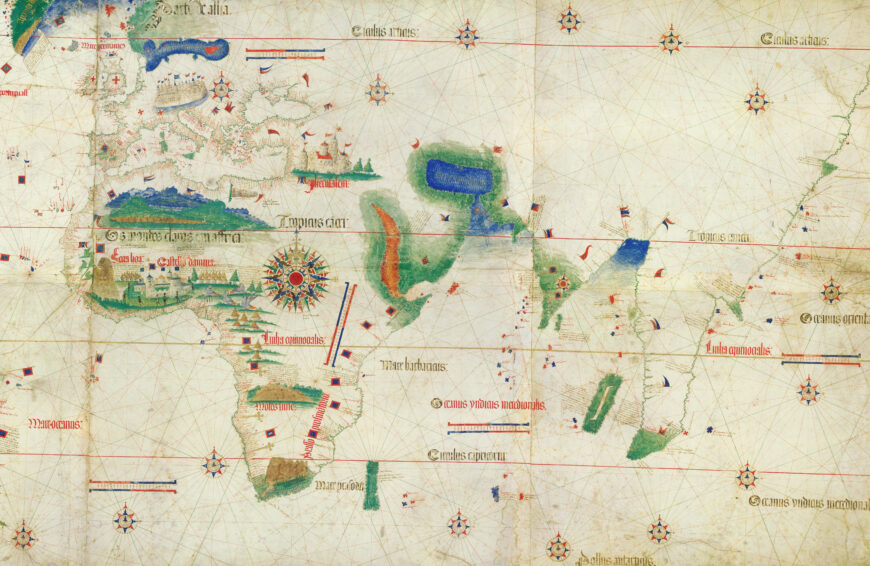
Cantino Planisphere, 1502, ink and pigment on vellum, 102 x 218 cm (Biblioteca Estense Universitaria, Modena)
- Introductions
- The Early Modern era: the 15th century
- The Early Modern era: the 16th century
- Two architects: Sinan and Brunelleschi
- Filippo Brunelleschi, Dome of the Cathedral of Florence
- Mimar Sinan, Süleymaniye Mosque, Istanbul
- Earth, heaven and hell
- Hieronymus Bosch, The Garden of Earthly Delights
- El Greco, The Burial of the Count of Orgaz
- The growing importance of the visual world
- Dürer’s Rhinoceros: art, science, and the Northern Renaissance
- Jan van Eyck, The Arnolfini Portrait
- Follower of Bernard Palissy, rustic platter
- The changing status of the artist
- The status of the artist in renaissance Italy
- Rogier van der Weyden, Saint Luke Drawing the Virgin
- Trade and colonization
- Kilwa Kisiwani, Tanzania
- Kilwa pot sherds
- How is the world becoming more interconnected during this period and how do we see that in the art of this period?
- How does the status of the artist begin to change during this period? How do artists argue for a higher status?
- What effect did the Protestant Reformation have on art and artists?
- Renaissance
- Humanism
- ancient Greece and Rome
- printing press
- Mexica (Aztec)
- Viceroyalty of New Spain
- triptych
- Protestant Reformation
- Counter-Reformation
- Ottoman Empire
- lacquer
- porcelain
Key Questions
Key Terms
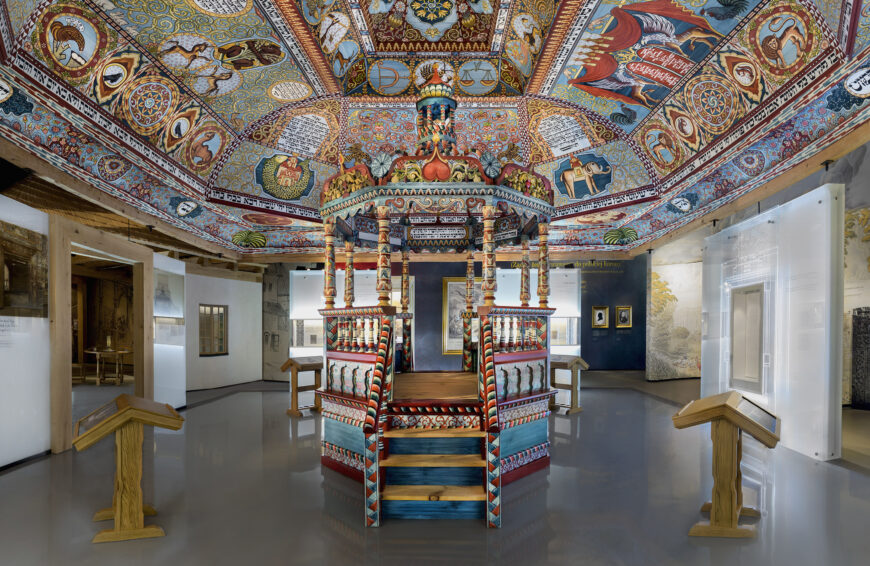
Installation of the reconstructed Gwoździec synagogue ceiling and bema in the POLIN Museum of the History of the Polish Jews, 2013, Handshouse Studio (photo: Magdalena Starowieyska and Dariusz Golik, CC BY-SA 3.0 PL)
- Introductions
- The Early Modern era: the 17th century
- The Early Modern era: the 18th century
- Science and art
- Maria Sibylla Merian’s Metamorphosis of a Small Emperor Moth on a Damson Plum
Getty Conversations
- Compound Microscope and Case
Getty Conversations
- Colonization and slavery
- Francisco Clapera, set of sixteen casta paintings
- The triangle trade and the colonial table, sugar, tea, and slavery
- Baroque painting
- Peter Paul Rubens, Elevation of the Cross
- Diego Velázquez, Las Meninas
- Unusual pairings
- Fashioning luxury from a coconut cup
- Meissen Porcelain Animals
Getty Conversations
- Nature and artifice
- Ogata Kōrin, Red and White Plum Blossoms
- Louis Carrogis de Carmontelle, Figures Walking in a Parkland
- Hua Yan, Pheasant, Bamboo and Chrysanthemum
- Give examples of how we can see the growing interconnectedness of the world through art.
- What are some characteristics of Baroque painting?
- Discuss the different approaches to nature during this period.
- Baroque
- Manila Galleon trade
- Royal Academy of Painting and Sculpture
- metamorphosis
- natural theology
- Rococo
- Age of Enlightenment
- Triangle trade
- Dutch East India Company
- Rinpa School
- King Louis XV
Key Questions
Key Terms
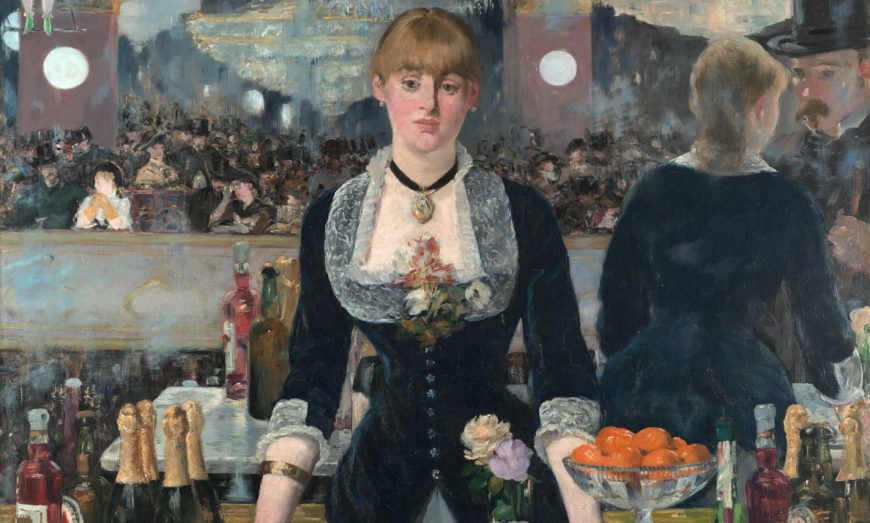
Édouard Manet, A Bar at the Folies-Bergère, oil on canvas, 1882 (Courtauld Gallery, London)
- Introduction
- Becoming modern in 19th-century Europe, an introduction
- Painting modern life
- Théodore Géricault, Raft of the Medusa
- How to recognize Monet: The Basin at Argenteuil
- Francisco Oller, Still Life with Plantains and Bananas and Still Life with Coconuts
- Jaime Colson, Merengue
- Toward abstraction
- James Ensor, The Fall of the Rebel Angels
- Paul Gauguin, Self-Portrait with Portrait of Émile Bernard (Les misérables)
- Henri Matisse, Open Window, Collioure
- Pablo Picasso, Guernica
- Rufino Tamayo, Perro aullando a la luna (Dog Howling at the Moon)
- Abstract art
- Jackson Pollock, Autumn Rhythm
- Lee Bontecou, Untitled (No. 25)
- Lygia Clark, Bicho
- What are some characteristics of modern art and the modern era?
- What are some of the ways that artists tried to address contemporary social and political problems in their art?
- What are some reasons that artists turned to abstraction?
- Modern
- avant-garde
- Industrial Revolution
- Belvedere Torso
- Romanticism
- Pre-Raphaelite
- Impressionism
- Condition-of-England problem
- leisure
- still life
- Rafael Trujillo
- Spanish Civil War
- World War II
- Civil Rights Movement
Key Questions
Key Terms
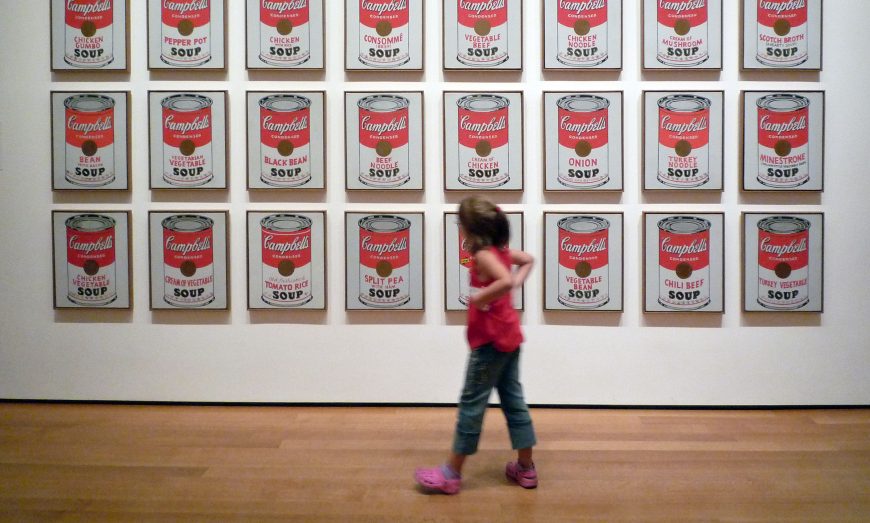
Andy Warhol, Campbell's Soup Cans, 1962, synthetic polymer on 32 canvases, each 20 x 16 inches (The Museum of Modern Art, New York)
- Introduction
- Contemporary art, an introduction
- Reframings
- Nam June Paik, Electronic Superhighway: Continental U.S., Alaska, Hawaii
- Michel Tuffery, Pisupo Lua Afe (Corned Beef 2000)
- Wendy Red Star, 1880 Crow Peace Delegation
- Maya Lin, Vietnam Veterans Memorial
- Resilience
- Arpilleras
- Sebastião Salgado, Kuwait
- Yayoi Kusama, Infinity Mirrored Room—My Heart is Dancing into the Universe
- Reuse
- Romare Bearden, Three Folk Musicians
- Song Dong, Waste Not
- Turning Uncle Tom’s Cabin upside down, Alison Saar’s Topsy and the Golden Fleece
- Rethinking Modernism: Postmodernism
- Postmodernism
- Philip Johnson and John Burgee, The AT&T Building
- Describe some of the materials artists used to make art during this period. Why are these materials important and what do they signify?
- How are artists of this period trying to effect a change in the world?
- Describe the ways that some of the art of this period can be described as experiential.
- Augusto Pinochet
- second wave feminism
- Medicine Crow
- food sovereignty
- Vietnam War
- postmodernism
- broken pediment
- Mary Wollstonecraft
- Harriet Beecher Stowe, Uncle Tom's Cabin
- Topsy
- Black Arts Movement
Key Questions
Key Terms
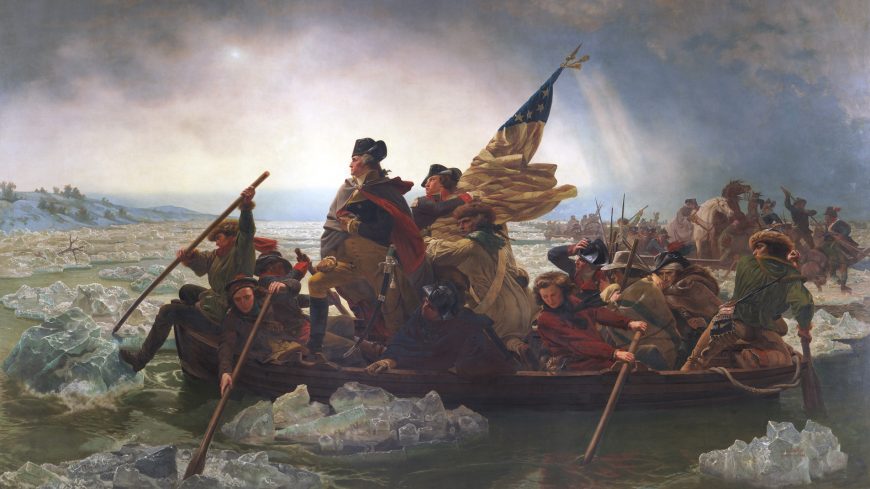
Emanuel Leutze, Washington Crossing the Delaware, 1851, oil on canvas, 378.5 x 647.7 cm (The Metropolitan Museum of Art)
- American icons
- Emanuel Leutze, Washington Crossing the Delaware
- Norman Rockwell, Rosie the Riveter
- Andy Warhol, Coca-Cola [3]
- Dorothea Lange, Migrant Mother
- Icons reinterpreted
- Beauford Delaney, Marian Anderson
- Roger Shimomura, Diary: December 12, 1941
- Nari Ward, We the People (black version)
- Jaune Quick-to-See Smith, State Names
- Histories forgotten and remembered
- Seneca Village: the lost history of African Americans in New York
- Timothy O’Sullivan, A Harvest of Death
- Hock E Aye Vi Edgar Heap of Birds, Native Hosts (Arkansas)
- The National Memorial for Peace and Justice (Equal Justice Initiative)
- Eliyahu Hanavi Synagogue, Jobar (Syria)
- How does studying art history help us to remember forgotten histories?
- What makes an image an “icon”?
- Why is it important to study history?
- American Revolutionary War
- Manifest Destiny
- icon
- U.S. Constitution
- Marian Anderson
- impasto
- Battle of Gettysburg
- World War II
- Pearl Harbor
- internment camp
- lynching
- the Gulf War
- blood libel
- Trail of Tears


