
Curated Guides > Syllabus > Latin American Art Syllabus
Latin American Art Syllabus
This course begins with an analysis of the art of the Ancient Americas, including its iconography, styles, traditions, and techniques, continues with an exploration of the cultural complexity of Viceregal Art, the nation building efforts of the Post-Independence era, and culminates in the exploration of Modern and Contemporary art, focusing on key artistic movements and cosmopolitan artistic centers.
 Open All
 Collapse All
Introduction to the Taino of the Greater Antilles, their traditions, language, and religion.
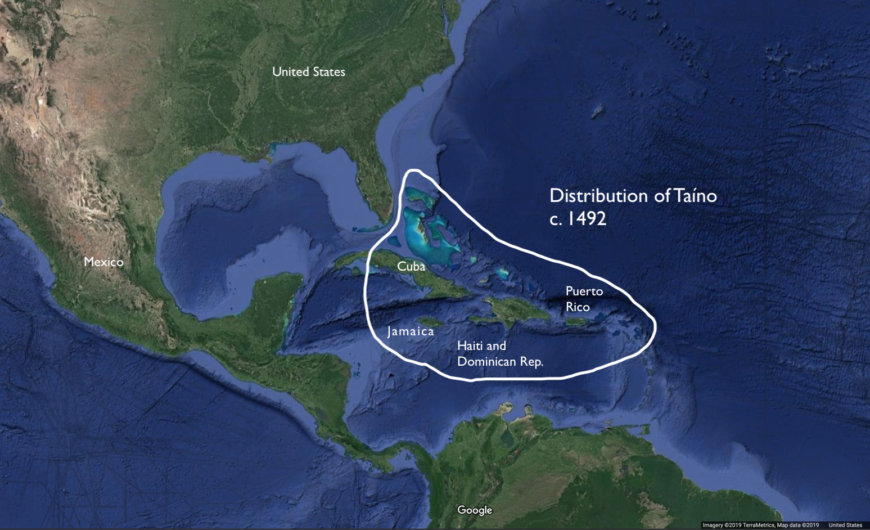
Taino distribution
- Introduction
- Latin American art, an introduction

- Taíno
- Introduction to Taíno art
- Taíno zemis and duhos
- Taíno zemís and duhos
- Taíno duho

- Taíno Kuisa
- Myth of Taíno extinction
- Glendalys Medina, Atabey
- Nitza Tufiño, Pareja Taína (Taíno Couple)
- Who were the Taíno?
- How would you characterize Taíno religion?
- What were the effects of the Spanish conquest on the Taíno?
- What are some common objects produced by the Taíno?
- How does Taíno culture and people continue to thrive today?
- zemi
- duho
- cohoba
- kuisa
- cassava
- hammock
- cacique
- bohique
Key Questions
Key Terms
Introduction to the cultures of Mesoamerica, their traditions, language, and religion.
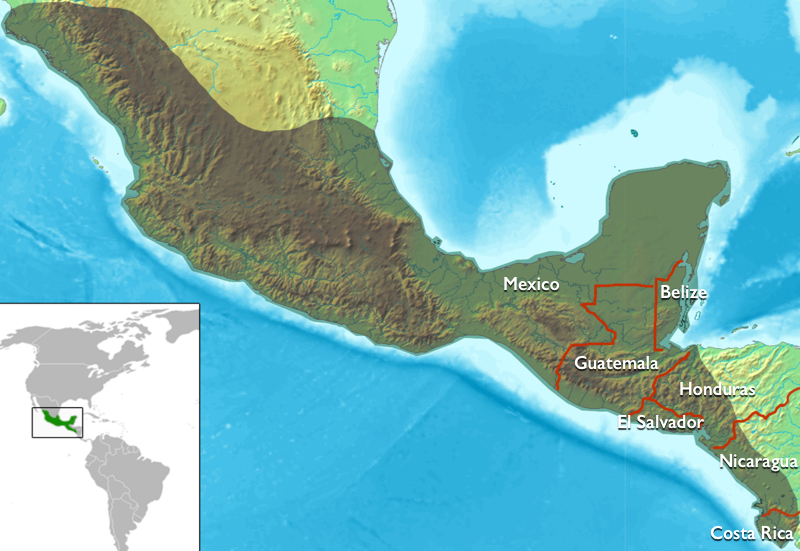
Map of Mesoamerica, with the borders of modern countries
- What is Mesoamerica?
- Mesoamerica, an introduction
- Pre-Classic Period, 1800 B.C.E.–250 C.E.
- Olmec
- Kunz Axe
- Olmec masks and masquerade, an introduction
- Classic Period, 150–650 C.E.
- Teotihuacan
- Teotihuacan
- Pyramid of the Moon and Pyramid of the Sun, Teotihuacan
- Maya
- The Maya, an introduction
- Palenque
- The Yaxchilán Lintels
- Vessel with a mythological scene
- Classic Veracruz
- The Mesoamerican ballgame and a Classic Veracruz yoke
- Post-Classic Period, 900–1519 C.E.
- Aztec
- Coatlicue
- The Templo Mayor and the Coyolxauhqui Stone
- Codex Borgia
- The House of the Eagles, and sculptures of Mictlantecuhtli and Eagle Warrior
- What are some shared traditions across Mesoamerica?
- What are some examples of monumental architecture of Mesoamerica?
- What are some examples of the diverse media of Mesoamerican artistry?
- How did the Aztecs depict ancestral and supernatural forces?
- What is the significance of Tenochtitlan and the Templo Mayor?
- jade
- basalt
- glyph
- codex
- pyramid
- Flowery War
- Mexica
- Mesoamerica
Key Questions
Key Terms
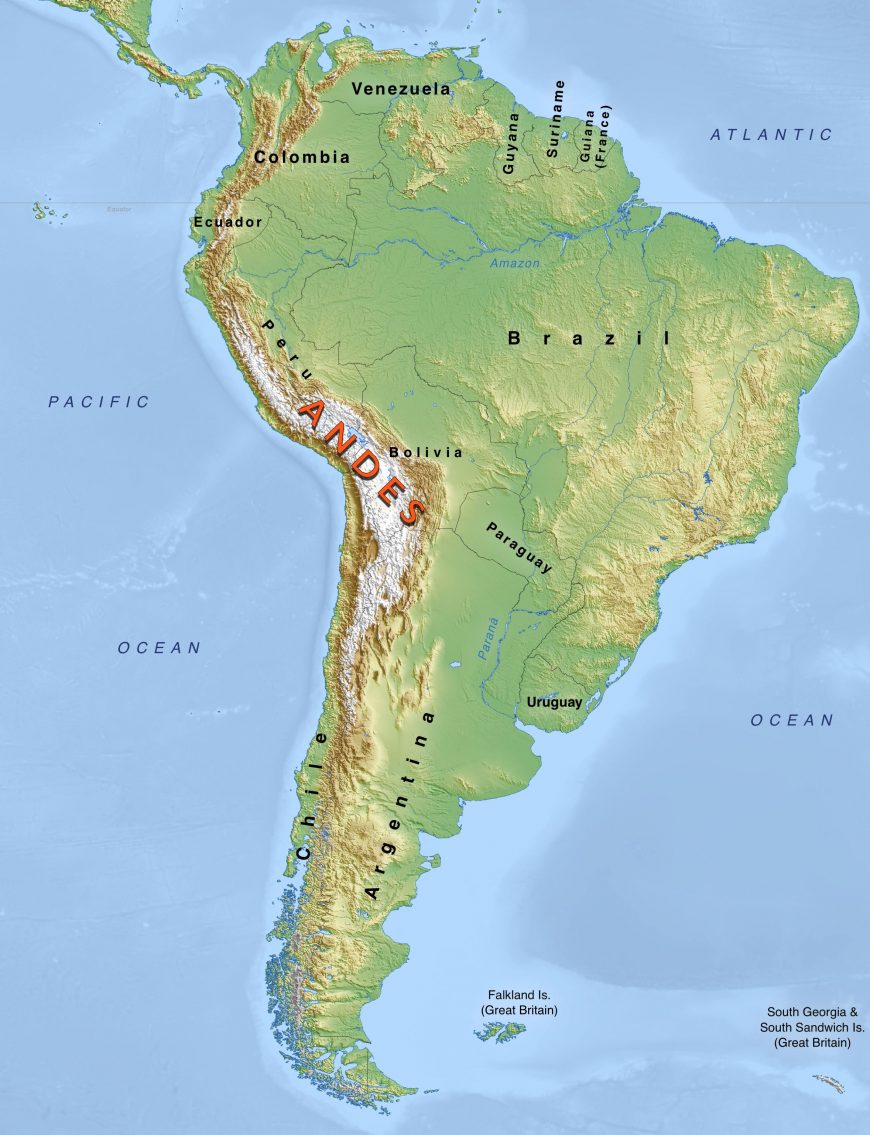
Map of South America showing the Andes
- Introduction
- Andean cultures, an introduction
- Ancient Andean art, an introduction
- Early Horizon, 900–100 B.C.E.
- Chavín
- Chavín de Huántar
- Paracas
- Paracas textiles, an introduction
- Early Intermediate, 100 B.C.E.–600 C.E.
- Nasca
- Nasca Geoglyphs
- Nasca art: sacred linearity and bold designs
- Moche
- The Moche Royal Tombs of Sipán
- Pair of Earflares, Winged Messengers
- Tiwanaku
- Tiwanaku, an introduction
- Late Horizon, 1438–1532 C.E.
- Inka
- The Inka, an introduction
- The Inka khipu
- All-T’oqapu Tunic
- Machu Picchu
- Describe the cities and sacred spaces of the Andes.
- How did royals and mummies adorn their bodies?
- Explain the relationship between drinking and social status in the ancient Andes.
- What was the relationship between empire and agriculture in the Andes?
- What is the significance of the Inca khipu?
- textile
- loom
- earflare
- geoglyph
- tocapu
- khipu
- masonry
- monolith
Key Questions
Key Terms
Introduction to Viceroyalty of New Spain, and the process of colonialism and evangelization in colonial Mexico (though the Viceroyalty of New Spain also included Central America, parts of the West Indies, the southwestern and central United States, Florida, and the Philippines).
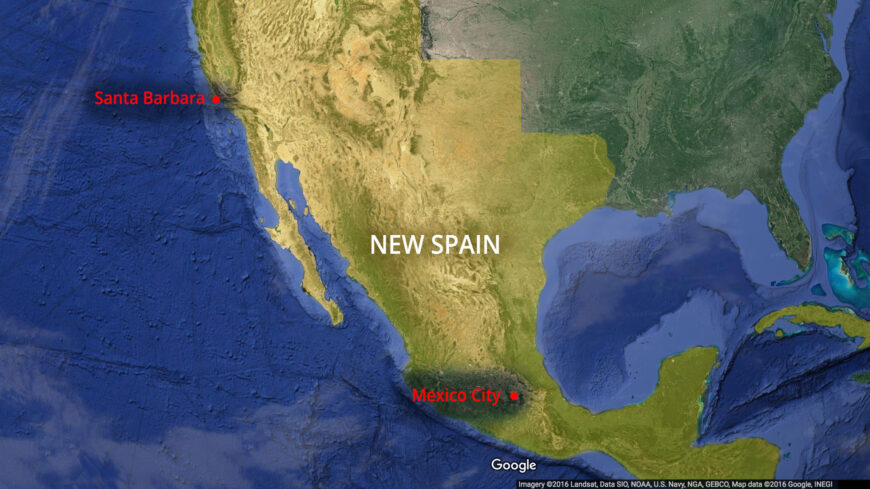
Map of New Spain, 1610 (underlying © Google)
- Introduction
- The Spanish Viceroyalties in the Americas, an introduction
- New Spain, an introduction
- Religious art and architecture
- Mission churches as theaters of conversion in New Spain
- Atrial Cross at Acolman
- Virgin of Guadalupe
- Featherworks: The Mass of St. Gregory
- Crowned nun portraits, an introduction
- Miguel Cabrera, Virgin of the Apocalypse
- Bernardino de Sahagún and Indigenous collaborators, Florentine Codex
- Secular art and architecture
- Elite secular art in New Spain
- Biombo with the Conquest of Tenochtitlan and View of Mexico City
- Spaniard and Indian Produce a Mestizo, attributed to Juan Rodríguez Juárez
- How was the Spanish conquest of New Spain depicted in art?
- Describe the religious art and architecture employed in colonial Mexico.
- What is the relationship between Indigenous materials and cross-cultural exchange?
- How do colonial manuscripts shape our understanding of Mesoamerican history?
- What colonial objects decorated the homes of Spanish elites?
- viceroyalty / viceroy
- conventos
- posa chapel
- atrial cross
- monjas coronadas
- codex
- biombo
- casta paintings
Key Questions
Key Terms
Introduction to the Viceroyalty of Peru, and the process of colonialism and evangelization in the colonial Andes.
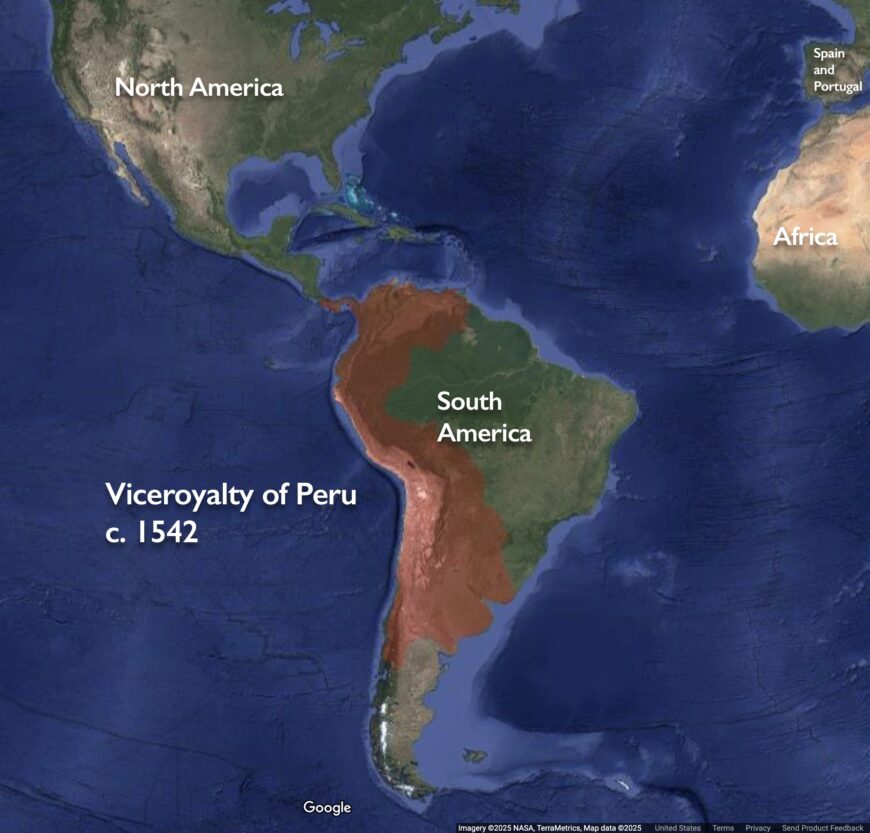
Map of the Viceroyalty of Peru (underlying map © Google)
- Introduction
- The Viceroyalty of Peru, an introduction
- Introduction to religious art and architecture in early colonial Peru
- Religious art and architecture
- Luis de Riaño and Indigenous collaborators, The Paths to Heaven and Hell, Church of San Pedro de Andahuaylillas
- Bernardo Bitti, Coronation of the Virgin
- The Virgin of Pomata: images of Andean faith
- Cuzco School Artist, Saint Joseph and the Christ Child
- Master of Calamarca, Angel with Arquebus
- Guaman Poma and The First New Chronicle and Good Government
- Textiles in the colonial Andes
- Secular art
- Portrait painting in the Viceroyalty of Peru
- Keru Vessel
- A colonial Andean portrait of Fermín Francisco de Ustaríz
- Portrait of Don Marcos Chiguan Topa
- How did Andean cities and structures change during colonialism?
- What were the important artistic centers of colonial Peru?
- Describe the religious iconography of the Viceroyalty of Peru.
- How did viceroys and clergymen secure their place in colonial society?
- In what ways did textiles remain an important part of colonial Peru?
- viceroyalty / viceroy
- Cuzco School
- Renaissance
- Baroque
- missionary
- mendicant order
- keru vessel
- uncus
Key Questions
Key Terms
Introduction to the Viceroyalty of New Granada, and the process of colonialism and evangelization in colonial Colombia, Ecuador and Venezuela, formerly part of the Viceroyalty of Peru until the 18th century.
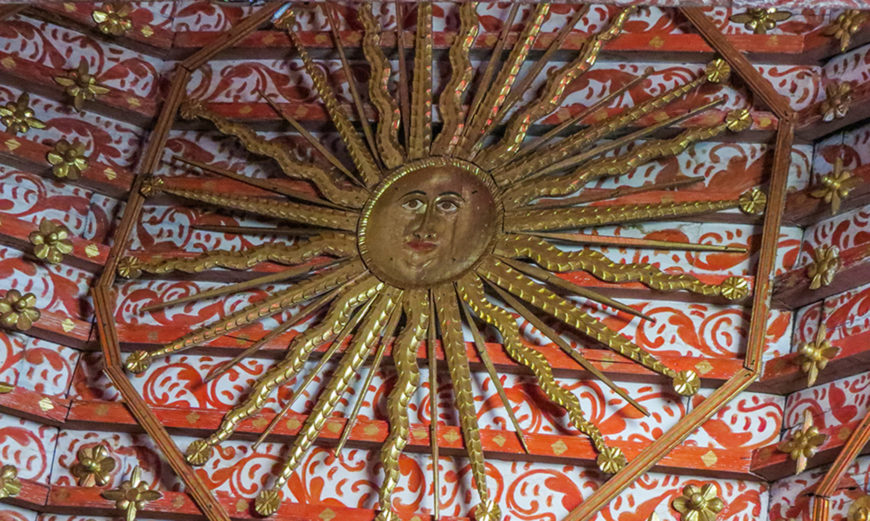
Nave of the Church of Santa Clara, detail of the sun (photo: Brad Fanta, CC BY-NC-ND 4.0)
- Introduction
- Early viceregal architecture and art in Colombia
- Religious art
- Virgin of Chiquinquirá
- Crown of the Virgin of the Immaculate Conception, known also as the Crown of the Andes
- Juan Pedro López, Our Lady of Guidance
- Secular art
- Vicente Albán, Quito series
- Diego Antonio de Landaeta, Portrait of Petronila Méndez
- How did colonial port cities defend themselves from invaders?
- How was gold and silver transformed in the Viceroyalty of New Granada?
- What was the role of confraternities in the viceroyalties?
- viceroyalty / viceroy
- El Dorado
- retablos
- audiencias
- confraternities
Key Questions
Key Terms
Introduction to the national heroes and liberators of Latin America, and the ways through which national identity was articulated in landscapes and costumbrismo.

Pedro José Figueroa, Simón Bolívar: Liberator of Colombia, c. 1820, oil on canvas, 95 x 64 cm (Museo Nacional de Colombia, Bogotá)
- Introduction
- Independence from Spanish rule in South America
- Mexican Independence
- Landscapes
- Landscape painting in 19th-century Latin America
- José María Velasco, The Candelabrum
- Carmelo Fernández, The Strait of Furatena in the Minero River
- Francisco Oller, Hacienda La Fortuna
- Marc Ferrez, Slaves at a Coffee Yard in a Farm, Vale do Paraiba, Sao Paulo
- Costumbrismo
- Costumbrismo
- Francisco Oller y Cestero, The Wake
- Coming of age in Gutiérrez’s costumbrista painting, La despedida del joven indio (The Young Indian’s Farewell)
- Picturing racial and social identities in José Agustín Arrieta’s costumbrista painting, La Sorpreza
- Víctor Patricio Landaluze, Three Kings Day in Havana
- What were the most significant changes that came after independence?
- How did depictions of the land help articulate a sense of nationalism?
- How did costumbrismo help articulate a sense of nationalism?
- Compare the genre of costumbrismo with colonial casta paintings.
- Creole (criollo)
- costumbrismo
- jibaro
- Realism
- hacienda
- ingenio
Key Questions
Key Terms
Introduction to the early art academies of Latin America, and the transatlantic artistic pilgrimages of artists and explorers.
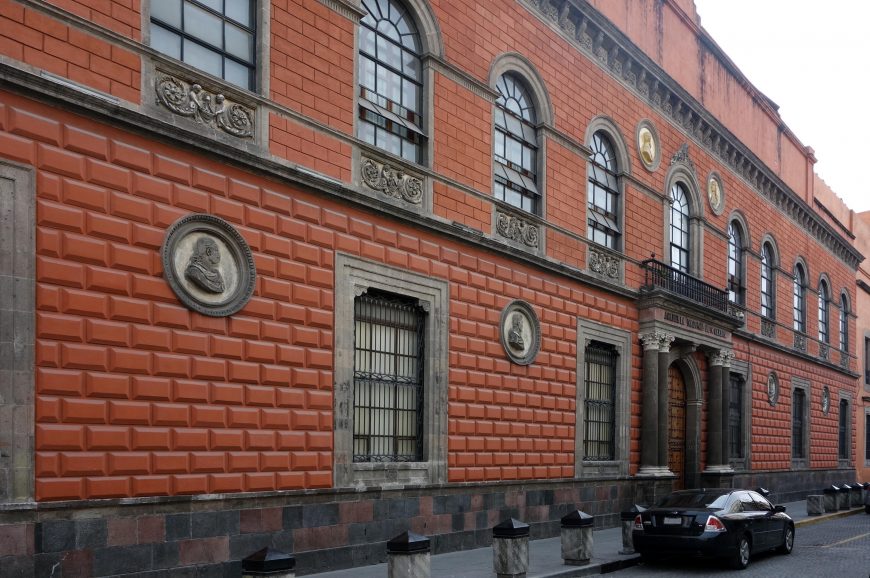
Site of the Academy of San Carlos in Mexico City since 1791 (photo: Steven Zucker)
- The academic tradition
- The Academy of San Carlos
- Félix Parra, Fray Bartolomé de las Casas
- José María Velasco, The Valley of Mexico from the Santa Isabel Mountain Range
- The challenge of the nude in 19th-century Latin American painting
- Manuel Vilar, Tlahuicole
- Transatlantic voyages
- Latin American artistic pilgrimages to Paris
- Early scientific exploration in Latin America
- How did art academies contribute to the nation building efforts of the 19th century?
- How did transatlantic voyages introduce a sense of cosmopolitanism to art?
- How did 19th-century artists depict their indigenous and colonial past?
- Neoclassicism
- history painting
- académies
- Académie Julian
- Impressionism
Key Questions
Key Terms
Examine how early avant-garde artists in Brazil, Mexico, and Peru combined European modernism with local cultural themes to express national identity, and how they used murals and photography to merge political messages with cultural identity and indigenous heritage.
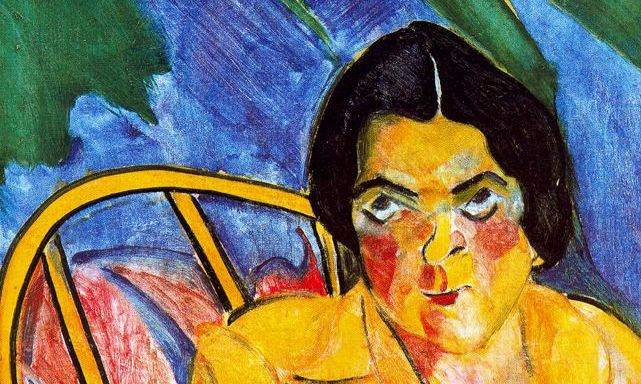
Anita Malfatti, The Fool, 1913, oil on canvas, 61 cm x 50.6 cm (Museum of Contemporary Art of University of São Paulo, Brazil)
- Semana de Arte in Brazil
- The origins of modern art in São Paulo, an introduction
- Tarsila do Amaral, Abaporú
- Early Vanguards in Mexico
- Francisco Goitia, Tata Jesucristo
- Rufino Tamayo, Perro aullando a la luna (Dog Howling at the Moon)
- Lola Álvarez Bravo, Architectural Anarchy in Mexico City
- Mexican Muralism
- Mexican muralism: Los Tres Grandes—David Alfaro Siqueiros, Diego Rivera, and José Clemente Orozco
- The History of Mexico: Diego Rivera’s Murals at the National Palace
- Diego Rivera, Man Controller of the Universe
- José Clemente Orozco, Dive Bomber and Tank
- What was the significance of the Semana de Arte Moderna?
- How did modern artists depart from the academic tradition?
- How did modern artists engage with their national past?
- How was Muralism used as an instrument for social and political change?
- Compare the artistic styles of los tres grandes.
- anthropophagy
- avant-garde
- photomontage
- Mexican Revolution
- buon fresco
- mural painting
- los tres grandes
- Indigenism
Key Questions
Key Terms
Investigate how Latin American artists in Mexico, Cuba, and Haiti used surrealist techniques to express their personal, cultural, and spiritual identities.
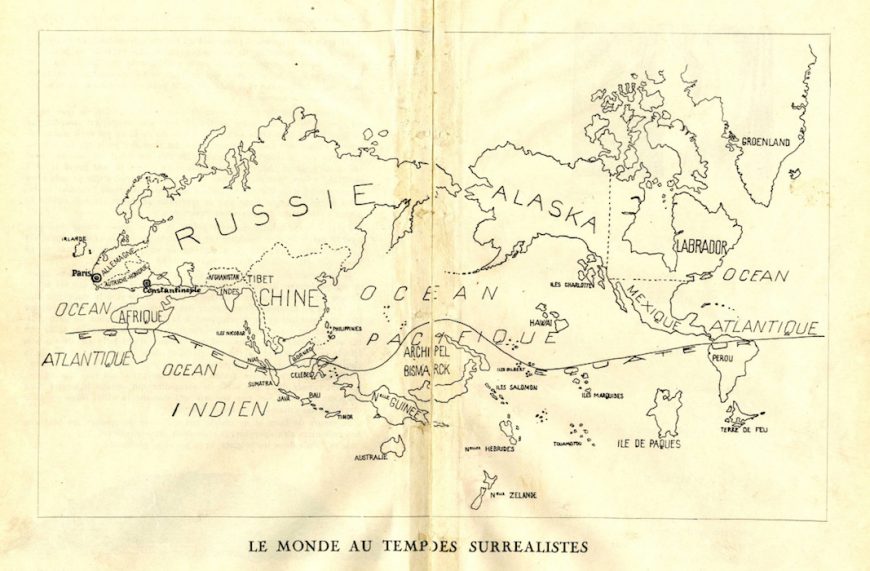
Le monde au temps des Surrealistes (The World at the Time of the Surrealists), image from p. 26-27 in special issue “Le Surrealisme en 1929″ of Varietes: Revue mensuelle Illustree de l'espirit contemporain (June 1929)
- Introduction
- Surrealism, an introduction
- Surrealism: Imagining A New World
- Surrealist women
- Surrealism and Women
- Frida Kahlo, an introduction
- Frida Kahlo, The Two Fridas (Las dos Fridas)
- Primitivism
- Primitivism and modern art
- Wifredo Lam, The Jungle
- Wifredo Lam, The Eternal Presence
- Hector Hyppolite, Ogou Feray also known as Ogoun Ferraille
- How did women explore the personal and unconscious in art?
- How did artists of African descent depict their ancestral past?
- What is the significance of the Centre d’Art in Port-au-Prince?
- automatism
- exquisite corpse
- retablo
- Primitivism
- vodou
Key Questions
Key Terms
Explore the influence and development of geometric abstraction in painting, sculpture, and architecture in Mexico, the Caribbean, and South America.
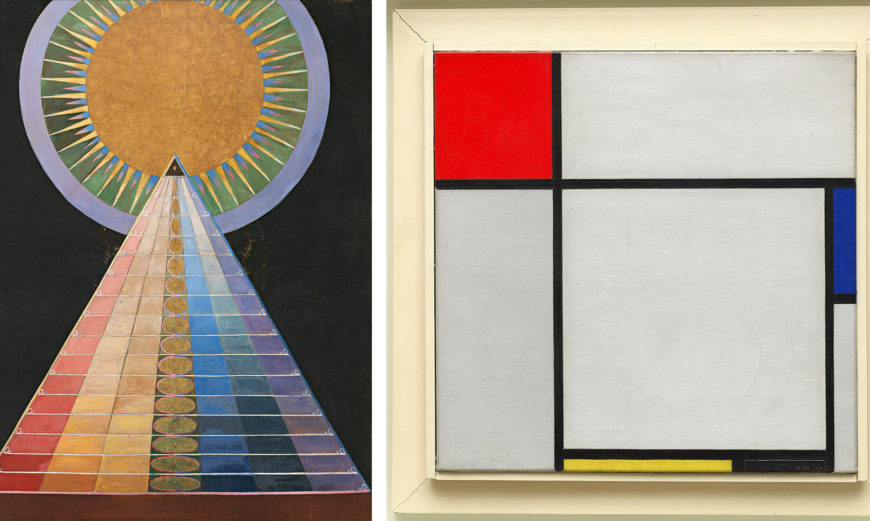
Left: Hilma af Klint, Group X, No. 1, Altarpiece (Altarbild), 1915, oil and metal leaf on canvas, 237.5 x 179.5 cm; Right: Piet Mondrian, Composition, 1929, oil on canvas, 45.1 x 45.3 cm (Guggenheim Museum, New York)
- Introduction
- Modern art and reality
- Pablo Picasso, Guitar
- Cubism and multiple perspectives
- Cubism
- Amelia Peláez del Casal, Fishes
- Jaime Colson, Merengue
- Geometric abstraction
- Geometric abstraction in South America, an introduction
- Joaquín Torres-García, Inverted America
- Lygia Clark, Bicho
- Jesús Rafael Soto, Houston Penetrable
- International Style
- International Style architecture in Mexico and Brazil
- Building Brasília
- How did Latin American artists reinterpret Cubism to reflect local culture and everyday life?
- How does Universal Constructivism merge modernist ideas with regional identity?
- How did Brazilian artists embrace a more organic approach to abstraction?
- Cubism
- still life
- Constructivism
- grid
- Neo-Concretism
Key Questions
Key Terms
Examine the Latin American diaspora in the United States, particularly the ways in which Chicanx and Latinx artists used murals, printmaking, performance, installations, and conceptual strategies to address issues of cultural identity, social justice, and community engagement.
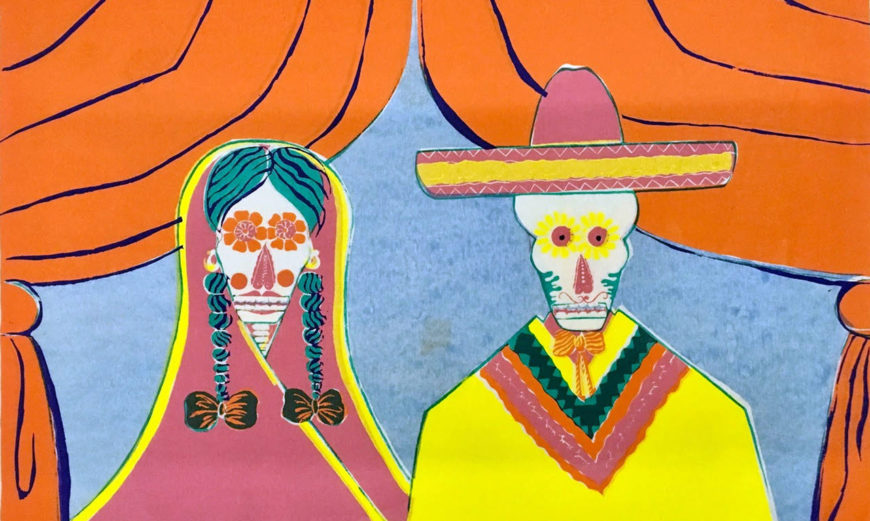
Carlos Bueno and Antonio Ibañez (Ibañez y Bueno), Bodas de Oro, 1973, silkscreen, Self Help Graphics and Art Collection
- Chicanx
- Self Help Graphics and Art
- Royal Chicano Air Force (RCAF)
- Yolanda López, Guadalupe Triptych
- Antonio Bernal, The Del Rey Mural
- Malaquías Montoya, Vote Register
- Mel Casas, Humanscape 70 (Comic Whitewash)
- Carmen Lomas Garza, Tamalada
- Latinx
- Pepón Osorio, En la barbería no se llora (No Crying Allowed in the Barbershop)
- Felix Gonzalez-Torres, “Untitled” (L.A.)
- Felix Gonzalez-Torres, “Untitled” (billboard of an empty bed)
- Freddy Rodríguez, Paradise for a Tourist Brochure
- What strategies did Chicanx artists use to navigate and challenge stereotypes about Mexican American identity?
- What role did art collectives and community-based organizations play in shaping the Chicano Movement?
- How did Latinx artists address issues of cultural identity and gender?
- How did Latinx artists use art as a tool for activism?
- diaspora
- serigraphy
- triptych
- installation art
- machismo
Key Questions
Key Terms
Explore the work of contemporary Latin American artists, responding to violence, inequality, and social injustice, while showcasing their work abroad at international art venues.
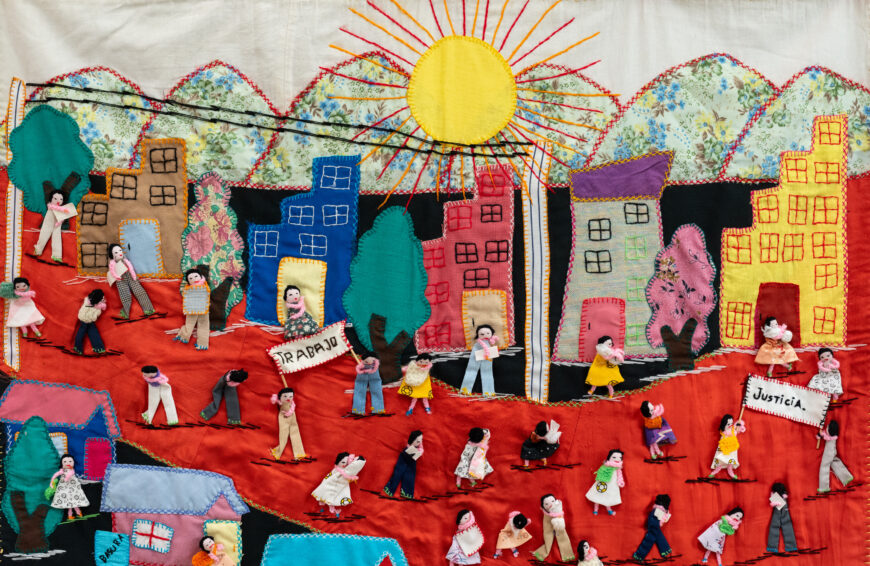
Arpillerista (unidentified woman artist, Chile), Arpillera, 1980s, embroidered and appliquéd cloth, crochet, and mixed media (El Museo del Barrio, New York)
- At home
- Arpilleras
- Hélio Oiticica, Parangolés
- Olga de Amaral, El gran muro
- Muriel Hasbun, Todos los santos (Volcán de Izalco, amén)
- Abroad
- Nicolás García Uriburu, Coloration of the Grand Canal, Venice
- Sebastião Salgado, Kuwait
- Alfredo Jaar, A Logo for America
- Doris Salcedo, Shibboleth
- Ilana Savdie, Thirty-Seven Counts and Trismus
- How do contemporary artists use unconventional materials or methods to challenge traditional definitions of art?
- How do contemporary artists use international exhibition spaces to amplify their critiques of global injustice, displacement, and identity?
- arpillera
- parangole
- favela
- Fiber Art Movement
- biennial
- conceptual art


