Minaʾi Bowl with Courtly and Astrological Motifs

Though small in size, this 12th-century Iranian bowl is filled with rich decoration: a golden sun, planets, and scenes of court life.

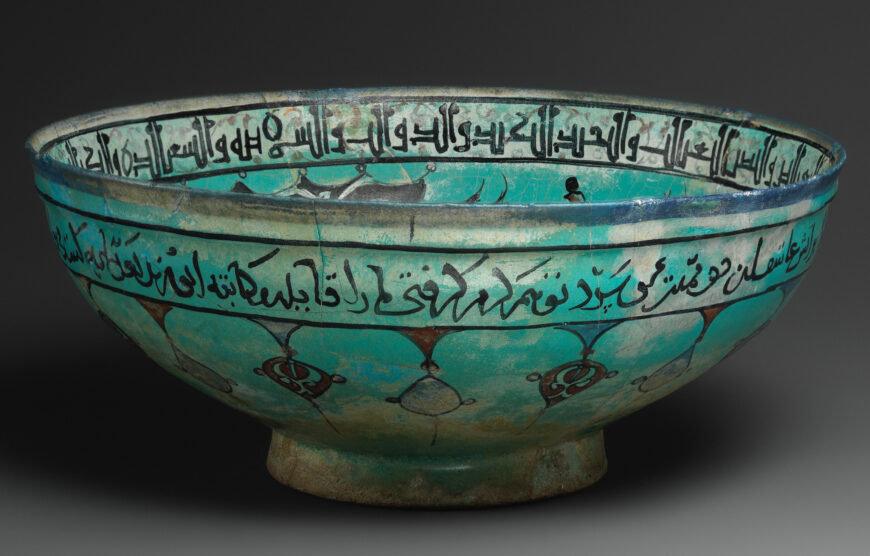
Bowl with Courtly and Astrological Motifs, late 12th–early 13th century (Central or Northern Iran), stonepaste, polychrome inglaze and overglaze painted and gilded on opaque monochrome glaze, 9.5 x 18.7 cm (The Metropolitan Museum of Art, New York). Speakers: Dr. Ariel Fein, Visiting Scholar in the visual cultures of Byzantium and the Islamic world, Smarthistory, and Dr. Steven Zucker, Smarthistory
[music]

0:00:06.6 Dr. Steven Zucker: I was at the Metropolitan Museum of Art a couple of weeks ago, and I was walking through galleries that hold art of the Islamic world, and I was stopped in my tracks by this beautiful gem of a bowl. It’s this tiny little ceramic bowl, but when you look inside it, the entire universe opens up.

0:00:24.6 Dr. Ariel Fein: This is an exceptional example of a minaʾi ceramic with gorgeous, finely detailed figures.

0:00:31.6 Dr. Steven Zucker: Now, minaʾi refers to a technique where enamel, that is glass, is ground up and is actually painted on the surface of a fully fired piece of ceramic. So this is a complicated process. It would start out with very fine clay being worked and shaped. It would be carefully dried, and that’s an especially hazardous process given how thin the walls of this pot are. And so already we know this is a luxury object. And then, of course, the pot is fired.

0:01:01.5 Dr. Ariel Fein: There’s now a second stage of work on this vessel. The crushed enamel is painted on in these gorgeous colors as well as gold, and then that is fired as well. It’s an overglaze.

0:01:14.2 Dr. Steven Zucker: Minaʾi is not the original term that was used to refer to this technique.

0:01:17.9 Dr. Ariel Fein: We started to use the Persian term minaʾi in the early 20th century. It means enamel. But when this bowl was made, the term that would likely have been used to describe it was the Persian word haft rang, meaning seven colors.

0:01:32.8 Dr. Steven Zucker: And we see a wonderful array of colors in this pot. In the very center is this brilliant sun with a human face at its center, surrounded by two rings of brilliant gold.

0:01:43.2 Dr. Ariel Fein: Around this sun are six figures, and these are depictions of the planets. Just above the sun, we see the planet Mars, which is shown holding a severed head and sword. And so what we’re seeing is a representation of how someone in Iran in the 12th century conceived of the universe.

0:02:02.3 Dr. Steven Zucker: And each of the six personifications of the planets are contained within a blue field, which is further illuminated by little touches of gold, which presumably represent the stars of the heavens. And so we have these references to astrology.

0:02:14.8 Dr. Ariel Fein: In the medieval world, astrology was considered a science. In fact, the Arabic term for astrology is the science of the judgments of the stars. This kind of imagery was so important because the 12th-century owner of such a vessel believed that the movements of the planets and the movements of the stars had a real impact on daily events, on their personality, and on their lives. So it was so important to study the planets and the stars, but also study how they moved and how they might impact your life.

0:02:48.4 Dr. Steven Zucker: You talked about the movements of the heavens, and I think that is so well represented in this bowl. With the sun in the center, we can see each of the rings that surround it in motion, the motion of the planets, but then especially of the men on horseback that surround them and move in a counterclockwise direction. Then you have this decorative band. And then on the inside wall of the bowl, we have this amazing group of seated figures. And then even above that, text, because this is Arabic, and so also moves in a counterclockwise motion. But to my eye, each of these bands moves at a slightly different pace, creating a sense of energy and motion that recalls the idea of the movement of the heavens.

0:03:28.7 Dr. Ariel Fein: These bands of horsemen and royal figures and courtiers offer a contrast to the orderly heaven depicted at the center. These figures are all emblematic of the kinds of pastimes that one might expect members of the court in Iran to have experienced. Here, perhaps the sport of falconry, where we see these horsemen surrounded by birds. Hunting was a favorite pastime, as well as feasting, and listening to music, and drinking. If we look closely in that outer band, you can see musicians. Just to their left, we see a seated figure on a throne, flanked on either side by attendants. And that royal figure on the throne is holding a glass of wine, a typical representation of a ruler.

0:04:21.6 Dr. Steven Zucker: And so what we’re being presented with is a kind of ideal representation of courtly life, where the order of the earthly is reflective of the order of the universe.

0:04:31.2 Dr. Ariel Fein: This would have been an especially evocative piece for a member of the court.

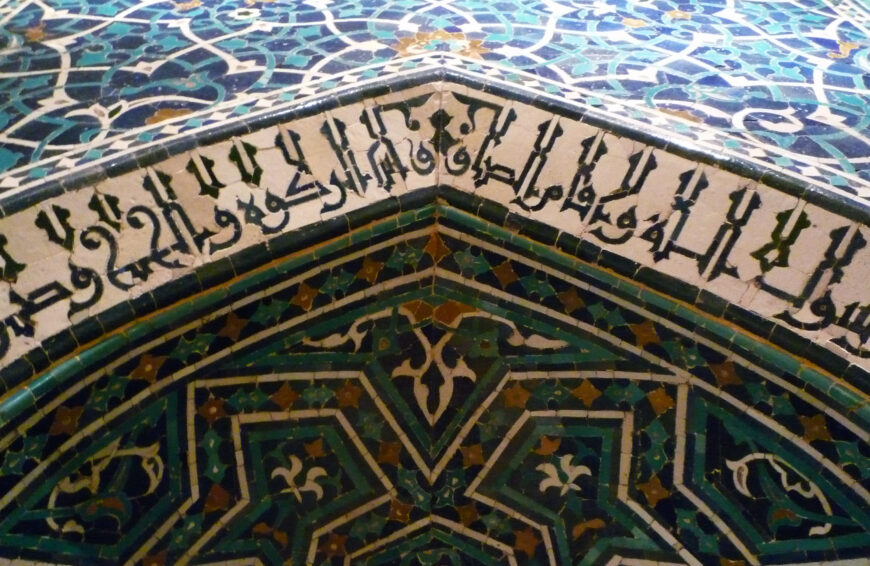
0:04:37.2 Dr. Steven Zucker: And on the outside is a Naskh script. It’s a curved script and much less angular than the Kufic script within.

0:04:43.4 Dr. Ariel Fein: The inscription on the outer rim of this bowl is unfortunately fragmentary, and so we don’t know who this bowl was originally made for. If it did belong to a ruler, this kind of imagery would have reminded the ruler of their position, ruling over their territory, as well as ruling within an ordered universe ordered by the stars and the planets. The inscription on the inner rim of the bowl is also fragmentary, but it includes repeated blessings for the owner of the vessel. This kind of imagery was especially popular in ceramics as well as in other media. We find astrological and courtly motifs in metalwork as well as in manuscripts.

0:05:29.6 Dr. Steven Zucker: This is a bowl that was clearly meant to be held, to enjoy these decorations, to look closely, to look more closely, in fact, than we’re allowed to in the museum. But the camera allows us to get up close, and through the camera’s lens, we can imagine what it would be like to hold it close, to lift it up to our eyes, and to explore its incredible imagery, color, and textures.

[music]

Title Minaʾi Bowl with Courtly and Astrological Motifs
Artist(s) Unrecorded artist
Dates late 12th–early 13th century
Places Asia / West Asia / Iran
Period, Culture, Style Islamic / Seljuq
Artwork Type Ceramics
Material Stonepaste (fritware), Ceramic glaze, Gold
Technique Gilding

This work at the Metropolitan Museum of Art

Ceramic Technology in the Seljuq Period on the Metropolitan Museum of Art’s Heilbrunn Timeline of Art History

Sheila R. Canby, Deniz Beyazit, Martina Rugiadi, and A. C. S. Peacock, Court and Cosmos: The Great Age of the Seljuqs (New York: The Metropolitan Museum of Art, 2016).

Stefano Carboni, Following the Stars: Images of the Zodiac in Islamic Art (New York: The Metropolitan Museum of Art, 1997).

Richard Piran McClary, “A New Approach to Mīnā’ī, Wares: Chronology and Decoration,” Persica, volume 25 (2016), pp. 1–20.

Loading Flickr images...

Cite this page as: Dr. Ariel Fein and Dr. Steven Zucker, "Minaʾi Bowl with Courtly and Astrological Motifs," in Smarthistory, December 5, 2025, accessed December 31, 2025, https://smarthistory.org/minai-bowl-courtly-astrological-motifs/.