A Coptic Miscellany: how do monastic texts carry memory across time and place?

Annunciation, frontispiece for Miscellany in Honor of the Virgin Mary, produced in the Touton scriptorium, 913–914 (Fayyūm Province, Egypt), ink on parchment, 26.8 x 35.1 cm (The Morgan Library & Museum, New York)

Annunciation, frontispiece for Miscellany in Honor of the Virgin Mary, produced in the Touton scriptorium, 913–914 (Fayyūm Province, Egypt), ink on parchment, 26.8 x 35.1 cm (The Morgan Library & Museum, New York)

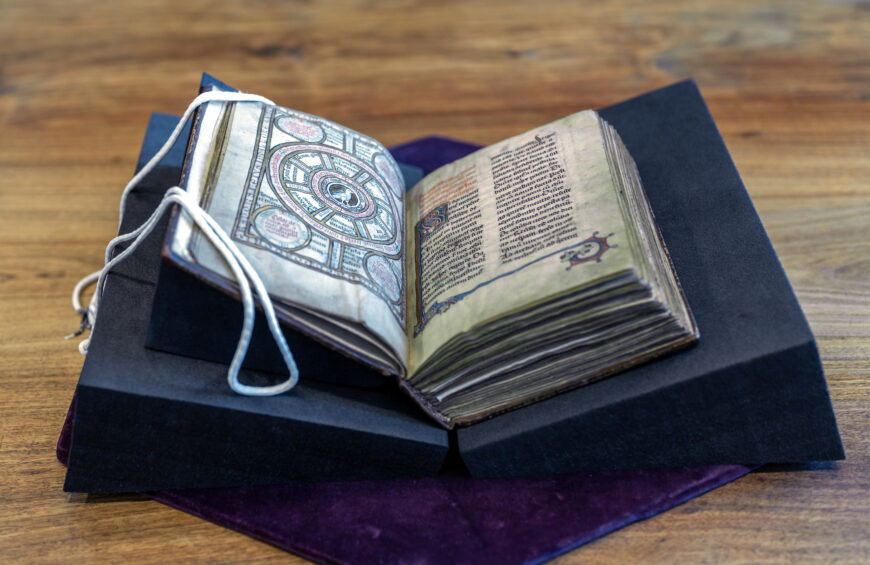
What do books remember that people forget? A 10th-century manuscript produced in the Touton Monastery in Egypt’s Fayyum Oasis invites this question with quiet persistence. Copied by two monks, Kalamon and Stephen, in 913–914, the manuscript offers more than sacred content; it also preserves the rhythms of a devotional life. Though modest in appearance, the Miscellany (a type of manuscript that contains a diverse collection of Christian texts brought together into one volume) holds profound significance for understanding the devotional, intellectual, and artistic cultures of Christian Egypt during the medieval period.

This illuminated folio (page), executed in ink and pigment on parchment by another monk named Samuel, presents a striking image of the Annunciation when the angel Gabriel visits the Virgin Mary to announce to her that she will be the mother of God. At this moment, Jesus Christ is miraculously conceived, and God becomes flesh and blood. The figures are depicted in a distinctly Coptic style.

Mary and Gabriel (detail), Annunciation, frontispiece for Miscellany in Honor of the Virgin Mary, produced in the Touton scriptorium, 913–914 (Fayyūm Province, Egypt), ink on parchment, 26.8 x 35.1 cm (The Morgan Library & Museum, New York)

Mary and Gabriel (detail), Annunciation, frontispiece for Miscellany in Honor of the Virgin Mary, produced in the Touton scriptorium, 913–914 (Fayyūm Province, Egypt), ink on parchment, 26.8 x 35.1 cm (The Morgan Library & Museum, New York)

The figures

The composition is symmetrical and frontal, with both figures occupying equal vertical space, a choice that grants visual parity to Mary and Gabriel. Both are set against a neutral parchment background bordered with abstract vegetal motifs, emphasizing their divine radiance. Their halos dominate the upper third of the image, surrounded by dense graphic lines that radiate their sanctity and distinguish them from the mundane world.

Mary sits on a throne on the left, dressed in a layered tunic and mantle of deep wine-red and muted cream tones. The linear folds of her garments are abstracted, featuring thin white outlines and patterns of parallel lines that resist creating illusionistic depth in favor of rhythmic, almost textile-like flatness. She holds a spindle and distaff, symbols of her domestic role, but that also allude to her miraculous weaving of Christ’s flesh in her womb. This iconographic detail echoes Byzantine and Coptic visual traditions, where the Incarnation (when God is made flesh) is represented through visual metaphors of thread, cloth, and craft.

Gabriel sits to the right, dressed in white robes. His right arm is raised in blessing or speech, while his left hand holds a slender staff. His gesture is calm yet assertive, marking him as a messenger and mediator. A Coptic inscription appears between the figures, Gabriel’s annunciation. The decorative tree motif that curls behind and between them, resembling a vine or a stylized palm, may symbolize the Tree of Life, serving as a visual bridge between annunciation and redemption.

The faces of both figures are strongly stylized: large, almond-shaped eyes dominate the face, accompanied by long and straight noses and small, closed mouths. Their expressions are solemn and direct, with unbroken gazes connecting with the viewer and reinforcing the didactic and devotional function of the image. The use of thick contour lines and contrasting areas of color emphasizes clarity over naturalism, a hallmark of Coptic manuscript painting.

The image’s material condition bears witness to its use and age: staining, flaking pigment, and ink erosion obscure parts of the surface, particularly around Gabriel’s legs and the lower register of the page. These traces of wear reinforce the manuscript’s status as a living liturgical object, handled, read, and revered over time. Manuscript images are designed to be touched and turned, bringing sacred imagery into close, tactile proximity with the reader.

Mary (detail), Annunciation, frontispiece for Miscellany in Honor of the Virgin Mary, produced in the Touton scriptorium, 913–914 (Fayyūm Province, Egypt), ink on parchment, 26.8 x 35.1 cm (The Morgan Library & Museum, New York)

Mary (detail), Annunciation, frontispiece for Miscellany in Honor of the Virgin Mary, produced in the Touton scriptorium, 913–914 (Fayyūm Province, Egypt), ink on parchment, 26.8 x 35.1 cm (The Morgan Library & Museum, New York)

Theologically, the scene emphasizes the Virgin’s active role in salvation history. Unlike some Byzantine representations of the Annunciation, here Mary is depicted as upright and firm, with her frontal pose signaling agency and receptivity. This aligns with the theological texts found in the Miscellany itself, particularly the Homily on the Virgin Mary, which frames Mary not merely as the vessel of Incarnation but as a theologically engaged figure worthy of sustained meditation.

Overall, this folio exemplifies the intersection of Coptic, Byzantine, and local Egyptian aesthetics. It draws on familiar iconographic conventions but renders them with stylistic choices unique to the scriptorium that produced it. Through color, form, gesture, and text, this image teaches, commemorates, and sanctifies.

The work of scribes

Yet what sets the Miscellany apart is not simply what it contains or how it looks but how it was made. Kalamon and Stephen describe themselves in the colophon as “scribes” (ⲥⲀⲓⲏⲱ̈ⲛⲟⲷⲏⲛⲉⲟⲩ), revealing not only their technical skill but also their awareness of scribal labor as a form of spiritual vocation. The act of copying, with all its attendant errors and embellishments, becomes a devotional gesture, an embodied offering to God and to the community. The presence of mistakes in this manuscript, misplaced words, uneven lines, and variants in spelling, are not flaws to be corrected but evidence of a living manuscript culture where books were used, sung, memorized, and inhabited.

We must also read the manuscript in light of its broader context: the Saint Michael Collection, a group of 47 Coptic codices discovered at the Monastery of Saint Michael at Hamuli, dating from the 9th to 10th centuries. Now housed in The Morgan Library & Museum, this collection offers a rare window into a regional book culture that is both deeply rooted and expansively connected. The manuscripts share similarities in format, script, and decoration, suggesting coordinated efforts at preservation and transmission. The Miscellany, while produced in the Touton scriptorium, participates in this same devotional network, a network spanning oases, languages, and liturgical rhythms.

Monasteries in medieval Egypt

These books remind us that monasteries in medieval Egypt were not isolated outposts; rather, they were thriving hubs of artistic and theological production. Despite political upheaval and shifting imperial borders, monastic communities continued to create, preserve, and circulate texts with diligence and care. The codex form itself, portable, durable, and intimate, suited their needs perfectly. Unlike monumental art, manuscripts could be held close, read aloud, annotated, and passed on. They carried memory not just through content but also through touch, smell, and sound.

The Miscellany thus resists the notion that Africa stands outside the history of Byzantine or Christian art. Instead, it insists on an alternative geography: one where Egypt is not peripheral but central. The manuscript’s Coptic script, its iconography, and even its mistakes offer evidence of a world where language and image converged to make memory tangible. To read this manuscript is to encounter a devotional ecology, a world where books shaped belief and sustained community across centuries.

In a world often shaped by fractures, the Miscellany presents a different narrative: one of resilience, quiet brilliance, and lives nourished by scripture, image, and scribal care. In doing so, it reminds us that even the most unassuming book can resonate across centuries if we choose to listen.

Title Annunciation, frontispiece from the Miscellany in Honor of the Virgin Mary
Artist(s) scribes: Kalamon and Stephen; illuminator: Samuel
Dates 913–914
Places Africa / North Africa / Egypt
Period, Culture, Style Medieval / Coptic Period
Artwork Type Manuscript
Material Ink, Pigment, Parchment
Technique Illumination

This work at the Morgan Library & Museum

More Coptic Manuscripts from the Morgan Library & Museum

Andrea Myers Achi, “Illuminating the Scriptoria: Monastic Book Production at the Medieval Monastery of St Michael,” Monastic Economies in Late Antique Egypt and Palestine, edited by Louise Blanke and Jennifer Cromwell (Cambridge: Cambridge University Press, 2023), pp. 233–68.

Cite this page as: Dr. Andrea Achi, "A Coptic Miscellany: how do monastic texts carry memory across time and place?," in Smarthistory, September 3, 2025, accessed January 7, 2026, https://smarthistory.org/coptic-miscellany-virgin-mary/.