George Morrison, Traversal

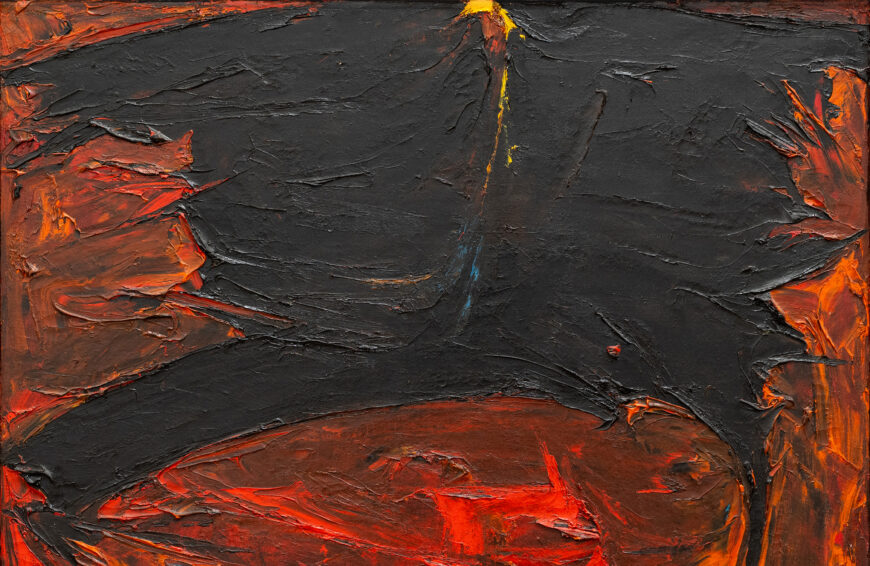
Though absolutely abstract, Traversal evokes of the skyline and frenetic movement of New York City.

George Morrison, Traversal, 1958, oil on canvas, 64.8 x 118.4 cm (Art Bridges Foundation) © George Morrison Estate. Speakers: Julia Mun, Assistant Curator, Art Bridges Foundation, and Steven Zucker, Smarthistory

Art Bridges Foundation logo

0:00:06.9 Steven Zucker: I feel really lucky. I get to go to Art Bridges storage and look at this gem of a painting by George Morrison. It’s a painting called Traversal, and it dates to 1958.

0:00:20.1 Julia Mun: Morrison was an Ojibwe artist born in 1919 in Minnesota. He attended boarding school in Wisconsin, but due to a sickness and hip surgery, he was hospitalized as a child. And this is where he’s beginning to encounter art. He graduated from the Minneapolis School of Art and eventually attended the New York Art Students League.

0:00:42.6 Steven Zucker: Now, the Art Students League was founded in opposition to the more rigorous traditional art schools. And it had, as its faculty, this incredible array of artists, many of whom had fled the Nazis in Europe. And so it was this place of real experimentation.

0:00:59.0 Julia Mun: George Morrison was truly invested in experimenting with art. He received a Fulbright Scholarship in 1952 and then traveled to Paris and studied at the École des Beaux-Arts, and he’s looking at Cubist works of art. He’s practicing automatic drawing, which comes from Surrealism. And eventually he moves back to Minnesota and then fully returns to New York in 1954.

0:01:21.5 Steven Zucker: 1954 was this pivotal moment, and that was especially true in New York, where art was being transformed. So many artists had come over fleeing the Nazis in the war, inspiring a new generation of artists. And so you have the development in the very late 1940s and early 1950s of a style that will come to be known as abstract expressionism, being led by artists like Mark Rothko, Jackson Pollock, Willem de Kooning. And George Morrison is spending his time with them. He’s drinking with them. These are his buddies. And his art is exploring many of the same issues that their art is exploring.

0:01:59.0 Julia Mun: There’s a sense of verticality throughout this painting that is so reminiscent of the skyscrapers that are starting to develop and changing the urban landscape as we know it.

0:02:09.2 Steven Zucker: I absolutely see the urban landscape here. But it’s a funny thing to say, because when we look at it, it’s just color and brushwork. It’s absolutely abstract, and yet somehow it’s evocative of the skyline of the city. But not just the skyline, somehow moving through the city, coming into contact with its movement, its frenetic quality, its music.

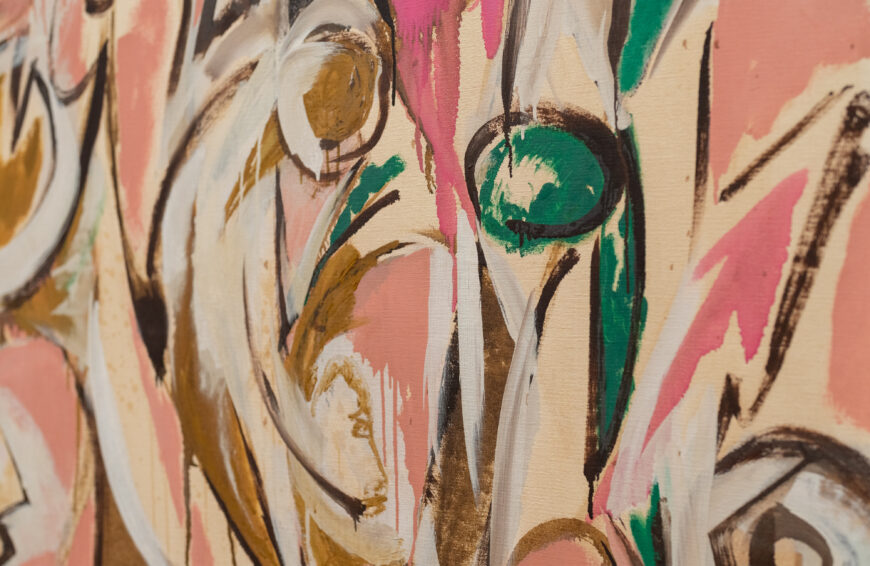
0:02:33.1 Julia Mun: Morrison would squeeze paint out of a tube onto the canvas, and it creates these thick layers of paint that creates a physicality to this painting.

0:02:44.3 Steven Zucker: There’s such a variety of brushstrokes. Towards the left side and the right, there are some horizontals. Then there are some curves in the center. And because all of this color, all these clouds of paint, feel like they’re in motion, it does have a quality of jazz. It does seem to dissolve and resolve in different places. It does almost feel syncopated.

0:03:07.6 Julia Mun: It doesn’t quite feel like the day. It doesn’t quite feel like the night. The red to me signifies the daytime. Whereas in the background we see this swath of blue punctuated by sections of orange. It reminds me of our apartments lit up at night.

0:03:22.6 Steven Zucker: And I don’t want to lose sight of how radical this painting was in 1958. American art before the war had been largely figural. People expected to be able to recognize things, to be told a story, to be able to navigate through a canvas with recognizable guideposts. And the artist has thrown this out the window. And it’s finding ways of expressing emotion, place and movement through pure form and color. It is a really radical experiment.

0:03:50.4 Julia Mun: And Morrison has constantly been defined as a Native American artist. When Morrison himself has stated that he is an artist who happens to be Indian.

00:04:01.2 Steven Zucker: And I think that his declaration that he was a painter that happened to be American Indian was a result of a pressure that he felt that so many artists have felt that they had to somehow satisfy the expectations of a white audience for what a Native American painter should be doing. And I think this artist simply wanted his art to be taken on its own terms.

00:04:25.7 Julia Mun: That doesn’t mean he wasn’t constantly reckoning with his cultural background and his identity. He eventually returned to Minnesota and was a key figure in establishing Indian Studies at the University of Minnesota. I think it’s not too much of a stretch to say that this element of place is an overarching theme in his life.

00:04:44.4 Steven Zucker: And in Traversal, that place just happened to be New York.

[music]

This work at Art Bridges

Truman T. Lowe, editor, Native Modernism: The Art of George Morrison and Allan Houser, exhibition catalogue (Seattle: University of Washington Press, 2004).

David Martínez, “This Is (Not) Indian Painting: George Morrison, Minnesota, and the Land He Never Really Left Behind,” American Indian Quarterly, volume 39, number 1 (2015), pp. 25–51.

Patricia Marroquin Norby, Hazel Belvo, Brenda J. Child, and Laura Wertheim Joseph, The Magical City: George Morrison’s New York, exhibition catalogue (New York: The Metropolitan Museum of Art, 2025).

W. Jackson Rushing III and Kristin Makholm, Modern Spirit: The Art of George Morrison, exhibition catalogue (Norman: University of Oklahoma Press, 2013).

Gerald Vizenor, “George Morrison: Anishinaabe Expressionist Artist,” American Indian Quarterly, volume 30, number 3/4 (2006), pp. 646–60.

Cite this page as: Julia Mun, Assistant Curator, Art Bridges Foundation and Dr. Steven Zucker, "George Morrison, Traversal," in Smarthistory, January 15, 2026, accessed January 15, 2026, https://smarthistory.org/george-morrison-traversal/.