


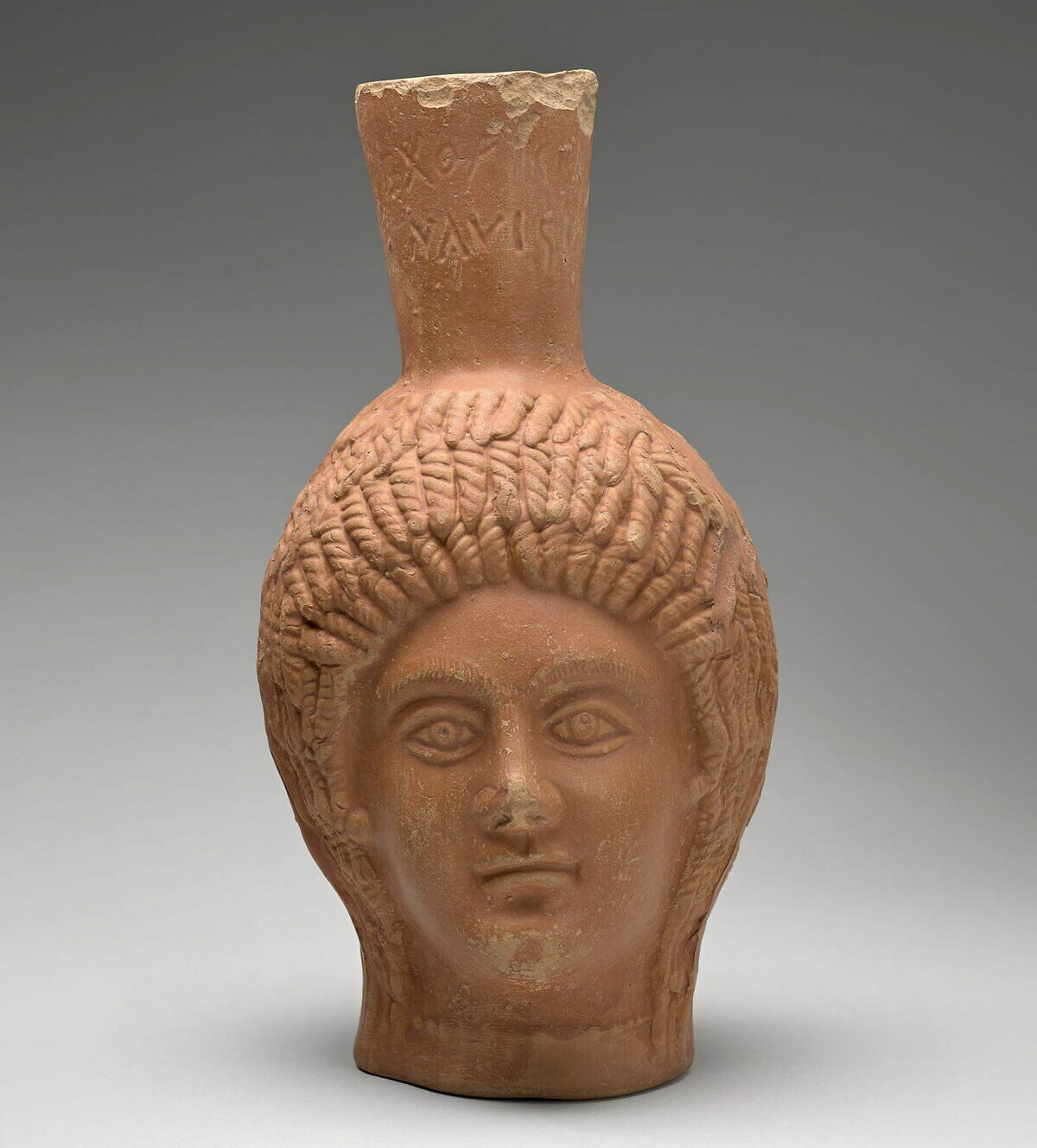
Jug, 290–320 C.E. (North African; Tunis El Aouja, Navigius school), African Red Slip Ware, 23 x 11.5 x 11 cm (Musée du Louvre, Paris)
Can an everyday object illuminate the complexities of empire, artistry, and cultural exchange? This head-shaped jug, made in North Africa between 290 and 320 C.E., asks us to look closely, not just at its features, but at the world that produced it. Molded from African Red Slip Ware (ARSW), a fine ceramic ware made in Roman and Byzantine North Africa, the jug merges beauty, function, and identity in ways that speak across centuries.
African Red Slip Ware: luxury in everyday life
African Red Slip Ware (ARSW) was one of the Roman Empire’s most successful ceramic industries. Produced mostly in what is now Tunisia, ARSW was exported across the Mediterranean from the 2nd to 7th centuries C.E., and it was found everywhere, from Rome and London to Constantinople and the Balkans. Though it imitated the appearance of luxury silver tableware, ARSW had a distinct identity. Its glossy red slip and carefully molded forms were the result of refined techniques, such as wheel-throwing, stamping, and slip coating, which reveal both technical mastery and regional style.
The jug’s striking anthropomorphic form, here in the form of a female head, is rare among the more typical ARSW plates and bowls. Her idealized features, almond-shaped eyes, straight nose, and stylized, radiating hair, evoke Roman portraiture while reflecting local aesthetic traditions. These vessels were mass-produced commodities, often intended for domestic contexts.
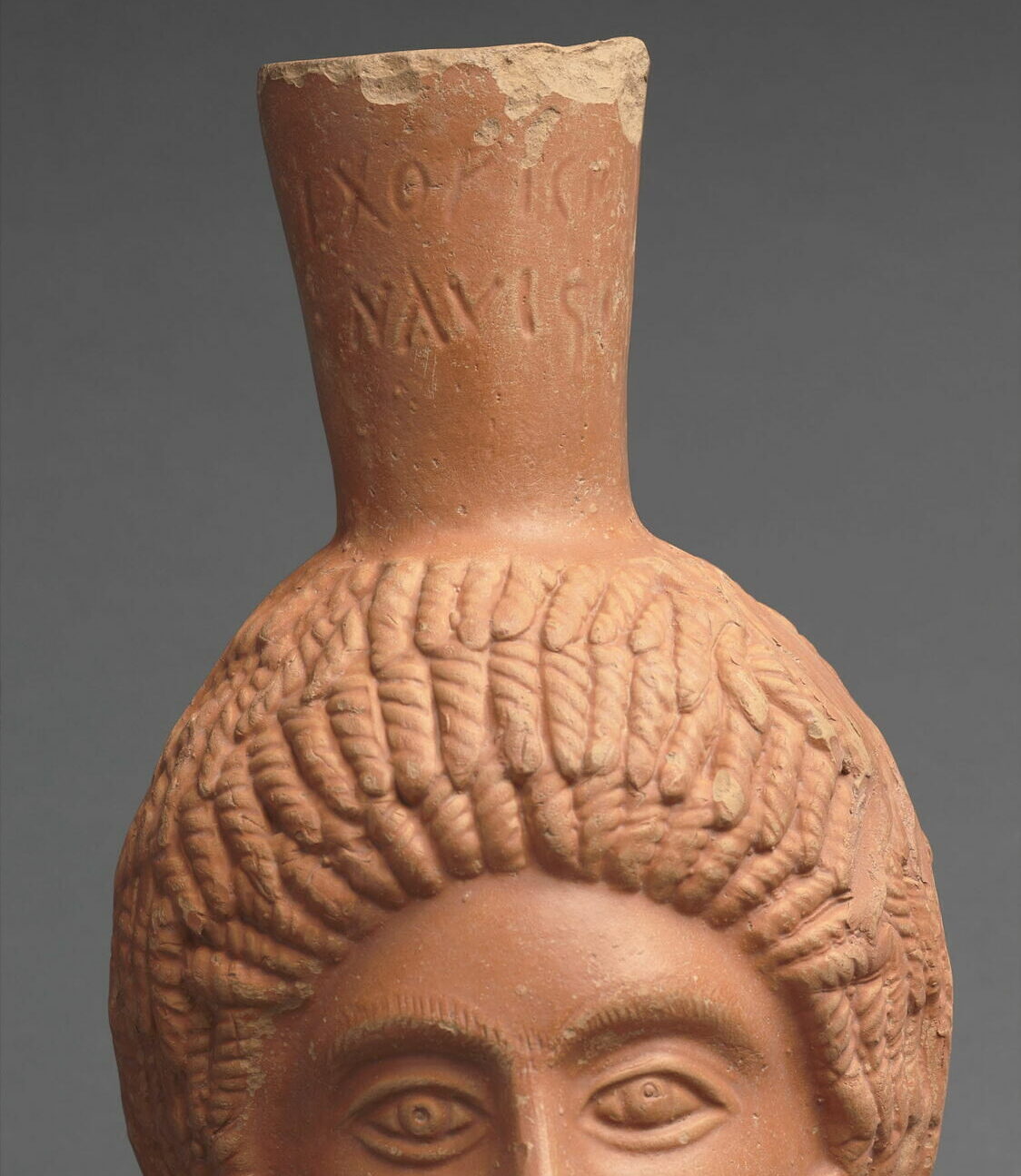
Inscription (detail), Jug, 290–320 C.E. (North African; Tunis El Aouja, Navigius school), African Red Slip Ware, 23 x 11.5 x 11 cm (Musée du Louvre, Paris)
A signature of craft
On the neck of the vessel is an inscription likely identifying the workshop: the Navigius school of El Aouja, one of several named ceramic production centers active in central Tunisia. Such markings functioned like maker’s signatures or brand labels, a rare glimpse into the artisans whose work reached far beyond their immediate communities. Traces of fingerprints and tool marks connect us even more intimately to their labor.
Trade, identity, and resilience
By the late Roman period, North Africa was a major hub of commerce, supplying the empire with olive oil, grain, and ceramics. The durability and stackability of ARSW plates made them ideal for maritime trade. However, more fragile forms like the head-shaped jug likely remained closer to home, valued for their symbolic and aesthetic qualities.
Even through political upheavals, including invasions by the Vandals and the later Byzantine reconquest, North African workshops continued to produce and innovate. Their resilience speaks to the strength of local economies and the adaptability of craft traditions under changing regimes.

Heracles and the Lernaean Hydra (left) and Dionysus (right), side of Bottle, 275–325 C.E. (North African; Tunisia), African Red Slip Ware, 20.5 x 12.5 cm (Musée du Louvre, Paris)
Iconography and aesthetics
The decorative themes of ARSW reflect both local craftsmanship and classical taste. The iconography includes figures from Greek mythology, such as Orpheus, Mercury, Dionysus, and Victory, surrounded by maenads and satyrs. These scenes, drawn from Hellenistic Greek traditions, appear as snapshots rather than full narratives.
By incorporating familiar classical motifs, ARSW appealed to both local and international markets. This widespread demand reflects how North Africa became an essential hub of fineware production and trade. Furthermore, the wares’ design and quality highlight a shared visual culture that extended throughout the Mediterranean basin during late antiquity.

Oil Lamp with Angel, late 6th century–first quarter 7th century (North African; Tunisia), African Red Slip Ware, 13.8 x 8.5 x 4.2 cm (National Museum of Carthage)
As Christianity spread throughout North Africa, the decorative repertoire of ARSW expanded to reflect the new religion’s iconography. From the 5th through 7th centuries, Christian motifs became increasingly prominent, particularly on oil lamps produced alongside traditional tableware. These motifs included crosses, angels, and religious symbols such as lambs, fish, peacocks, and doves.
Legacy of a vessel
Though small in scale, the head-shaped jug is monumental in what it reveals. It tells a story of regional ingenuity, Mediterranean networks, and the fluidity of cultural identity in late antiquity. More than just a container, this jug functions as a microcosm of a complex and cosmopolitan world. Its form reflects the lasting influence of Roman aesthetics, yet its manufacture in Tunisia, bearing the signature of a North African workshop, asserts a strong sense of local identity. It invites us to see provincial artisans not as passive imitators of imperial styles, but as active agents shaping and sustaining regional artistic languages.
The study of African Red Slip Ware itself has become a window into these networks of production and exchange. Scholars such as John Hayes, whose 1972 typology cataloged ARSW forms, have laid foundational groundwork for understanding this material. These layered typologies reveal not just ceramic forms, but also trade patterns, workshop lineages, and shifting consumer tastes over centuries.
This vessel’s survival allows us to glimpse a world in motion, a world where clay could carry ideas across seas, and where something as seemingly simple as a jug could reflect the vast, interconnected fabric of the late antique Mediterranean.


