Lloyd Kiva New, Untitled (Landscape)

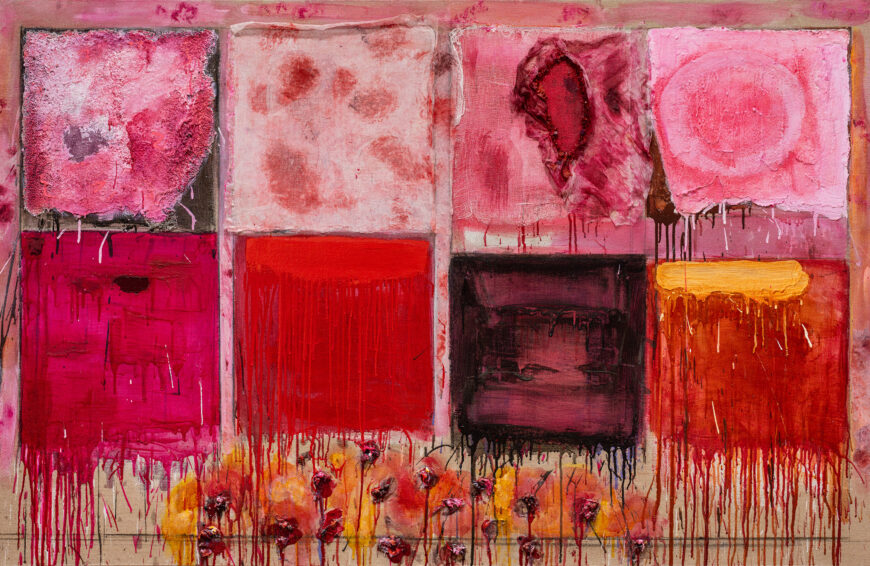
Landscape and textile are brought together in this painting by fashion designer Lloyd Kiva New.

Lloyd Kiva New, Untitled (Landscape), c. 1980, acrylic and oil on canvas, 90.2 x 86.4 cm (Art Bridges Foundation) © Estate of Lloyd Kiva New. Speakers: Dr. Ashley Holland, Curator & Director of Curatorial Initiatives, Art Bridges Foundation, and Dr. Steven Zucker, Smarthistory

Art Bridges Foundation logo

0:00:06.8 Dr. Steven Zucker: We’re in Art Bridges storage, and we’re looking at a new acquisition. This is a work by Lloyd Kiva New. It’s untitled, and it was painted around 1980.

0:00:17.2 Dr. Ashley Holland: I don’t think we can overemphasize the importance of Lloyd Kiva New to contemporary Indigenous art. I don’t think I would be where I am today without him, and I know that there are all of these artists and legacies of artists that wouldn’t be. He is responsible for the founding of the Institute of American Indian Art in the ’60s. He is thinking about what it means to create a school that is thinking about contemporary Native art in a time where authenticity is being debated. What does it mean to create Native art? The history of the Institute of American Indian Art comes out of the Santa Fe Indian School, which was this school that created sort of a guidebook to create Native art that was really market-driven that defined this idea of authentic Native art. Lloyd Kiva New thought whatever my students want to make is authentic, and he encouraged them to do that, and he said bring everything in your life to what you are painting.

0:01:21.0 Dr. Steven Zucker: But the painting that we’re looking at was produced two years after he retires.

0:01:26.0 Dr. Ashley Holland: This is such an interesting work by Lloyd Kiva New because what he is really known as is a fashion designer. But before Lloyd Kiva New becomes a fashion designer, he was born in a small town in Oklahoma or what is now known as Oklahoma. It was in a part of the state that was part of the historical Cherokee Nation. His father was a Scots-Irish. His mother was Cherokee. He grew up with the Cherokee identity, and this is something that is a through line through his life, this understanding of being both a very contemporary person that is existing within the larger United States environment. He went to school at the School of the Art Institute in Chicago. He got his bachelor’s and his master’s there, but he never lost his connection to his community, and he never lost sight of what it meant to be an Indigenous person within the United States.

0:02:27.6 Dr. Ashley Holland: He’s applied the paint in a way that the canvas weave is still visible, so there’s still a design sort of fabric element to it. He’s thinking about a landscape, but there is a repetition to it that lends itself really well to fabric, his thoughts about color and balance and the ways that he’s building on the color as it’s progressing down the canvas. New was Cherokee, and the idea of balance and harmony is so integral to the health of our community that all of that is playing in here when he’s thinking about his use of color, when he’s building the canvas, and when he’s creating these images, and there’s four dots that are going down. Four is a really sacred number to Cherokee people. I’m not sure if that’s what he’s thinking about, but that’s what I see when I look at it.

0:03:18.3 Dr. Steven Zucker: You have those four stacks of rounded, thick paint strokes, and there’s a progression from a kind of light pink to a deeper pink, and then that black. But the black echoes the black at the top of the canvas, and then that more landscape-like portion of the canvas has its own progression from that deep tan to the yellow with its greens to the blue. And so there’s this four-stage progression that exists both in the part of the canvas at the bottom that is more two-dimensional, that is more emphatically flat, and the part of the canvas at the top that seems to be referencing landscape and deep space.

0:03:56.3 Dr. Ashley Holland: It’s fun to think that at this moment of retirement, he’s becoming a student again, and it’s nice to think that this is a moment where he is revisiting earlier work.

0:04:07.7 Dr. Steven Zucker: And so it makes me think of a textile in the bottom half. It makes me think of landscape at the top half, but it also is making me try to understand the relationship between those two, and the sense that perhaps the artist is seeing a direct linkage between the land and the fashion design, and his working with fabric, and the relationship between these different parts of his career.

0:04:30.4 Dr. Ashley Holland: And the more I look at it, and I start to see these sort of lines that are happening at the top of that red bottom half, you’re wondering, oh, is this an adobe figure that we’re looking at? Are these adobe shapes? And then he’s overlaying them with different pinks, trying to figure out what’s a good color contrast there. There’s a lot of experimentation going on.

0:04:52.0 Dr. Steven Zucker: I actually love looking at the work of artists who have been successful through their careers, are financially stable, and they go back to their work no longer needing to worry about the market, so that we have an artist who has now the freedom to paint exactly what’s important to him, not thinking about a potential audience. He’s literally simply painting for himself.

This work at Art Bridges

Roy Boney Jr., “Lloyd Kiva New: His Cherokee Roots and Legacy in Oklahoma,” First Americans Art Magazine (Fall 2016).

Tony R. Chavarria and Ryan S. Flahive, Lloyd Kiva New: A New Century, exhibition catalogue (Santa Fe: Museum of Indian Arts and Culture, 2017).

Lloyd Kiva New, The Sound of Drums: A Memoir of Lloyd Kiva New (Santa Fe: Sunstone Press, 2016).

Cite this page as: Dr. Ashley Holland, Curator & Director of Curatorial Initiatives, Art Bridges Foundation and Dr. Steven Zucker, "Lloyd Kiva New, Untitled (Landscape)," in Smarthistory, November 20, 2025, accessed December 15, 2025, https://smarthistory.org/lloyd-kiva-new-untitled-landscape/.