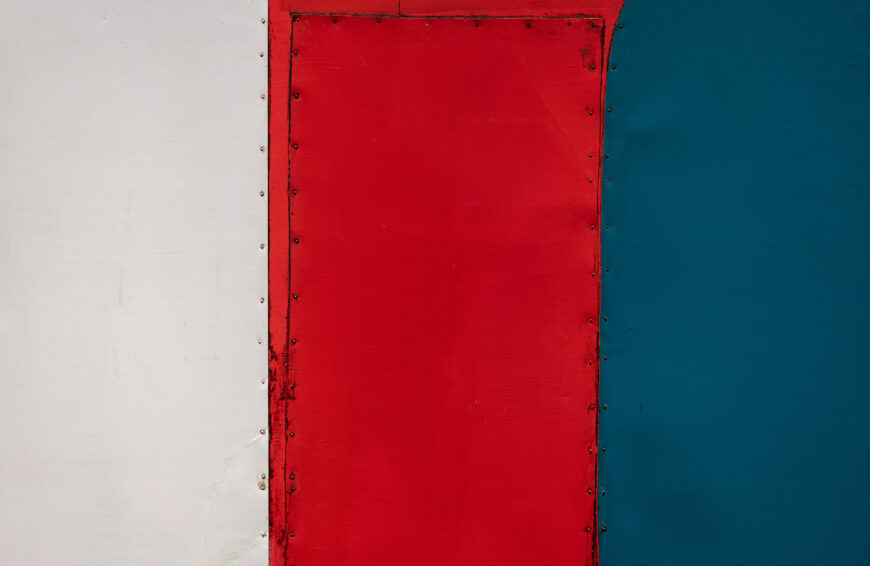
Rita Letendre, Menace (Ramat Gan)

Letendre’s expressive, gestural paint application creates an image that seems to be moving, shifting, and surging.

Rita Letendre, Menace (Ramat Gan), 1963, oil on canvas, 64.8 x 81.3 cm (Art Bridges Foundation) © Estate of Rita Letendre. Speakers: Dr. Javier Rivero Ramos, Associate Curator, Art Bridges Foundation and Dr. Steven Zucker, Smarthistory
Art Bridges Foundation logo

0:00:00.2 Dr. Steven Zucker: We’re in Art Bridges storage and we’re looking at a new acquisition. This is by a Canadian artist, Rita Letendre. And its title seems to me perfect: Menace (Ramat Gan). And the painting does feel menacing. Its dark reds and browns and blacks with little touches of yellow and blue.

0:00:28.4 Dr. Javier Rivero Ramos: Rita spoke a lot about the thought that went into her compositions. And so it’s interesting that a work that seems so quickly put together actually had so much work go into it. Oftentimes she would start with a large black mass, and then the rest of the colors would surge out and find points of confrontation. And oftentimes she would try to locate within the picture plane a specific point of friction that, in her words, would cause an almost explosion of energy that would animate the rest of the canvas. And she would think very deliberately about this. But then the execution of the works that she’s doing at this point in her career is incredibly fast.

0:01:06.8 Dr. Steven Zucker: So she wanted the spontaneity, but the result of that is a kind of flux that makes me think that black mass is dominating. Or wait, maybe the red is taking over. The entire painting seems to be moving and shifting and surging.

0:01:22.0 Dr. Javier Rivero Ramos: If we focus on the lower portion of the canvas, this hint of green seems to be lurking in the background, and then there’s this blue that then surges upward and then transforms into this thickly impastoed yellow passage. When we look at some of the other parts of the canvas where the black and the red are confronting each other, it takes almost a kind of geological or topographical quality. At this point in her career, Rita is working mostly with a spatula. And as an artist who started out her career as a figurative painter using a paintbrush to later on delving into hard edged abstraction with an airbrush, she was an artist who was very attentive to what tool her hand used to communicate. And so in this case, we have this quickly moving spatula that seems to be almost carving or modeling the surface of the work.

0:02:13.8 Dr. Steven Zucker: It almost seems like this is not so much painting as sculpture. The red at the bottom can have some dimensionality. Is this some kind of pool that almost exists below? But then when we try to read the black, that sense of space begins to fall apart. And we seem to have almost something cape-like, a huge bat, some creature of the night flying towards us and obscuring our view.

0:02:38.8 Dr. Javier Rivero Ramos: This is obviously an abstract work, but it’s impossible not to see at points some kind of a creature that is lurking or throwing itself onto the foreground, onto the viewer’s space. Which might help us explain the work’s title, Menace.

0:02:53.2 Dr. Steven Zucker: Well, it reminds me of the explorations of Francisco Goya or the work of Francis Bacon in the way that danger is explored, violence is explored. It seems as if this is a carcass, this is a pool of blood, that this is some sort of violent confrontation. What did it mean for a woman of Native American ancestry to take on some of the most radical painting in contemporary art in Montreal first and then Toronto?

0:03:20.5 Dr. Javier Rivero Ramos: She was the eldest of seven siblings and had to abandon school as early as age 13 in order to help provide for her family. But her talents were actually detected early on and she was able to attend the École des beaux-arts. And although she seems to have excelled within the strictures of that system, she also was searching for something else. Later on, she met the artist Paul-Émile Borduas, who encouraged her and who was also the author of a 1948 manifesto titled Le Refus Global, the Global Rejection. And this was a manifesto that called against the over rationalizing strictures of art and culture. It was in a manifesto that called for an art that was completely intuitive, completely personal and completely free. It’s important to remember that within the Canadian art environment, this would have been incredibly potent and revolutionary. This being a very conventional space that still favored representation and more conventional kind of art. And we see an artist that is constantly innovating, and I think that is proof of just how fearless her work was.

Title Menace (Ramat Gan)
Artist(s) Rita Letendre
Dates 1963
Places North America / Canada
Period, Culture, Style Modernisms / Native North American (First Nations) / Eastern Woodland Native American / Abenaki
Artwork Type Painting
Material Oil paint, Canvas
Technique Impasto

This work at Art Bridges

Adam Lauder, “Rita Letendre: Toronto Public Art,” essay for the exhibition Rita Letendre: Toronto Public Art (2018).

Wanda Nanibush and Georgiana Uhlyarik, Rita Letendre: Fire And Light, exhibition catalogue (Toronto: Art Gallery of Ontario, 2017).

Cite this page as: Dr. Javier Rivero Ramos, Associate Curator, Art Bridges Foundation and Dr. Steven Zucker, "Rita Letendre, Menace (Ramat Gan)," in Smarthistory, November 25, 2025, accessed December 13, 2025, https://smarthistory.org/rita-letendre-menace-ramat-gan/.