Guerrilla Girls, Dearest Art Collector
Getty Conversations

This “cutesy” letter tackles a serious problem: the lack of art made by women in many private collections.

Guerrilla Girls, Dearest Art Collector, 1986, poster, Guerrilla Girls records, 1979–2003 (Getty Research Institute, Los Angeles, 2008.M.14) © Guerrilla Girls, used with permission. Speakers: Dr. Zanna Gilbert, senior research specialist, Getty Research Institute and Dr. Beth Harris, Smarthistory

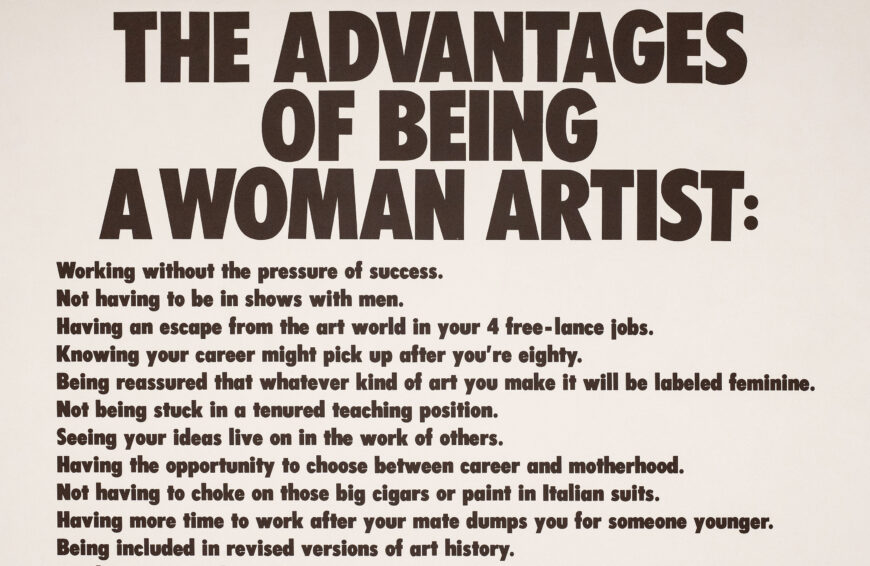
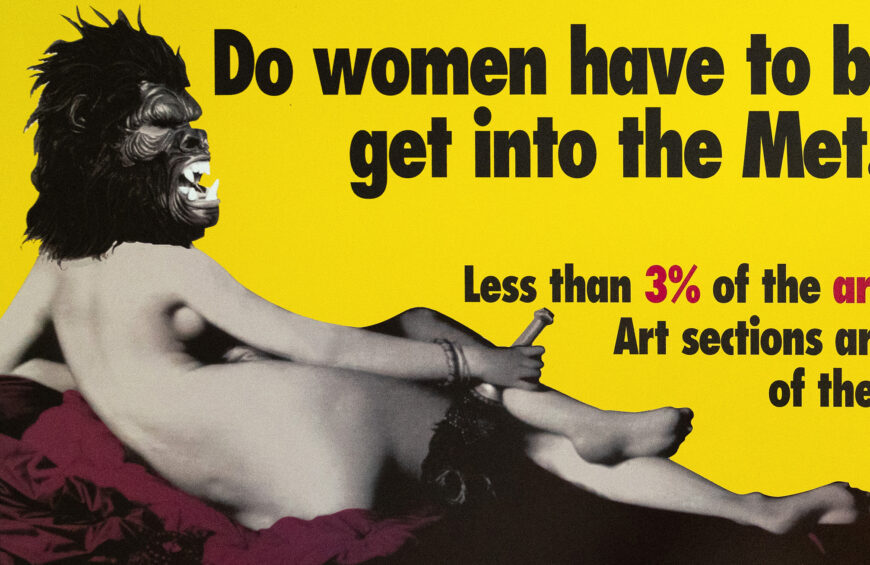
The Guerrilla Girls are an art collective formed in New York in 1985 to protest sexism and discrimination in the art world. Composed of anonymous members who went by pseudonyms and wore gorilla masks, the group launched a series of poster campaigns that highlighted the lack of representation given to women artists and artists of color in museums and galleries. Their posters often had a humorous and ironic tone, and their collaborative process is illuminated in their archives, which are held at the Getty Research Institute.

This early work by the Guerrilla Girls shows them trying new tactics after they realized that traditional protests were not having the effect they’d hoped for. Instead, they turned to designing posters with statistics and simple, humorous messages. For Dearest Art Collector, the “feminine” elements of the design—the cutesy handwriting, pink paper, flower drawing, and endearing, earnest language—form an ironic contrast with the poster’s actual message, which is about sexism in the art world.

The archive of the Guerrilla Girls contains early drafts of Dearest Art Collector, showing the group’s creative process and how they evolved the work. For Guerrilla Girls Review the Whitney, an exhibition critiquing the 1987 Whitney Biennial (one of the art world’s most important events), they created a large version of the work that specifically addressed Alfred Taubman, the chair of the board of trustees, and his conflicting business interests. In 2015, they did another updated version called Dear Billionaire Art Collector, pointing to the low wages paid to museum workers in contrast to the astronomically high prices paid for works of art.

The form of the letter recurs in the Guerrilla Girls’ work and traverses both the public and the private realm. Dearest Art Collector could take the form of a personal postcard mailed to a specific person, or a large poster plastered on a gallery wall. The Guerrilla Girls’ posters included an address for their P.O. Box, which flooded with fan mail from people wanting to show their support for the group.

Getty has joined forces with Smarthistory to bring you an in-depth look at select works within our collection, whether you want to learn more at home or make art more accessible in your classroom. This video series illuminates art history concepts through fun, unscripted conversations between art historians, curators, archaeologists, scientists, and artists, committed to a fresh take on the history of visual arts.

This video was made possible by the GRI Council.
[music]

0:00:06.8 Dr. Beth Harris: We’re at the Getty Research Institute looking at probably one of the most famous works by the Guerrilla Girls, Dearest Art Collector. What’s really special about being here at the GRI is that we have the archive. We have these documents that help us to understand the process of this community of artists.

0:00:27.9 Dr. Zanna Gilbert: The poster reads, “Dearest Art Collector, it’s come to our attention that your collection, like most, does not contain enough art by women. We know that you feel terrible about this and will rectify the situation immediately. All our love, Guerrilla Girls.” So this was made in 1986. So it makes it one of the earliest posters by the Guerrilla Girls, who formed in 1985 in New York City. And they were formed out of a frustration with the way that feminist protests hadn’t had the effect that they should have had. And they wanted to try new tactics. And their posters used statistics, very simple messages and humor to get at the issues.

0:01:08.7 Dr. Beth Harris: It starts ironically, “Dearest Art Collector.” We know that they don’t feel anything endearing about the art collector that they’re writing to. The pink paper, the little flower at the top with the sad face, so sort of leaning in to ideas of femininity, ideas of how women artists are not serious.

0:01:30.9 Dr. Zanna Gilbert: Up until this point, all of their posters had been black and white, Futura bold, very direct, very simple. And this one departs from that method. What we found in the archive was what we think is probably the prototype of the Dearest Art Collector letter. It has whiteout, where it says “Art Collector.” So they were deliberating on who this was going to be addressed to. They were interested in addressing all different aspects of the art world, so it could have also been addressed Dear Art Critic, Dear Museum Curator, Dear Male Artist. The Dear Art Collector poster was done in 1986. But then in 1987, the Guerrilla Girls did an exhibition at The Clocktower, and they were reviewing the Whitney Biennial, which is one of the most important events of the art world. And it was notoriously bad for lack of inclusion of women and artists of color. So what they decided to do was make the Dearest Art Collector letter very specific and address it to the chair of the Board of Trustees, who at that time was Alfred Taubman. And in the letter, they drew attention to conflicts of interest and his business interests in his role at the Whitney Museum.

0:02:44.4 Dr. Zanna Gilbert: So in this case, they changed the format of the letter. They made it really big. They made it into installation art in a way. And then in later years, they have done more of these projects. So in 2015, they made a new one that’s called Dear Billionaire Art Collector. And they worked with an organization called the Illuminators to project this ransom note style letter that said Dear Billionaire Art Collector onto the side of the Whitney Museum. But it’s also a poster. So there are many different iterations of the Dearest Art Collector letter.

0:03:19.9 Dr. Beth Harris: Blending that private letter with these ironic, sarcastic posters that are out there in the public sphere.

0:03:27.4 Dr. Zanna Gilbert: The mail system traverses both the public and the private realm. And that’s what’s unique and interesting about their use of it, because they can apply in these different contexts the direct address of a curator or a critic, and they also can show it as an open letter. We have a postcard that was addressed to a curator at the Museum of Modern Art called Margit Rowell. And it’s another example of writing specifically to a person. So in this case, they objected that the exhibition “Objects of Desire: The Modern Still Life, ” only had four women included out of 71 artists. And they take one of the objects that was included by Meret Oppenheim, which is her famous furry teacup and spoon with Guerrilla Girls heads inside the teacup.

[chuckle]

0:04:20.7 Dr. Zanna Gilbert: And they suggest that they rename the show “The Objects of MOMA’s Desire are Still White Males.” And then they sign off, “Lotsa luck, Guerrilla Girls” Another thing to mention about the posters is that they had this P.O. Box and that invited a real flood of fan mail, people who were just interested in getting a poster for their wall or for their class.

0:04:44.3 Dr. Beth Harris: I can imagine this pent up anger and then seeing these posters and wanting to join.

0:04:52.0 Dr. Zanna Gilbert: What they landed on is that they suggested that everyone can do something, and that makes you an honoree Guerrilla Girls.

0:05:01.0 Dr. Beth Harris: I just wanna go back to the poster itself in the last line, which really strikes me in a tragic and also very funny way. “We know that you feel terrible about this and will rectify the situation immediately.” And of course, here we are 40 years later and we know that there’s still so much to be done in order for there to be real equity in the art world.

0:05:24.9 Dr. Zanna Gilbert: I think it’s fair to say that they did have a huge impact on the art world. And there are cases of curators who, when they were younger, learning about the Guerrilla Girls’ work, and then they set about the rest of their careers trying to rectify things. Of course there are a lot of people doing this work, but there’s a lot still to be done.

[music]

Title Dearest Art Collector
Artist(s) Guerrilla Girls
Dates 1986
Places North America / United States
Period, Culture, Style Contemporary
Artwork Type Print
Material Ink, Paper
Technique

Cite this page as: Dr. Zanna Gilbert, Senior Research Specialist, Getty Research Institute and Dr. Beth Harris, "Guerrilla Girls, Dearest Art Collector
Getty Conversations," in Smarthistory, October 23, 2025, accessed December 16, 2025, https://smarthistory.org/guerrilla-girls-dearest-art-collector/.