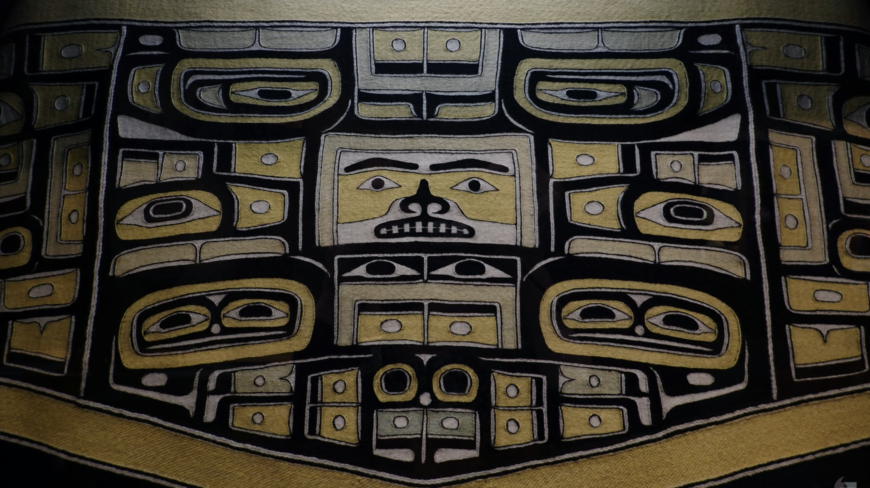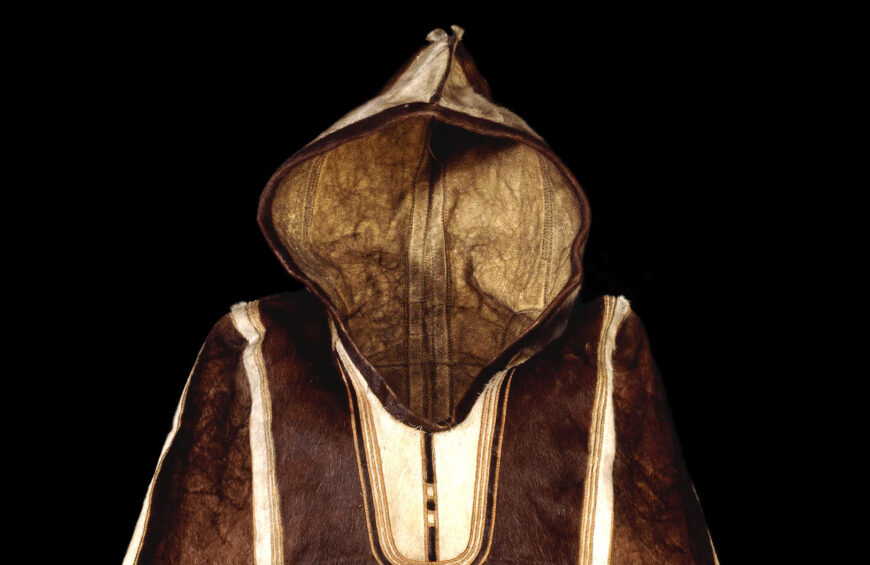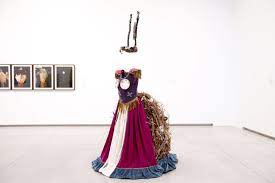


Anishinaabe outfit, c. 1790, collected by Lieutenant Andrew Foster, Fort Michilimackinac (British), Michigan, Birchbark, cotton, linen, wool, feathers, silk, silver brooches, porcupine quills, horsehair, hide, sinew; the moccasins were likely made by the Huron–Wendat people (National Museum of the American Indian, Smithsonian Institution), a Seeing America video
Despite the unequal power between themselves and the colonists, indigenous North American societies were able, over time, to adapt to the new presence in their land, finding some convergences between their artistic practices and those of the Europeans. The term used to define this form of cultural encounter is syncretism—the melding of two or more different belief systems, artistic styles, or cultural practices to form a third, distinctly different one.
Although many indigenous societies had been dislocated from their ancestral homelands as a result of white settlement, epidemic, forced relocation, intertribal raiding, warfare, and shifting ethnic alliances, they were nevertheless often able to devise a culture of the middle ground. The crucial factor permitting this was that Natives and Europeans met in partnerships from which each benefited, based on trade. Natives retained aspects of their cultural autonomy as they hunted and trapped America’s abundant wildlife to supply an international market. The pelts and hides were sent to Europe; in exchange, cloth, iron and silver, and glass beads made their way across the ocean to North America. The indigenous artistic repertoire expanded to incorporate these trade goods. Although their cultures were changing so rapidly as to be threatened with virtual extinction, Native people acquired and assimilated new materials and motifs, while trying to exploit new opportunities for economic and artistic enrichment. The visual culture of the middle ground was hybrid and inventive, resilient in the face of foreign occupation. [1]