


The popularity of religious pilgrimages transformed church architecture in the Romanesque period.
Romanesque architecture explained, in Durham Cathedral, begun 1093. Speakers: Dr. Steven Zucker and Dr. Beth Harris
0:00:06.8 Dr. Beth Harris: We’re sitting in Durham Cathedral in Northern England, and we wanted to talk about how you recognize a Romanesque church. And Durham is a great place for us to have this conversation.
0:00:19.1 Dr. Steven Zucker: It’s one of the oldest Romanesque churches in England, and it’s enormous.
0:00:23.7 Dr. Beth Harris: Romanesque is a word that often is applied to this style of architecture on the continent. Here in England, we often refer to this style as Anglo-Norman, referring to the Normans who had invaded in 1066 and brought this style of architecture with them from France.
0:00:42.7 Dr. Steven Zucker: And it’s often put forward that Romanesque architecture was the first large scale architecture since the Roman Empire in Western Europe. But there was, in fact, large scale building before the Romanesque. One only needs to look at, for example, the Palatine Chapel in Aachen or Saint Ambrosia in Milan. And art historians are also aware that traditions from the Middle East and from Spain, which was at this time not under the control of Christians, but was under the control of Islam, might also play a role here.
0:01:14.4 Dr. Beth Harris: But what makes the architecture of this period unique is that it addressed the needs of people who were now on the move. And they were on the move because they were going in large numbers on pilgrimages to visit important religious sites, to visit relics in the hope, often of a miracle that could be performed, a healing, or even acquiring merit that could ultimately lead to less time in purgatory and an arrival sooner in heaven. And the church that we’re in was an important pilgrimage destination because it housed and still houses the relics of Saint Cuthbert.
0:01:56.4 Dr. Steven Zucker: Churches had to be built to accommodate large numbers of pilgrims. And those pilgrims brought wealth to the towns that held these relics. And the wealth that pilgrims brought with them, which was spent at local inns or to purchase souvenirs or direct donations to the church, meant that there was money to build these large scale structures. It also meant that the design of the building needed to be able to allow for large numbers of people to move through without interrupting, for instance, a mass that might be taking place at the high altar.
0:02:31.1 Dr. Beth Harris: And there had to be chapels that contained the relics that the pilgrims could visit.
0:02:35.6 Dr. Steven Zucker: Let’s begin with a basic plan.
0:02:37.7 Dr. Beth Harris: This church uses the plan of a basilica, which is actually an ancient Roman type of building that was adapted by early Christians.
0:02:46.9 Dr. Steven Zucker: Basilicas in the Romanesque era often also included a transept, that is a second hall perpendicular with the main hall, which we call the nave, and therefore gives the entire building the outline of a cross.
0:03:00.2 Dr. Beth Harris: They also often included an aisle on either side of that main hallway, the nave, sometimes even two aisles, so that you could hold larger numbers of people who needed to circulate through the church.
0:03:13.6 Dr. Steven Zucker: The single most characteristic aspect of Romanesque architecture is its use of the ancient Roman arch, that is the round arch.
0:03:23.2 Dr. Beth Harris: When we look, for example, across the nave, we notice at the very lowest level, a row of round arches. In fact, very deep round arches with rolled molding. Above that, at the gallery level, we see another round arch, this one subdivided into two smaller round arches.
0:03:43.1 Dr. Steven Zucker: And at Durham, it’s a very deep gallery with a walkway that would have been used for members of the church. And above that is a more narrow passage and windows that bring in daylight. But as is typical of Romanesque churches, these are quite small and so these are relatively dark spaces.
0:04:03.6 Dr. Beth Harris: We see yet another round arch, this time subdivided into three smaller round arches, where the central arch is larger than the ones on either side. So the architects of the Romanesque period had to span the nave. And to do that, most Romanesque churches used a barrel vault.
0:04:23.3 Dr. Steven Zucker: Usually the barrel vault runs the length of the nave. But in certain Romanesque churches, because the Romanesque is a period of experimentation, a series of segmented barrel vaults run laterally across the nave as opposed to down its length. An example of that can be seen at Tournus in Burgundy.
0:04:41.1 Dr. Beth Harris: In the nave, the aisles, the crossing, and the chancel in Durham, we see the use of ribbed groin vaults. So this is a very early use of a ribbed groin vault, which will see extensive use in the period after the Romanesque called Gothic.
0:04:58.5 Dr. Steven Zucker: Another important characteristic of the Romanesque is its sense of weight, its heaviness, and that’s accentuated by the relative darkness. The walls are largely unpierced by windows, and the windows that do exist are relatively small, especially in comparison with the Gothic windows that will come after. You can see the massiveness, especially in the enormous piers that help to support the massive weight of the stone vaulting above. What you can’t see is the thickness of the walls beyond the aisles. These walls are as much as nine feet thick in certain places. That is, an enormous amount of stone had to be piled up in order to support the weight of the stone vaulting.
0:05:41.4 Dr. Beth Harris: And here we begin to see the use of compound piers.
0:05:46.5 Dr. Steven Zucker: In Durham Cathedral, those bundled piers alternate with cylindrical piers or columns, the that are incised with a variety of decorations. Closest to the west end of the church, we see just vertical fluting. Next we see chevrons, and then we see diamonds. And then as we get closer to the more sacred part of the church, we see a spiral pattern.
0:06:09.0 Dr. Beth Harris: It’s very typical for the most sacred part of the church, the eastern end, to be more heavily decorated. That’s where the monks performed their duties, and that’s also where the body of Saint Cuthbert lies. There is a wonderful geometric simplicity to a Romanesque church. When you walk through it, you notice these distinct geometric parts.
0:06:32.3 Dr. Steven Zucker: And yet another typical feature of the Romanesque is a love of a kind of architectural marginalia. If you look at illuminated manuscripts, of course, the scribe is paying most of their attention to accurately copying the text. But there are moments where the scribe will create little drawings that have little to do with the text, that are just playful asides. And there is an architectural equivalent of that. In many Romanesque churches, there are fanciful carvings, often of heads, of monsters, of grotesques, that are meant, perhaps horrify, but also to entertain. And we can see that here in the wonderful heads that form the corbels from which spring the ribbed groin vaults. It’s interesting to note that although the basic building elements, the basilica plan and the round arch, are borrowed directly from ancient Roman architecture, the Romanesque is a truly international style. The elements that we’ve discussed can be seen in churches from England to Italy.
0:07:30.8 Dr. Beth Harris: And we’re lucky that here at Durham Cathedral, so much of the Romanesque style remains. Often parts of Romanesque churches were torn down to make room for the new Gothic style. But here at Durham, we get a true sense of Anglo-Norman or Romanesque architecture.
The name gives it away—Romanesque architecture is based on Roman architectural elements. It is the rounded Roman arch that is the literal basis for structures built in this style.
Ancient Roman ruins (with arches)
All through the regions that were part of the ancient Roman Empire are ruins of Roman aqueducts and buildings, most of them exhibiting arches as part of the architecture (you may make the etymological leap that the two words—arch and architecture—are related, but the Oxford English Dictionary shows arch as coming from Latin arcus, which defines the shape, while arch—as in architect, archbishop, and archenemy—comes from Greek arkhos, meaning chief and ekton means builder).
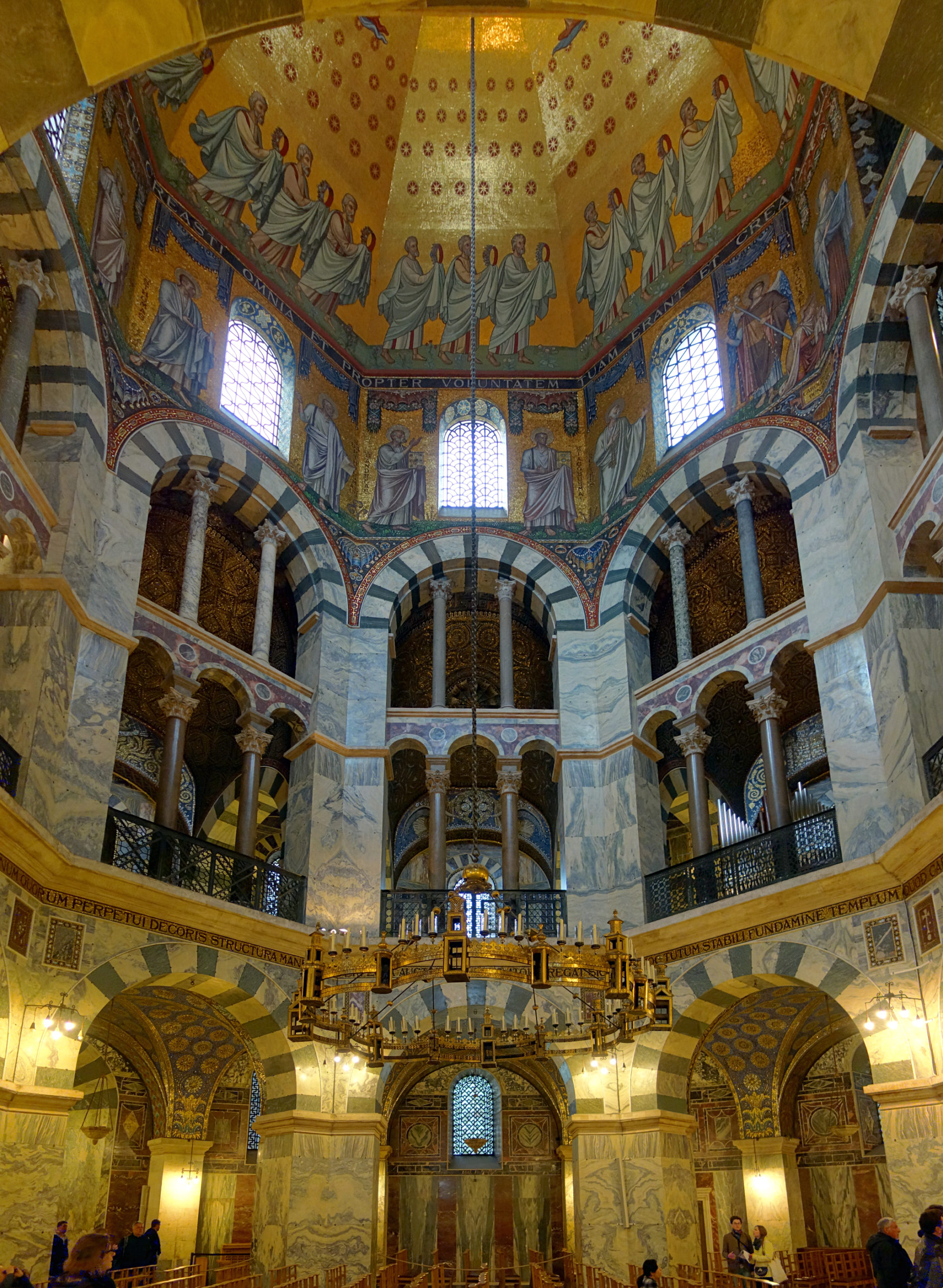
Interior of the Palatine Chapel of Charlemagne, Aachen, Germany, 792–805 (photo: Velvet, CC BY-SA 3.0)
When Charlemagne was crowned Holy Roman Emperor in 800 C.E., the remains of Roman civilization were seen all over the continent, and legends of the great empire would have been passed down through generations after the fall of Rome in the fifth century. So when Charlemagne wanted to unite his empire and validate his reign, he began building churches in the Roman style—particularly the style of Christian Rome in the days of Constantine, the first Christian Roman emperor.
After a gap of around two hundred years with no large building projects, the architects of Charlemagne’s day looked to the arched, or arcaded, system seen in Christian Roman edifices as a model. It is a logical system of stresses and buttressing, which was fairly easily engineered for large structures, and it began to be used in gatehouses, chapels, and churches in Europe.
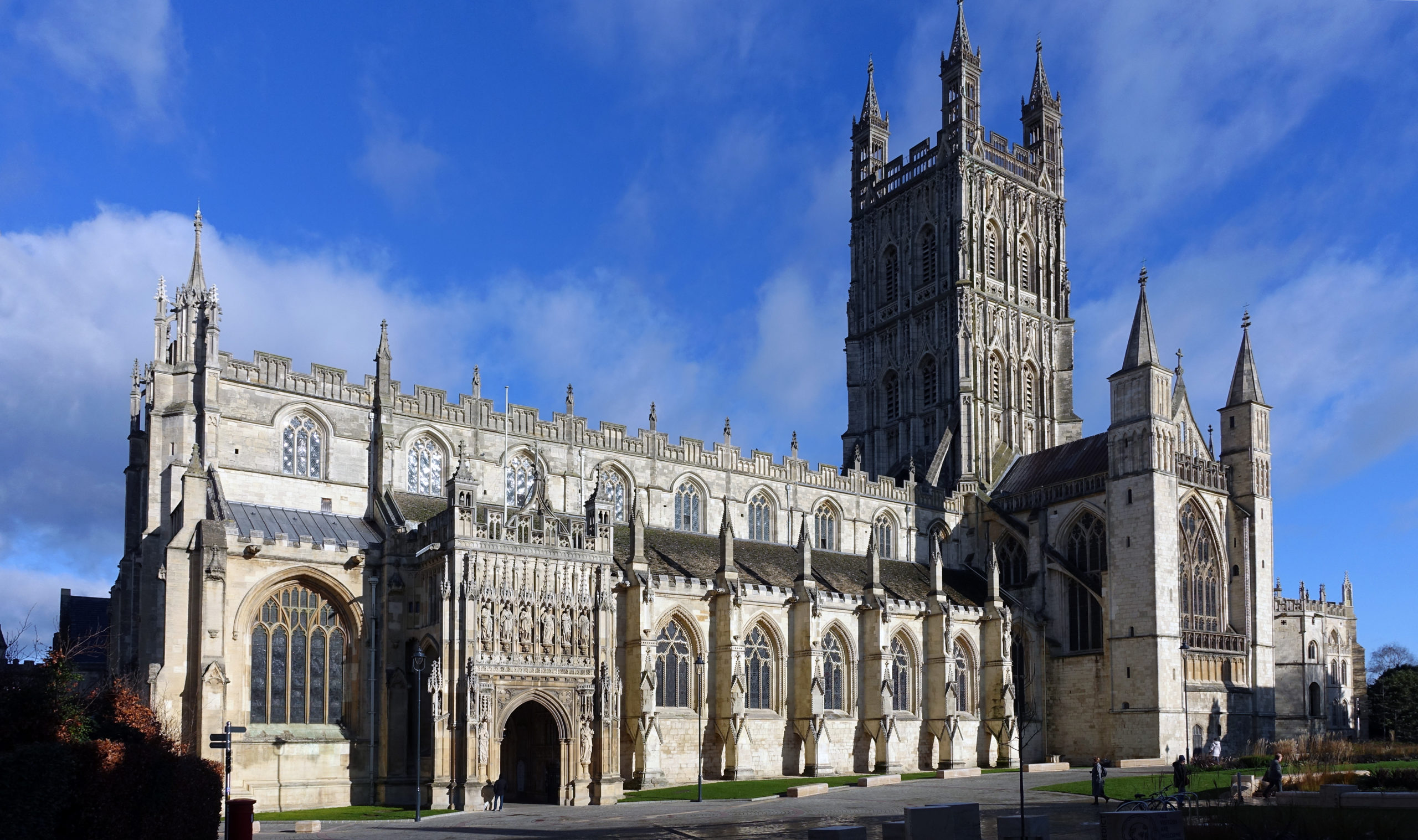
Gloucester Cathedral, begun 1089 (photo: Steven Zucker, CC BY-NC-SA 2.0)
These early examples may be referred to as pre-Romanesque because, after a brief spurt of growth, the development of architecture again lapsed. As a body of knowledge was eventually re-developed, buildings became larger and more imposing. Examples of Romanesque cathedrals from the early Middle Ages (roughly 1000–1200) are solid, massive, impressive churches that are often still the largest structure in many towns.
In Britain, the Romanesque style became known as “Norman” because the major building scheme in the 11th and 12th centuries was instigated by William the Conqueror, who invaded Britain in 1066 from Normandy in northern France. (The Normans were the descendants of Norse, or north men (“Vikings”) who had invaded this area over a century earlier.) Durham and Gloucester Cathedrals and Southwell Minster are excellent examples of churches in the Norman, or Romanesque style.
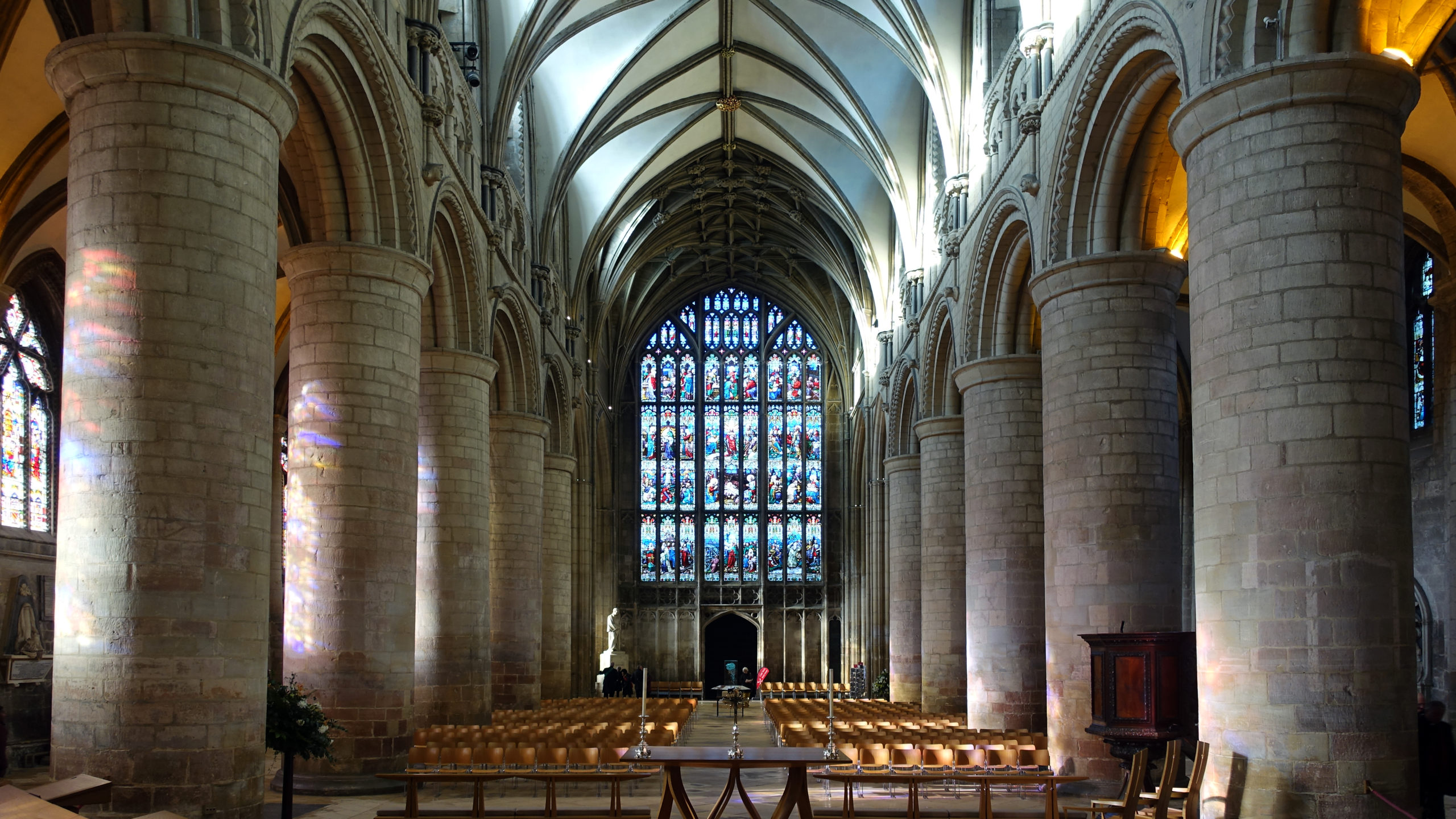
Gloucester Cathedral, nave, begun 1089 (ceiling later) (photo: Steven Zucker, CC BY-NC-SA 2.0)
The arches that define the naves of these churches are well modulated and geometrically logical—with one look you can see the repeating shapes, and proportions that make sense for an immense and weighty structure. There is a large arcade on the ground level made up of bulky piers or columns. The piers may have been filled with rubble rather than being solid, carved stone. Above this arcade is a second level of smaller arches, often in pairs with a column between the two. The next higher level was again proportionately smaller, creating a rational diminution of structural elements as the mass of the building is reduced.

Gloucester Cathedral, decorative carving on the nave arcade and triforium (photo: Steven Zucker, CC BY-NC-SA 2.0)
The decoration is often quite simple, using geometric shapes rather than floral or curvilinear patterns. Common shapes used include diapers—squares or lozenges—and chevrons, which were zigzag patterns and shapes. Plain circles were also used, which echoed the half-circle shape of the ubiquitous arches.
Early Romanesque ceilings and roofs were often made of wood, as if the architects had not quite understood how to span the two sides of the building using stone, which created outward thrust and stresses on the side walls. This development, of course, didn’t take long to manifest, and led from barrel vaulting (simple, semicircular roof vaults) to cross vaulting, which became ever more adventurous and ornate in the Gothic.


