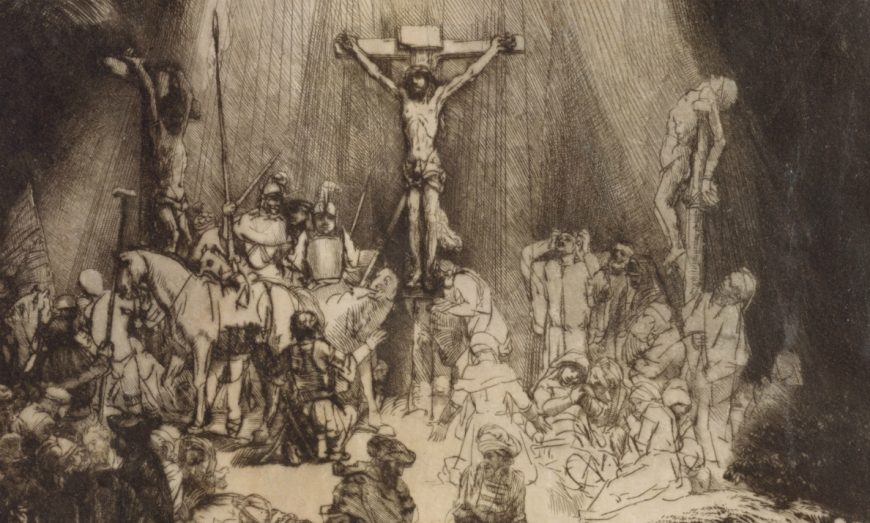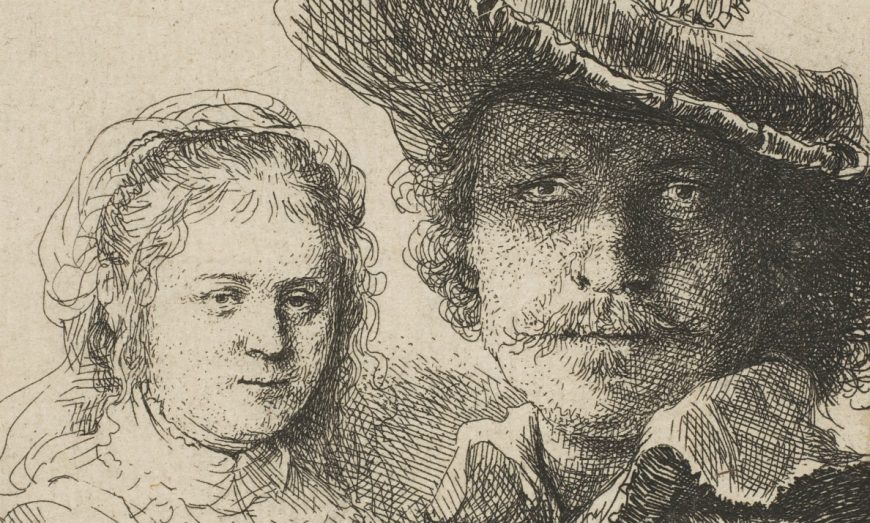
Peter Paul Rubens, Elevation of the Cross, a print by Heyndrik Withouck

Though based on of a painting, it’s clear that Rubens saw this print as an independent work of art.

Heyndrik Withouck after Peter Paul Rubens, Elevation of the Cross, 1638, engraving and etching, 61.5 x 124.5 cm (Museum of Fine Arts, Boston). Speakers: Benjamin Weiss, Leonard A. Lauder Senior Curator of Visual Culture, Museum of Fine Arts, Boston and Beth Harris

VISITFLANDERS has joined forces with Smarthistory and the Center for Netherlandish Art at the MFA Boston to bring you a series of video conversations with curators on important Flemish paintings by artists such as Jan van Eyck, Hans Memling, Peter Paul Rubens, and James Ensor.

 

Visit Flanders logo

Center for Netherlandish Art, MFA Boston logo

[music]

0:00:06.8 Beth Harris: We’re standing in the Center for Netherlandish Art at the MFA in Boston, and we’re looking at an unexpectedly large print of the Elevation of the Cross, a print after the famous altarpiece by Rubens that’s today in the Church of Our Lady in Antwerp.

0:00:22.9 Benjamin Weiss: You’ll probably recognize the subject of Christ appealing up to the heavens as the cross is being raised in this great dramatic swirl of energy. But while the print looks very much like that painting and is related to that painting, this print isn’t after that work specifically. This is actually based on another version of that composition that Rubens made 30 years after in preparation specifically for this print.

0:00:50.0 Beth Harris: And that takes us to the important subject of how Rubens saw his prints in relationship to his paintings.

0:00:58.8 Benjamin Weiss: Printmaking was really important to Rubens. The way that most people around Europe knew Rubens’ work was actually through prints as much as it was through paintings. So Rubens is very conscious of the importance that printed versions of his works are in spreading his fame and in spreading his brand. But he wasn’t much of a printmaker himself. This print is not by Rubens. It was made under his direction, very much the way that most of the paintings are actually a product of Rubens and company. It’s a brand. He’s the leader of an artistic factory producing the brand of Rubens.

0:01:33.8 Benjamin Weiss: He wants the print to look like the kind of print that he would make were he a printmaker. There’s different ways of digging a groove into a copper plate, because that’s what you’re doing. You’re taking a sharp tool, and you’re digging into comparatively soft metal to make little grooves that will hold ink. There’s an infinite number of different ways of making those lines. The printmaker who made this is not a famous printmaker. He’s basically known only for the work he did around Rubens.

0:02:02.9 Beth Harris: That makes a lot of sense to me because he’s not looking for a printmaker who has his own artistic identity and ambitions, but someone who will follow his directions. And he’s also protecting his work legally.

0:02:17.0 Benjamin Weiss: The print conveys that very message: the idea that this is a branded product, that this is in our terms a copyrighted product. And one of the fascinating things on prints of his period is little statements like this one down at the bottom right, “Cum previlegiis Regis Christianissimi Principum Belgarum et Ordinum Batavie.” So this is basically a copyright statement that Rubens, and Rubens alone, has a privilege on this image, that only he or his studio can issue this image. And he gets the privilege for a certain number of years in a certain area. And there’s a lot of copyright pirating in this period. And Rubens is trying to make sure that his brand is protected.

0:02:59.1 Beth Harris: Normally we think about prints as small and rather intimate, but here we are dealing with something else entirely.

0:03:05.1 Benjamin Weiss: Big prints like this are complicated. It’s not always clear why they were made.

0:03:09.9 Beth Harris: When I think about this composition, my mind goes to the altarpiece and its triptych format, literally three separate panels. But here that composition is brought together and of course is reversed because of the print.

0:03:25.0 Benjamin Weiss: The print is also divided into three sections, but for a different reason. If you look carefully, you can find where there are seams in the print, because this was printed from three copper plates. It would be impossible to print a copper plate this big at that time, at least. But even though the print is also a triptych, by pulling the composition together, it somehow creates a more clear definition of zones of struggle and reaction. Here on the right you get a zone of despair. Here on the left you get a zone of political triumph, perhaps. You can walk around the image without the barriers of the frame, and have a fuller emotional and psychological picture of the event.

0:04:05.9 Beth Harris: I feel much more part of this composition because we have figures on both sides looking at the center in this unified composition. The figures in the trees who look at the center, and even between some of the figures who are raising the cross, we see other onlookers.

0:04:20.0 Benjamin Weiss: It’s a large print, but in comparison to the altarpiece, it’s a small object, and you’re much closer to it than you would ever be to the altarpiece itself. So, you have the opportunity to participate in the composition in a way that you can’t quite when you’re in the church.

0:04:35.0 Beth Harris: And originally that altarpiece was meant for the Church of Saint Walburgis and was up a flight of stairs, and you would have been quite far from it and seen it in a very specific liturgical context.

0:04:47.8 Benjamin Weiss: And in that sense, though, you don’t think of Rubens as an artist of private devotion in a way a big print like this of an even bigger public altarpiece could translate into an object of more quiet devotion. At the same time, it’s also a public statement, because underneath the image is this lovely dedicatory inscription to his patron, Cornelis van der Geest, who had just died, recalling him as the oldest of friends and the most wonderful of men.

0:05:15.8 Beth Harris: It’s clear that Rubens is really thinking about this as an independent work of art, even though it is after a painting.

0:05:24.0 Benjamin Weiss: This is very much an independent work of art, just as the oil sketch is an independent work of art and the altarpiece is. Each one of them does a different job. The oil sketch in Toronto is not just black and white, it has color. And that suggests that perhaps Rubens intended it as an independent work even after it had served as a model for the print. Perhaps he even added the color after the print had been made, when the oil sketch could serve as a gift or maybe even something to sell.

0:05:51.0 Beth Harris: But perhaps that color was there because in some way Rubens is asking his engraver to translate his color into this engraving.

0:06:01.2 Benjamin Weiss: And that’s one of the most powerful reasons why we need to study works of art in the original, because when that color was applied matters. And it may tell us what Rubens’ intentions were, and what he thought the work of art was to do, and how he was trying to communicate both to his engraver but also to his audience.

[music]

Title Elevation of the Cross
Artist(s) Heyndrik Withouck after Peter Paul Rubens
Dates 1638
Places Europe / Western Europe / Belgium
Period, Culture, Style Baroque / Flemish Baroque
Artwork Type Print
Material Ink, Paper
Technique Intaglio printing, Engraving, Etching

This work at the Museum of Fine Arts, Boston

Learn more about Peter Paul Rubens’ Elevation of the Cross in the Cathedral of Our Lady, Antwerp

David Freedberg, “Prints and the Status of Images in Flanders,” Le Stampe e la diffusione delle immagini e degli stili: Atti del XXIV Congresso internazionale di storia dell’arte, 1979, volume VIII, edited by Henri Zerner (Bologna: CLUEB, 1983), pp. 39–54.

Andrew D. Hottle, “Commerce and Connections: Peter Paul Rubens and the Dedicated Print,” Nederlands Kunsthistorisch Jaarboek (NKJ) / Netherlands Yearbook for History of Art, volume 55, RUBENS AND THE NETHERLANDS / RUBENS EN DE NEDERLANDEN (2004), pp. 54–85.

Cynthia Lawrence, “Before the Raising of the Cross: The Origins of Rubens’s Earliest Antwerp Altarpieces,” The Art Bulletin, volume 81, number 2 (1999), pp. 267–96.

Cynthia Lawrence, “Rubens’s Raising of the Cross in Context: the ‘Early Christian’ Past and the Evocation of the Sacred in Post-Tridentine Antwerp,” Defining the Holy, edited by Sarah Hamilton and Andrew Spicer (London: Routledge, 2006).

John R. Martin, Rubens: the Antwerp altarpieces: The raising of the Cross, The descent from the Cross (London: Thames and Hudson, 1969).

Cite this page as: Benjamin Weiss, Leonard A. Lauder Senior Curator of Visual Culture, Museum of Fine Arts, Boston and Dr. Beth Harris, "Peter Paul Rubens, Elevation of the Cross, a print by Heyndrik Withouck," in Smarthistory, August 18, 2025, accessed December 14, 2025, https://smarthistory.org/peter-paul-rubens-heyndrik-withouck-elevation/.