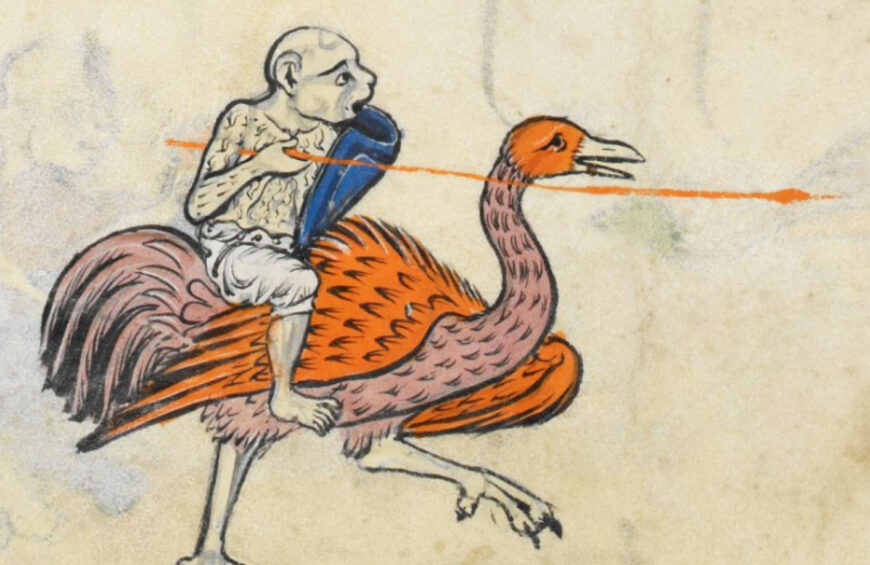
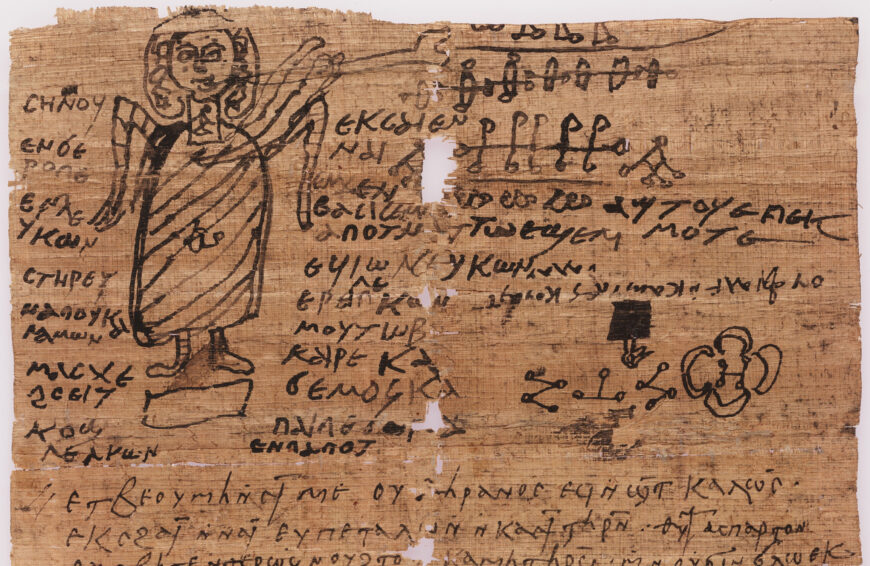
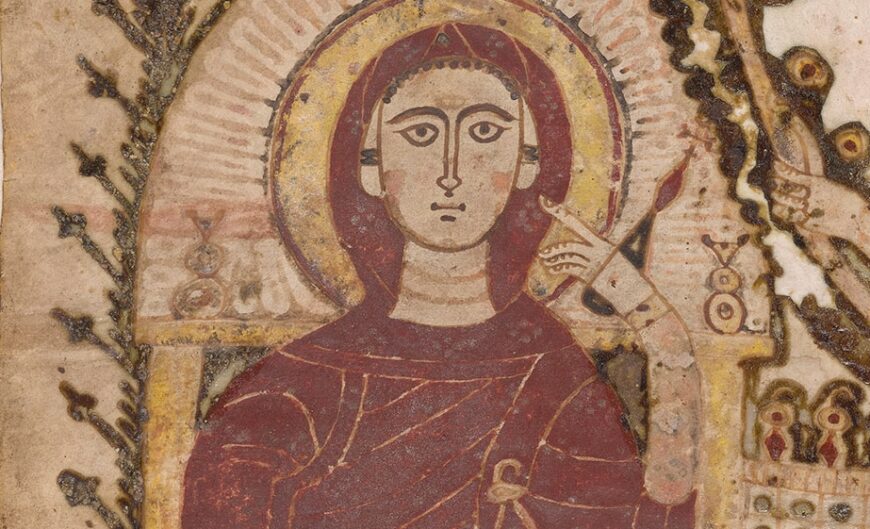
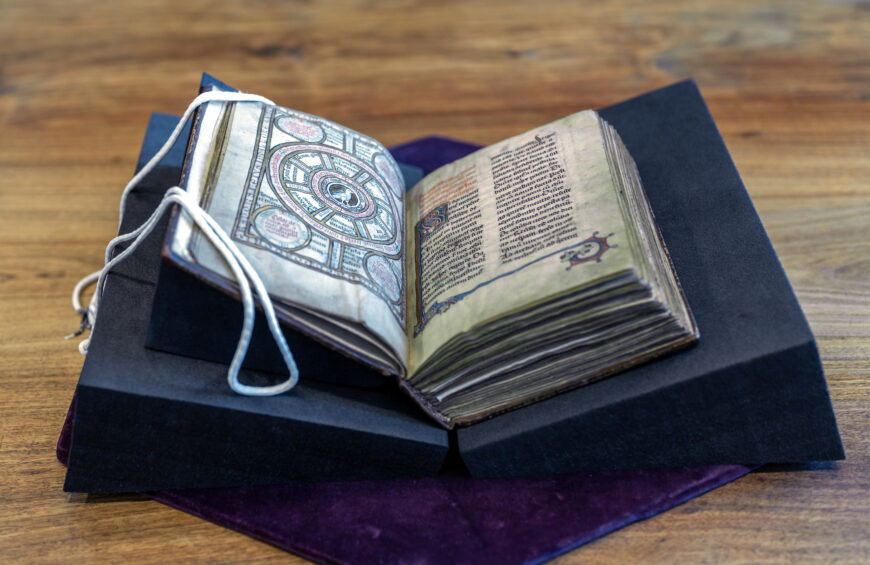
A medical prescription; a letter from a trader in India to their associate in Egypt; a receipt for the rent of a shop; a marriage contract; a doodle of a knight on horseback; the last letter written by a brother before he died at sea en route to India. [1] These snapshots of everyday life were preserved in the Cairo Geniza—a repository of hundreds of thousands of manuscript pages collected and saved over a thousand years at the Ben Ezra Synagogue in Cairo. This treasure trove opened windows into the interconnected world of the medieval Mediterranean and Red Sea regions that we are still only beginning to uncover.

Hebrew alphabet primer from the Cairo Geniza, ink on parchment (Cambridge University Library, T-S K5.13)

Amulet from the Cairo Geniza (John Rylands Library, University of Manchester, JRL Gaster ar. 38; photo: Princeton Geniza Project)
What is a geniza?
While the most famous geniza—that of the Ben Ezra Synagogue in Cairo—gave us an extraordinary archive of Jewish life from the 11th to 19th centuries, the practice itself represents something broader: a medieval approach to document preservation that transcended religious and linguistic boundaries throughout the Islamic world.
The Hebrew word “geniza” means “burying” or “burial place,” but this barely captures the dynamic nature of these repositories. The traditional explanation for the geniza’s existence stems from a Jewish religious prohibition against destroying texts bearing God’s name. Just as the human body is buried, so too should writings bearing the name of God be put aside to await burial. Yet this doesn’t fully explain what was found in the Cairo Geniza: shopping lists, magical amulets, business contracts, children’s alphabet primers, and personal letters. Perhaps the community extended this notion to all documents bearing Hebrew letters, regardless of content. But this still cannot account for the many pages written in Arabic. These interpretations cast the geniza as an accidental archive of “Sacred Trash.”
But the geniza was not merely a depository for useless, damaged materials. Manuscripts moved freely in and out of the geniza, set aside not because they were worthless, but because they might be consulted or reused, as pages with later annotations indicate. [2] Egypt’s dry climate protected these documents over centuries, preserving them under layers of dusty debris, while legends about a curse and poisonous snake guarding the geniza helped keep materials undisturbed.

Solomon Schechter examining documents from the Cairo Geniza, photographed at Cambridge University, c. 1898 (photo: Cambridge University Library)
Discovering the archive
The story of how the Cairo Geniza came to Western attention is inseparable from the colonial context of the 19th and early 20th centuries. In 1864, traveler and scholar Jacob Sapir left a vivid account of accessing the Cairo Geniza:
The shammas (guardian)… brought me a ladder to climb up to it because the Geniza is in a small chamber on the roof of the Synagogue. It is closed off on all sides without any entrance; the roof is opened from above and from there they put in or throw down old and torn scrolls. I went up by the ladder. It is full to the height of two and a half storeys… I had labored for two days and was covered with dust and loose earth… who knows what else there was underneath.Jacob Sapir [3]
The dispersal of the Cairo Geniza accelerated between 1889–92 when the synagogue’s roof collapsed. During reconstruction, the geniza chamber was emptied and its fragments spread across the synagogue’s courtyard, where manuscripts laid for weeks. An anonymous report noted pages were “mixed with rubbish heaps… buried in the ground under the synagogue… transferred to the Jewish cemetery near al-Basatin… and returned to the Genizah chamber of the newly reconstructed synagogue.” [4] During this time, geniza manuscripts circulated on the open market, reaching European collections through dealers and travelers.
In 1896, twin sisters, Agnes Lewis and Margaret Gibson—accomplished biblical scholars—brought a fragment from these circulating materials to Solomon Schechter, their colleague at Cambridge University and renowned scholar of Rabbinics. The remarkable fragments, a lost Hebrew original of the book of Ben Sira, prompted his now-famous expedition to Cairo to “discover” the hoard and bring the largest corpus of fragments—roughly 193,000—to Cambridge University Library. Although perhaps the most famous, Schechter was neither the first nor the only scholar involved in this mass extraction. Fragments from the Cairo Geniza are now found worldwide, from collections at Princeton University and the Jewish Theological Seminary in New York, to the National Library of Russia, and the Hungarian Academy of Sciences, among so many others.

Tiraz fragment, 1021–36 (Fatimid; Egypt), linen and silk, 27.3 x 63.5 cm (The Metropolitan Museum of Art, New York)
The geniza and art history

Fragment of a marriage contract, with top register of Arabic calligraphy (Kufic) and below that a band of floriated and animal motifs, from the Cairo Geniza (Cambridge University Library, T-S K10.12)
For art historians, the Cairo Geniza offers far more than text. Among the papers and parchments were illuminated manuscripts, decorated legal documents, and even the carved dedicatory and liturgical inscriptions that once adorned the synagogue’s walls. One remarkable find is an illuminated Fatimid marriage contract featuring bands of monumental Arabic calligraphy repeating “al-mulk lillah” (sovereignty is God’s) and inhabited scrolls—animals, including a rabbit, oryx, and bird, connected by vegetal motifs, with traces of gold leaf. The text and ornament resemble contemporaneous tiraz textiles and woodcarvings. Such documents reveal how artistic ideas moved across varied media.
The geniza also preserves evidence of artistic production, workshop practices, and trans-regional trade. A 12th-century marital contract records the precious commodities in a wealthy bride’s dowry: gold, silver, amber, pearl, and niello jewelry, peacock pins, crystal, porcelain, copper, and ivory vessels, and textiles with golden threads, and so much more. [5]

Magical amulets to protect against scorpions, designed to be worn rolled up in an amulet case around the neck, from the Cairo Geniza (Cambridge University Library, T-S AS 143.26; photo: Princeton Geniza Project)
One document reveals a family’s storeroom, containing objects imported from across the world: Andalusian cloths, a turban from Southern Morocco, a Sicilian robe, a mat from Southern Iran, and an Iraqi gown. [6] Another document tells of a workshop in Cairo where a Jewish weaver employed Muslims, Jews, and a Jewish convert to Islam, revealing Jews as artists as well as evidence of collaboration between craftspeople of different faiths. [7]
Beyond art history, the pioneering work of S. D. Goitein, whose six-volume A Mediterranean Society transformed our understanding of this interconnected medieval world, established the Cairo Geniza as one of the most important sources for Mediterranean and Islamic studies. The geniza revolutionized our understanding of medieval society across many fields. Letters written by women provide unprecedented insight into women’s history; maritime documents detail shipping routes across the Mediterranean and Indian Ocean; legal documents illuminate Jewish and Islamic law as actually practiced; religious texts preserve lost liturgical practices; poetry collections reveal sacred and secular literary traditions, including wine songs, love poems, and philosophical verses; medical texts show scientific knowledge exchanged across cultures. From grand narratives to intimate details, these documents deepen our understanding of the life of Jews in medieval Islamic society, and crucially, of the Islamic society in which they lived.

View of maqsura, Great Mosque of Kairouan (also spelled Qayrawan), Tunisia, c. 1904 (Library of Congress, Washington, D.C.)
A shared medieval practice
The Cairo Geniza, while extraordinary in its scale and preservation, was not unique even among Jewish repositories. Jewish communities throughout Egypt and across the medieval world maintained genizot (plural)—and continue to do so today. Islamic tradition similarly developed practices of burning, washing, shredding, and burying worn-out texts, also theorizing them as analogous to human bodies deserving of respectful burial.
But the widespread collection in both Jewish and Islamic spaces of precious manuscripts and materials related to daily life—clearly outside the bounds of sacred texts—suggests these sites were guided less by religious injunctions than by a broader documentary economy. These repositories represented one stage in a document’s lifecycle—a temporary limbo where materials were preserved and might be reused, a practice shared across religious communities.

Bifolium from the “Nurse’s Qur’an” with Sura 6 (al-An‘am, “The Cattle”), verses 40–41, 48–49, c. 1019–20 (Tunisia), ink, opaque watercolor, and gold on parchment, 44.5 x 60 cm (The Metropolitan Museum of Art, New York)
In 1896, the same year Solomon Schechter entered the Ben Ezra Synagogue’s geniza, Muhammad Bek Bayram VI, a local dignitary, visited the Great Mosque of Kairouan in Tunisia. Within the mosque’s maqsura (a special enclosure) and adjacent storerooms, he discovered magnificent manuscripts, including the 11th-century Nurse’s Qur’an, a gift from the Sultan’s nursemaid to the Mosque, and possibly folios from the famed Blue Qur’an with its gold calligraphy on indigo-dyed parchment, along with other precious manuscripts, legal texts, and religious works. Bayram wrote:
All these packages consist of parchments of gazelle skin, written by a beautiful hand in Kufic script, and adorned with the most wonderful ornaments and colors… When I saw these packages, opened them, and searched through them, my heart stopped at what I found. Muhammad Bek Bayram VI [8]

Qubbat al-Khazna (Dome of the Treasury) at the Great Mosque of Damascus (photo: Erik Shin, CC BY-NC 2.0)
Damascus’ Great Mosque also housed materials too fragile for circulation or fallen from use in the Qubbat al-Khazna (Dome of the Treasury)—an octagonal structure decorated with mosaics standing on Roman columns in the courtyard. In the 1890s, Edward Thomas Rogers, a British diplomat, caused a scandal when he opened the treasury. Along with Arabic manuscripts, including Qur’ans, Hajj certificates, and documents relating to daily life, he also found Jewish, Christian, and Samaritan texts in a variety of scripts and languages: Greek, Hebrew, Latin, Coptic, Syriac, and Armenian. Following a fire in 1893, most Arabic manuscripts were transported to the Museum of Turkish and Islamic Arts in Istanbul, though the whereabouts of many of the Damascus manuscripts remain unknown—a testament to these chaotic extractions.

Great Mosque of Sanaʿa, Yemen, 715 (Umayyad) (photo: lelebella, CC BY 2.0)
In Yemen, at Sanaʿa’s Great Mosque, manuscripts stuffed above the mosque’s ceilings were exposed when the roof collapsed. These included primarily Qur’ans from the early Islamic period, among them an 8th-century fragment bearing architectural illustrations with arcades from which hang mosque lamps—valuable evidence for understanding early Islamic architectural representation.

Frontispiece from the “Great Umayyad Qurʾan,” 710–715 Umayyad) (Dār al-Makhṭūṭāt, Sanaʿa, DAM 20-33.1)
Preservation, study, and modern technology
As Solomon Schechter wrote after encountering the Cairo Geniza: “I cannot overcome a sad feeling stealing over me, that I shall hardly be worthy to see all the results which the Geniza will add to our knowledge of Jews and Judaism. The work is not for one man, and not for one generation.” [9] His words proved prescient. We are still uncovering the secrets of the Cairo Geniza and other similar collections.

Multispectral image of a letter from the Cairo Geniza (Cambridge University Library, T-S 12.122)
Modern technology, like multispectral imaging, has revealed faded text invisible to the naked eye and palimpsests—manuscripts where one text was written over another. Through initiatives like the Princeton Geniza Project and the Friedberg Genizah Project, the digitization of seemingly minor scraps to the most precious manuscripts has reunited fragments scattered across continents and created opportunities for comparative study which were previously impossible. Each newly deciphered fragment or reunited manuscript adds another piece to our understanding of medieval life.