


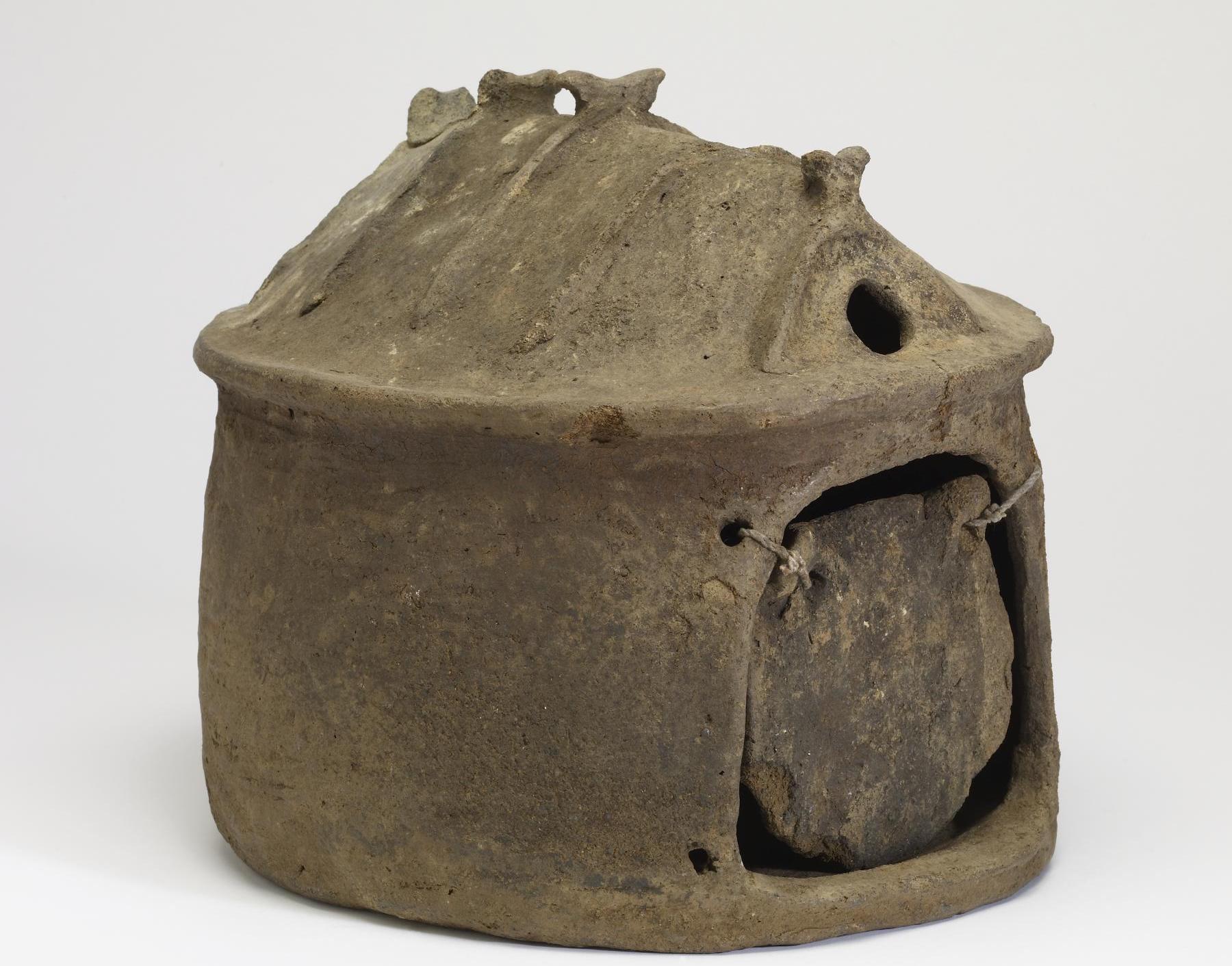
Hut Urn, 8th century B.C.E., ceramics, 22 x 23 x 28 cm (The Walters Art Museum, Baltimore)
In the Italian peninsula, with the conclusion of the Final Bronze Age, settlements were generally small and likely organized along kinship lines. The Early Iron Age witnessed several social and economic phenomena that together altered the trajectories of settlements, the nature of communities, and the organization of society overall. Household archaeology shows a fairly consistent type of dwelling—the Iron Age “hut.”
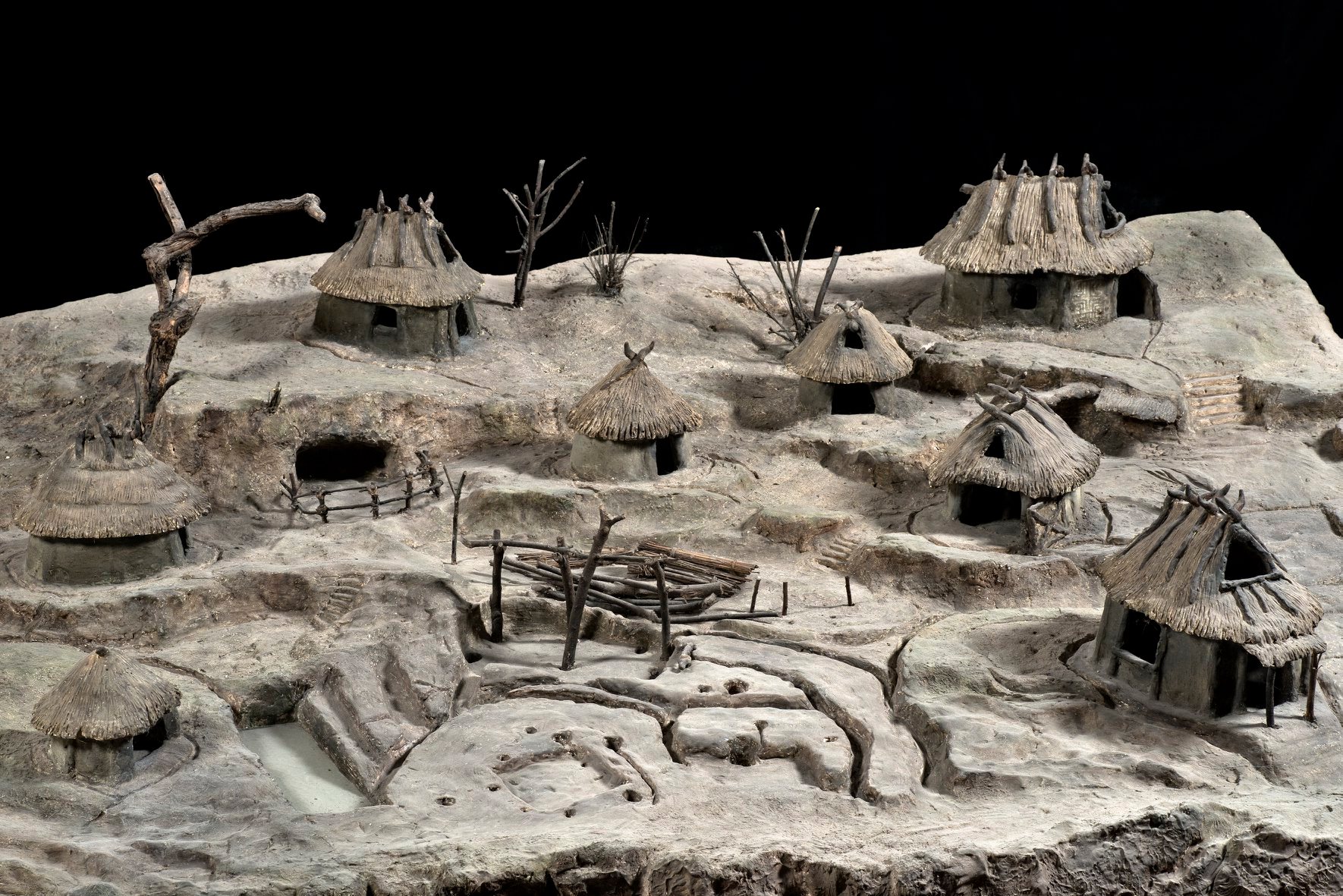
Model of Ancient Roman hut village, c. 9th–7th century B.C.E. (Palatine Museum, Rome)
These structures were often ovoid in their ground plan, with sunken floors of pounded earth, walls of wattle-and-daub, and thatched roofs. Such huts served not only as shelter but also as centers of daily life—cooking, storing, and processing food all took place in fairly cramped spaces.
In Central Italy, the 8th century B.C.E. bears witness to several important changes that are reflected not so much in our fragmented evidence for settlements but more so in the record of tombs documented archaeologically. These changes seem to indicate a shift toward a more rigid and ranked ordering of the communities of living people, and these changes came to be reflected in the commemorative practices used to bury the dead. Some tombs would become the center of burial clusters, indicating that the deceased person’s status was important and perhaps remained so post-mortem. Another shift is in the deposition of objects with the deceased, known as grave goods, that seem to suggest that socio-economic rank passes from one generation to the next and that material objects signify this status.
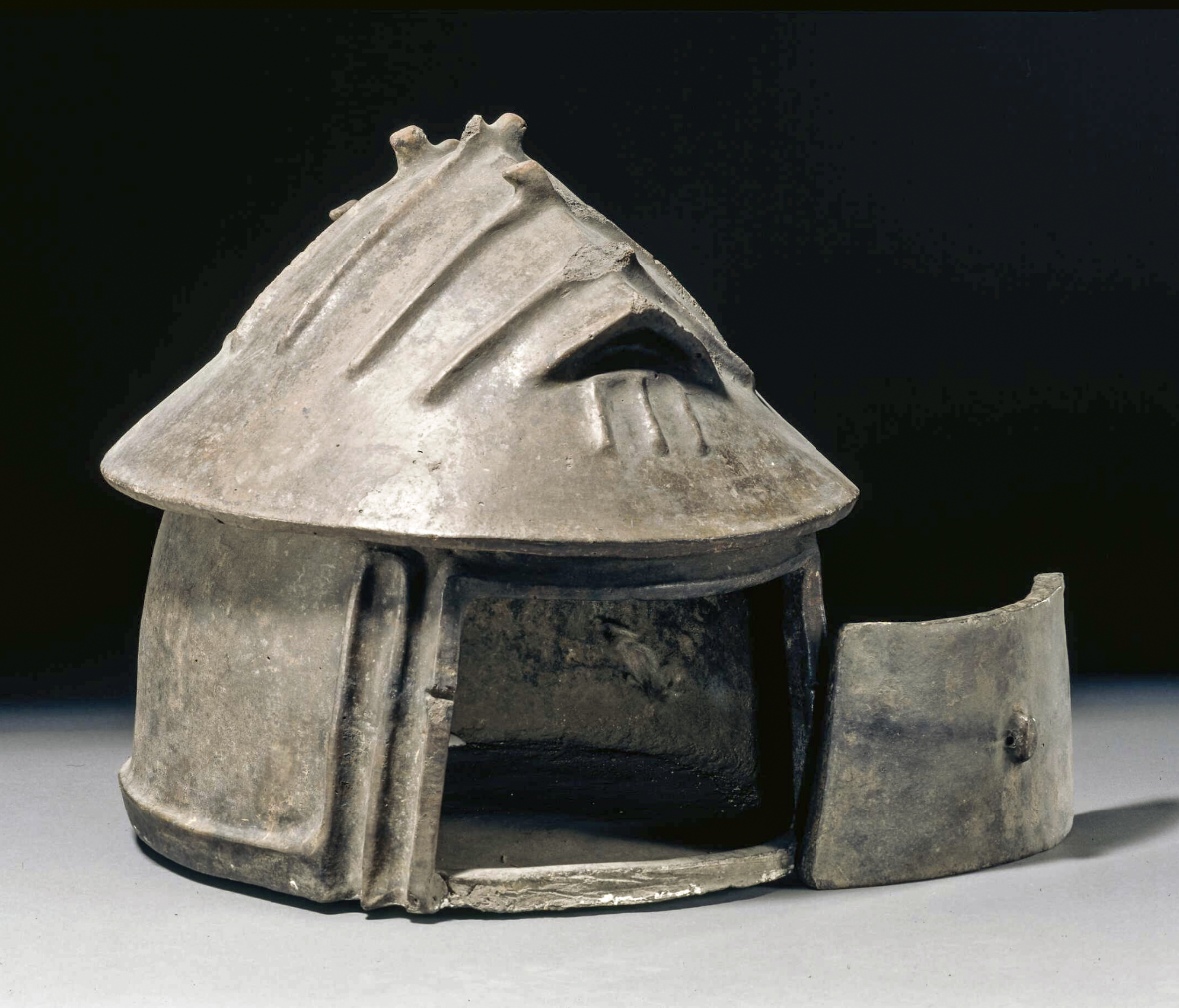
Hut Urn, c. 9th century B.C.E., ceramic, 33 x 38.1 cm (© The Trustees of the British Museum, London)
An urn as a status symbol
The hut urn currently housed in the collections of the British Museum is a good representative of this class of object. While no two of these urns are identical, they tend to be fairly consistent. The majority of them are made of terracotta and are hand-built (as opposed to being manufactured on the potter’s wheel). These urns, along with most contemporary Early Iron Age pottery in Italy, are hand-modelled using clay that contains a good deal of silica. The firing process results in vessels that are often dark in color, and this type of terracotta has acquired the name “impasto.”
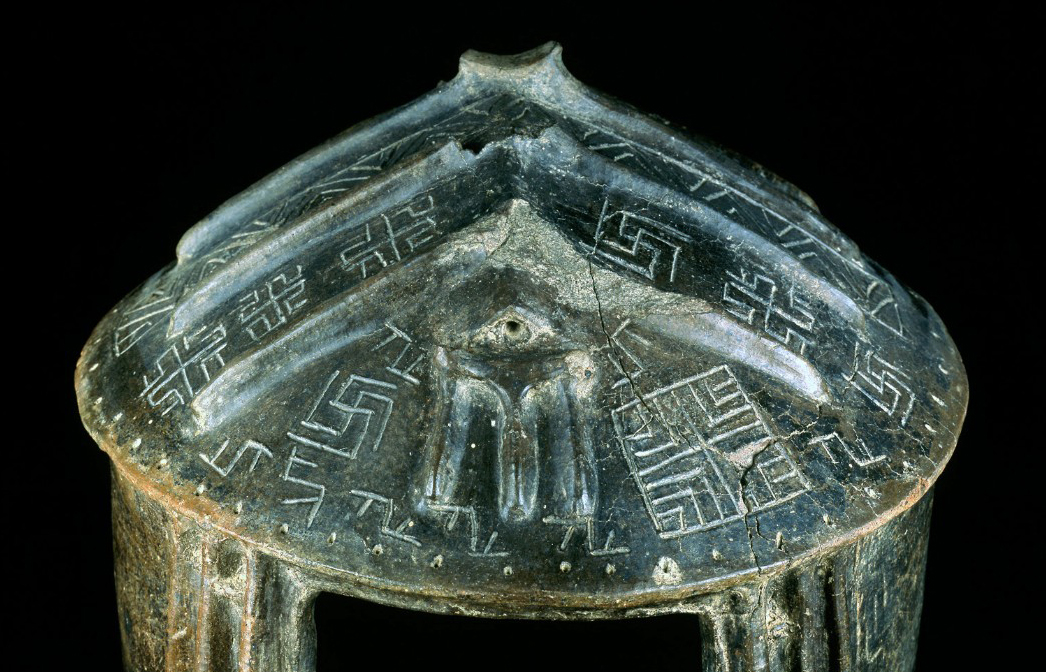
Incised decorations on surface (detail), Hut-shaped Urn, 900–850 B.C.E., ceramic, excavated from Castel Gandolfo, 27 x 29 x 30 cm (The Vatican Museums, Rome)
Sometimes the surface of the urn carries incised decoration, usually these are geometric patterns, such as those decorating the hut urn from Castel Gandolfo, Italy. These angular patterns, including meanders and swastikas, are typical of Geometric-period ceramic manufacture in the Mediterranean.

Contents of tomb 137 including a hut urn, excavated from Osteria dell’Osa, early 9th century B.C.E. (Museo Nazionale Romano, Terme di Diocleziano, Rome; photo: Dr. Daniel P. Diffendale, CC BY-NC-SA 2.0)
In examples of hut urn burials discovered in situ (in their original location), such as those from the archaic cemetery known as the Sepolcretum in the valley between the Palatine and Capitoline Hills in Rome, we are reminded that the urns are only one part of the grave assemblage. The hut urn serves as the cinerary container and is accompanied in the burial by other implements, including sets of terracotta containers and implements.
The remarkable thing about the hut urn as a type of funerary object is not its function, as ceramic containers used to deposit the ashes of decedents in Early Iron Age Italy are nearly ubiquitous. The remarkable thing is their form. Since numerically this type of urn is in the minority of known examples, it allows us to speculate as to what dictates this form. Since the general shape and model of the ceramic hut urns conform to known archaeological examples of Iron Age huts, scholars speculate that the individuals whose remains are deposited in hut urns enjoyed special status during their lifetimes and that this status carried over into the afterlife. It is possible that these individuals were at the head of familial or kinship networks, or perhaps they were propertied individuals.
Regardless of the interpretation adopted, the hut urns make clear that funerary customs among both Latin and Etruscan speakers were essential mechanisms for demonstrating and reinforcing personal status within the community.


