

This Swiss-born artist painted Roman stories with moralizing messages. Here, Cornelia provides a model of virtue.
Angelica Kauffman, Cornelia, Mother of the Gracchi, Pointing to Her Children as Her Treasures, c. 1785, 101.6 x 127 cm (Virginia Museum of Fine Arts, Richmond). Speakers: Dr. Beth Harris and Dr. Steven Zucker
Dr. Beth Harris: We’re in the galleries at the Virginia Museum of Fine Arts looking at one of their most important paintings. This is such a fascinating work from the end of the 18th century and by a woman artist, Angelica Kauffman, who was a history painter, something very rare for women artists.
Dr. Steven Zucker: And she was phenomenally successful as a professional artist, which required her to navigate a very complicated political and social landscape. But let’s begin with the painting.
Dr. Beth Harris: So we have a story of an ancient Roman woman. Her name is Cornelia. She’s standing here at the center on her left holding the hand of her daughter, Sempronia, and with her right hand gesturing to her two sons. The older one, Tiberius, was known to be mild-mannered in the sources from ancient Rome, and the younger brother more impetuous. Both brothers will grow up to be reformers in the politics of the ancient Roman Republic. To her left sits a woman who’s dressed in very rich red clothing and wearing jewelry, who seems to be showing Cornelia her jewels. And the friend asks Cornelia, where are your jewels? And Cornelia points to her sons and says, “These are my jewels.” So Cornelia has the right values that rearing her children, educating her children, is so much more a value than the jewelry displayed by her friend.
Dr. Steven Zucker: The little Sempronia seems so enchanted by the jewels. She’s looking down and taking hold of the pearls and seems completely enchanted.
Dr. Beth Harris: And I think there’s another juxtaposition between the jewelry box and the sewing box. So we have these humble domestic tools compared with these ostentatious jewels.
Dr. Steven Zucker: Cornelia is painted in such opposition to the woman who is seated. First of all, she’s upright, almost like the pillars behind her. She’s dressed in white. But look at the neckline. It’s straight as opposed to the curve of the woman who’s seated beside her. Cornelia is represented as an image of rectitude, a moral center in this painting. There’s even a distinction between the activity of the seated woman that is in contrast to the sense of quiet stillness that Cornelia represents.
Dr. Beth Harris: The uprightness of her body, the way the drapery falls almost like the fluting of a column, projects her confidence about her role as a mother. And in fact, we know that in the ancient Roman Republic, a statue was erected in honor of Cornelia and her dedication to the education of her children.
Dr. Steven Zucker: So Cornelia was an important symbol in ancient Rome and then again in Europe in the 18th century.
Dr. Beth Harris: Artists, writers, Enlightenment thinkers looked back to the ancient Roman Republic as this period of civic virtue, raising ideas of what is a virtuous kind of government. And here we are in between the American Revolution and the French Revolution, which will ultimately bring about a republic in France.
Dr. Steven Zucker: The United States was founded on the Roman ideal of a republic. And so these are ideas that are being discussed in Britain. They’re ideas that are being discussed on the continent. And at this moment, they’re actually being enacted in the young United States. And so, this painting would have been an opportunity to discuss these issues, to discuss the kind of moral foundation upon which a state should be founded. The figures are set in this grand architectural space. And there’s a lovely way that the angle formed by the architecture creates a separation between the female figures on the right and the male figures on the left.
Dr. Beth Harris: And Enlightenment thinkers like Rousseau held that men were able to make the kinds of sacrifices that were necessary for the good of the republic, but that women were incapable of those kinds of sacrifices because for them, family came first. But what the story of Cornelia so brilliantly did was to show that women could serve the needs of the state by being exemplary mothers. The really fascinating thing is that although these examples of virtue drawn from ancient history did serve the needs of the revolutionaries, it also could serve the needs of Angelica’s varied patrons from the English businessman, George Bowles, who commissioned this painting, to the Queen of Naples. And she painted a version of Cornelia for the Queen of Naples. So these examples of virtuous behavior could really be adopted by anyone along the political spectrum.
[music]
A moment of moralizing
To the artists of eighteenth-century Europe, it was not enough to simply paint a beautiful painting. Yes one could marvel at your use of colors, proportions, and how masterfully you draped the fabric on your figures, but this was just not enough. The story that is represented must also improve the viewer and impart a moralizing message. This was a common theme even before the emergence of the Neoclassical trend (for example, Chardin’s canvases of simple French country life or Hogarth’s painted commentaries on the wealthy classes of England). When interest in the ancient cultures of the Mediterranean—more specifically Rome—arose in the mid eighteenth century the moralizing theme segued to also include stories from classical antiquity.
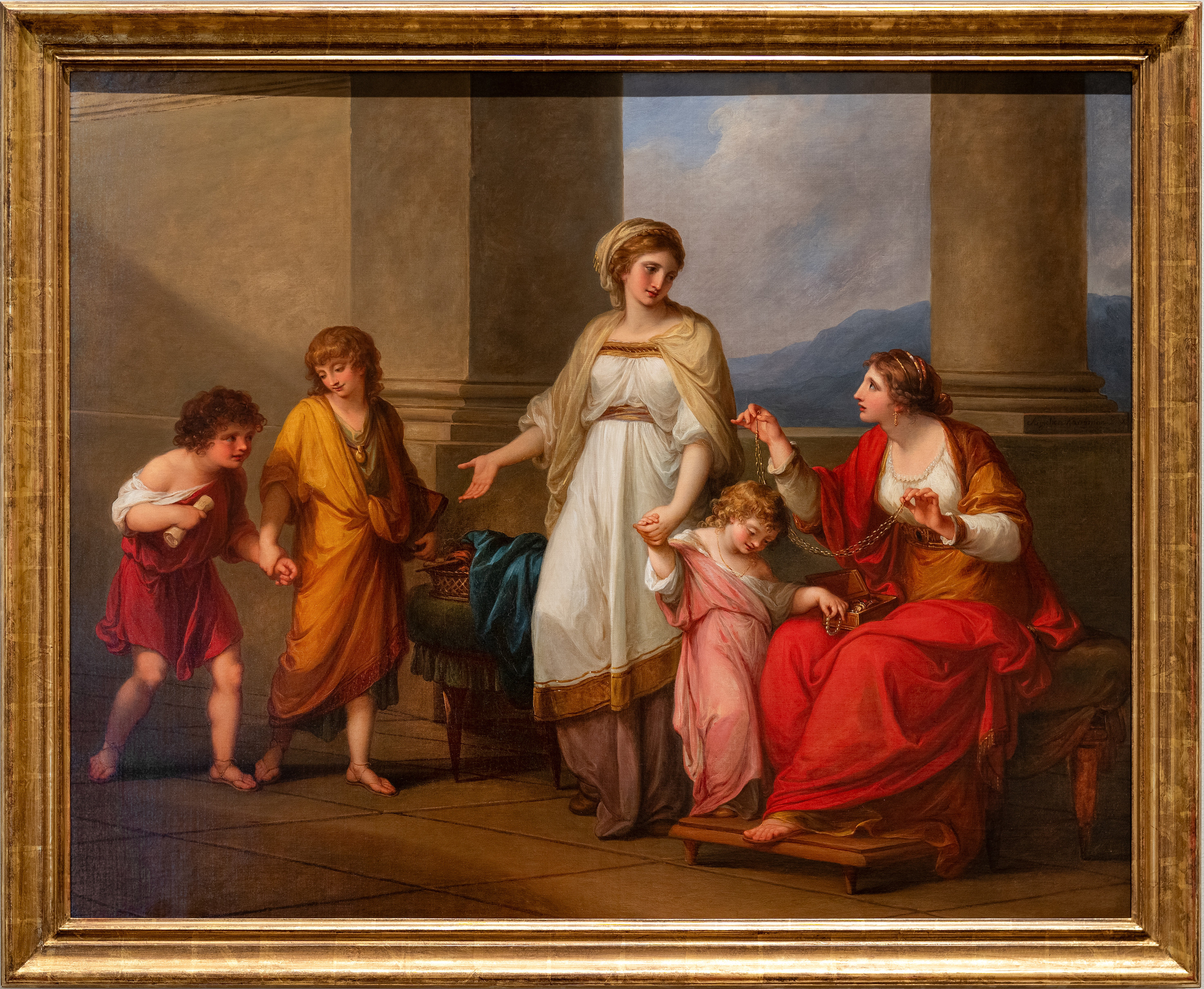
Angelica Kauffmann, Cornelia, Mother of the Gracchi, Pointing to her Children as Her Treasures, c. 1785, oil on canvas, 40 x 50 inches (Virginia Museum of Fine Arts; photo: Steven Zucker, CC BY-NC-SA 2.0)
The Swiss-born painter Angelica Kauffmann is just one artist to contribute to this genre. Painted in 1785, Cornelia, Mother of the Gracchi, Pointing to Her Children as Her Treasures, is her subject. Roman architectural influences frame two women portrayed wearing what one can imagine is typical of ancient Roman dress, along with three children, also wearing masterfully draped togas with thin leather sandals. They look like they might have stepped directly off a temple’s pediment.
An example of virtue
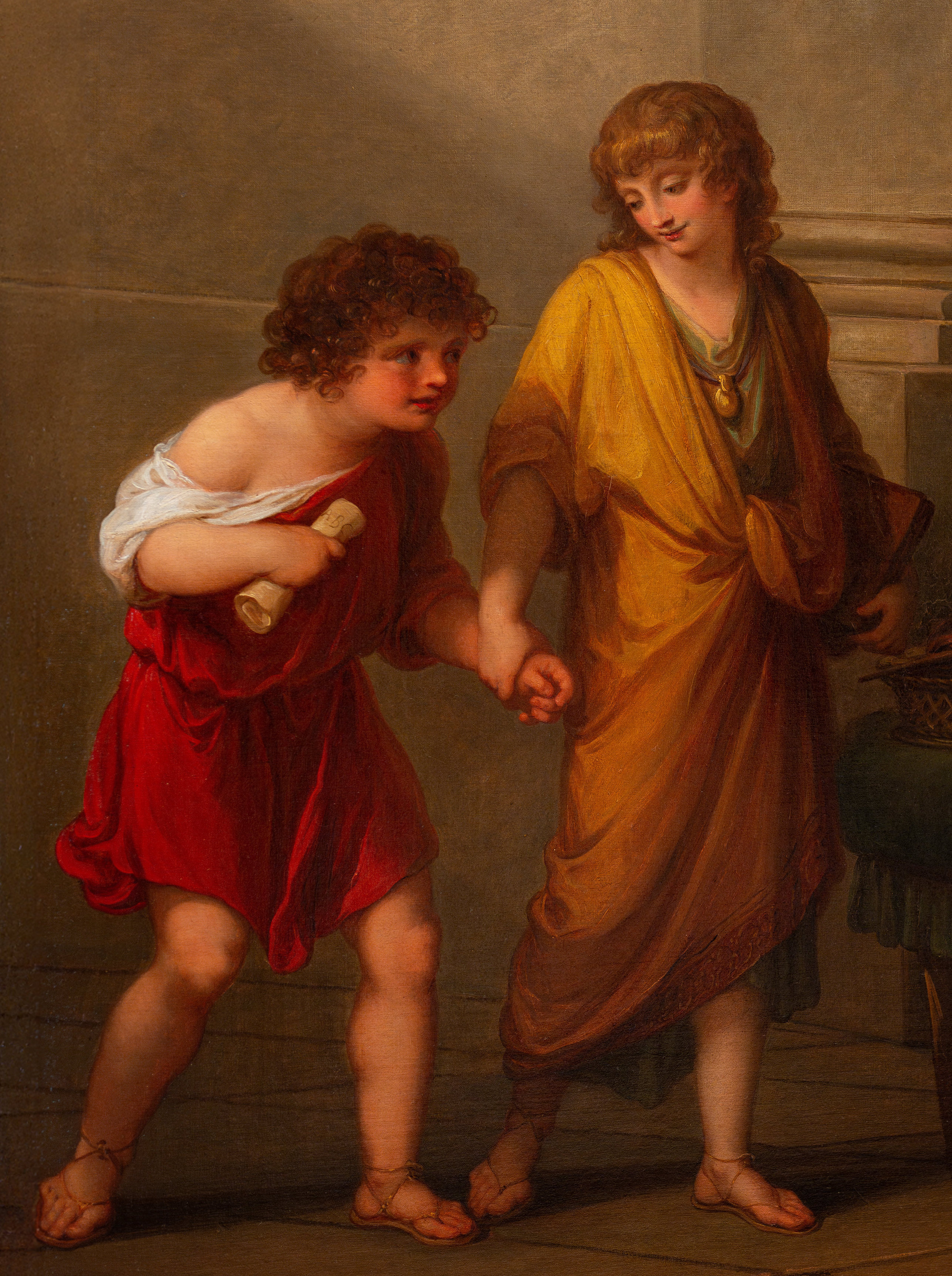
Tiberius and Gaius Gracchus (detail), Angelica Kauffmann, Cornelia, Mother of the Gracchi, Pointing to her Children as Her Treasures, c. 1785, oil on canvas, 40 x 50 inches (Virginia Museum of Fine Arts; photo: Steven Zucker, CC BY-NC-SA 2.0)
If you compare Kauffmann’s simple presentation to the previous Rococo genre, with the lush landscapes, frothy pastel pink frocks, and chubby frolicking cherubs, it is clear that art is going in a different direction. This painting is an exemplum virtutis, or a model of virtue. The story that Kauffmann painted is that of Cornelia, an ancient Roman woman who was the mother of the future political leaders Tiberius and Gaius Gracchus. The brothers Gracchi were politicians in second-century B.C.E. Rome. They sought social reform and were seen as friends to the average Roman citizen. So where did these benefactors of the people learn their exemplary ethics? That would be their mother, Cornelia.
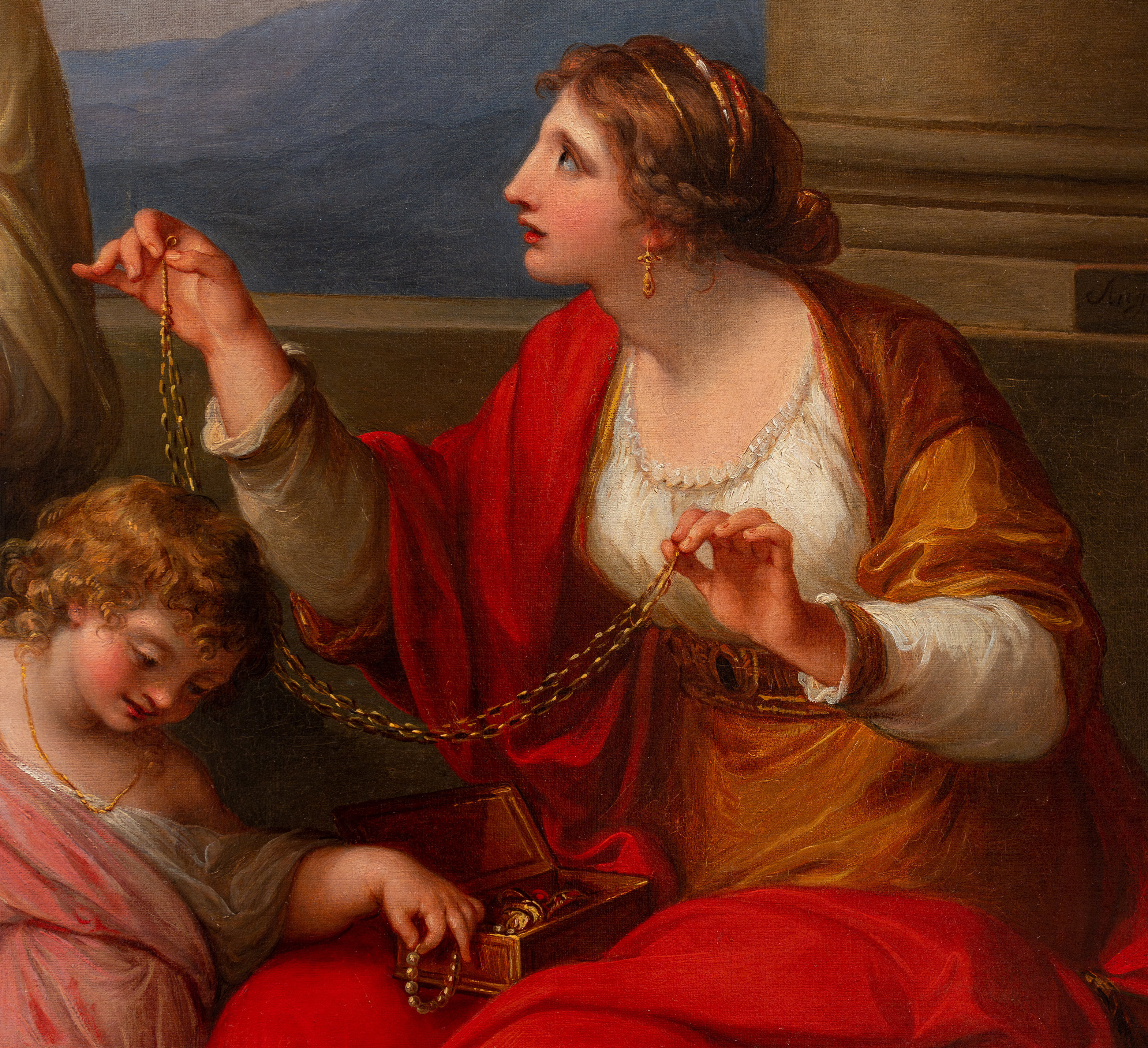
Cornelia with child and jewelry (detail), Angelica Kauffmann, Cornelia, Mother of the Gracchi, Pointing to her Children as Her Treasures, c. 1785, oil on canvas, 40 x 50 inches (Virginia Museum of Fine Arts; photo: Steven Zucker, CC BY-NC-SA 2.0)
The scene that we see in Kauffmann’s painting illustrates one such example of Cornelia’s teachings. A visitor has come to her home to show off a wonderful array of jewelry and precious gems, what one might call treasures. To her visitor’s chagrin, when she asks Cornelia to reveal her treasures she humbly brings her children forward, instead of running to get her own jewelry box. The message is clear; the most precious treasures of any woman are not material possessions, but the children who are our future. You can almost feel the embarrassment when you look at the face of the visitor, who Kauffmann has smartly painted with a furrowed brow and slightly gaped mouth.
The lure of ancient Rome
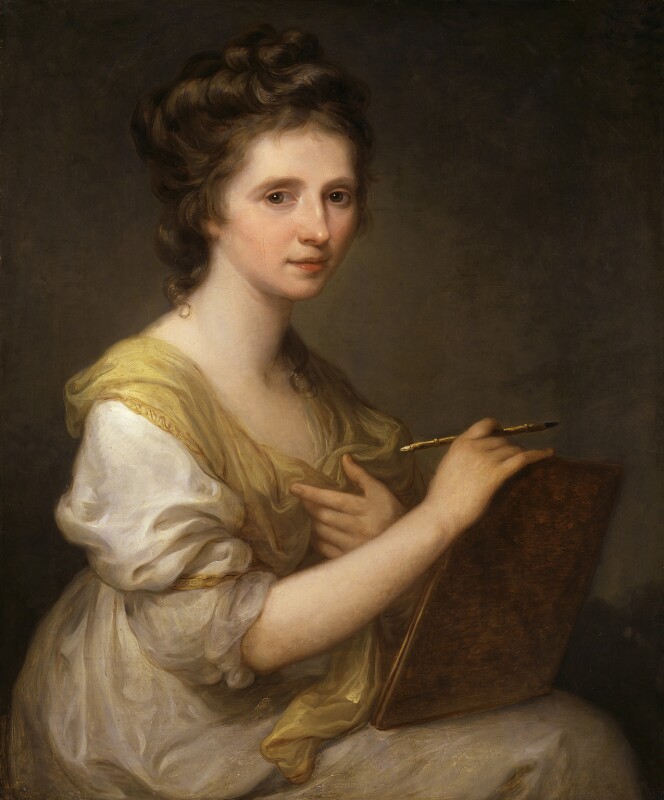
Angelica Kauffmann, Angelica Kauffmann, c. 1770–75, oil on canvas, 73.7 x 61 cm (National Portrait Gallery, London)
Born in 1740, Angelica Kauffmann received a first-rate artistic education from her father, who was a Swiss muralist. She traveled through her native Switzerland, Austria, and eventually Italy where she was able to see the work of the ancient artists with her own eyes. She was following in the tradition of the Grand Tour, the educational excursion that many wealthy Europeans took to marvel and study the art, architecture, and history of ancient Rome.
The interest in ancient Mediterranean cultures was fueled not just by the cultural productions of Rome, but also by the newly discovered remains of the ancient Roman cities of Herculaneum and Pompeii, which were excavated beginning in 1738 and 1748, respectively. Covered by the volcanic ash of Mount Vesuvius in August 79 C.E., an almost perfect scene of typical ancient life was preserved. These findings did not just spark a renewed interest in classical antiquity in eighteenth-century art and architecture, but also inspired new fashions, interior design, and even gardens and tableware. This was a find that one must see in person, and Angelica Kauffman was lucky enough to take the Grand Tour like so many of her fellow artists.
Enlightenment ideals
While the geometric symmetry and simplicity of the arts in antiquity might have greatly inspired the work of Kauffman and other Neoclassical artists, these ancient societies also aligned with Enlightenment ideals, which were often seen as the zenith of human civilization. Greece and Rome—it was felt—were the cultures that gave us the enlightened political systems of democracy and republicanism, as opposed to the modern monarchies, which would be increasingly criticized as corrupt and arbitrary in the mid and late eighteenth century. The ancients could instruct modern audiences in patriotism, civic virtue, and ethics, and Kauffmann’s moralizing message is a wonderful example of this trend.
This revival of classical antiquity was a cultural phenomenon that affected not just artistic practices, but also shaped the modern mind. Angelica Kauffman would eventually settle in England where she enjoyed great success as a portrait artist and history painter. In an age that can be described as patriarchal at its best and chauvinistic at its worst, Kauffmann played a major role in the British art scene. She was a regular exhibitor at the prestigious Royal Academy and had many aristocratic and even royal patrons. Cornelia Pointing to Her Children as Her Treasures is truly one of Kauffmann’s most famous treasures, and permanently positioned her as a pioneer of the Neoclassical movement.