


Nativity (or crèche) scenes from the Middle Ages to today often include three kings (or magi) bringing gifts to the infant Jesus. Often, these scenes include a Black king, sometimes referred to by the name Balthazar (his two traveling companions are known as Caspar and Melchior). European Christian tradition often referred to Balthazar as coming from Africa, and maps from the time reveal a combination of fantasy, desire, and lived encounters with Africa and African people.
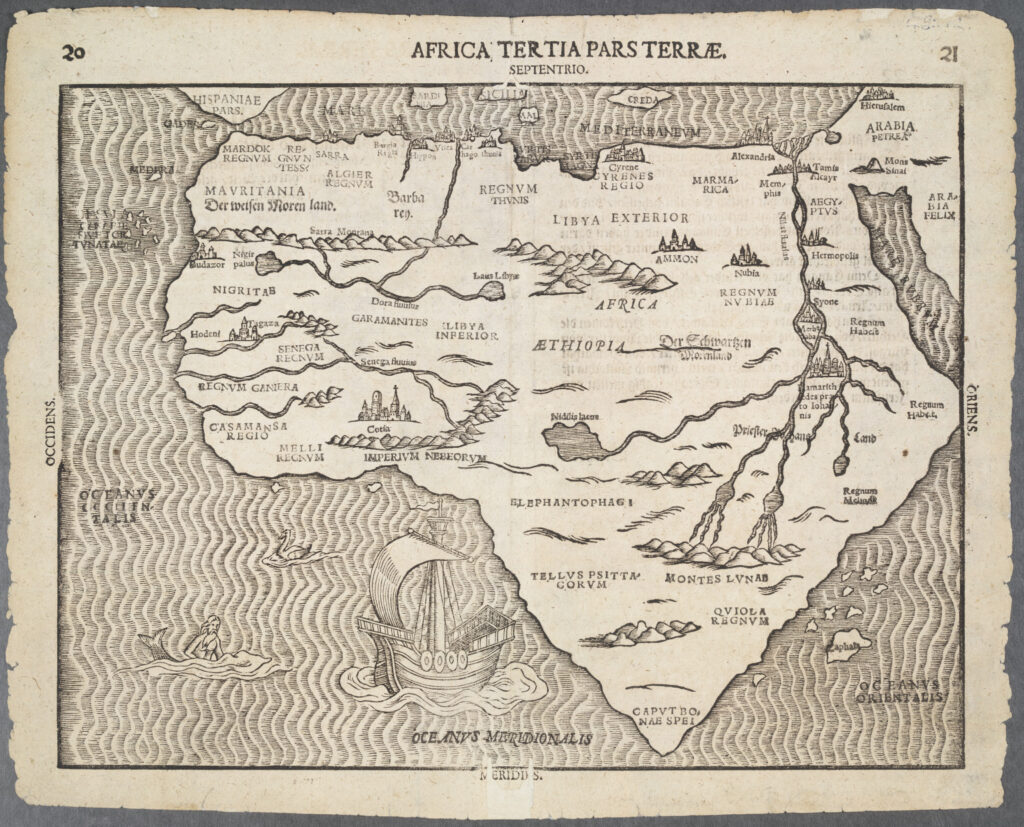
Heinrich Bünting’s Map of Africa from Travel through Sacred Scripture, Magdeburg, Germany, 1597 (Courtesy of Dr. Oscar I. Norwich Collection of Maps of Africa and its Islands, 1486 – ca. 1865, David Rumsey Map Center, Stanford Libraries).
In 1597, German Protestant scholar and cartographer Heinrich Bünting designed a map of Africa marked by both real and imagined kingdoms. In West Africa, we encounter the realm of the Muslim king Mansa Musa of Mali, who was famous for wealth and piety. Mediterranean North Africa features numerous cultures, including kingdoms in Tunis and Egypt (visible on the map above). In East Africa, near the horn of the continent, we read the name of the legendary Christian king Prester John, who was said to reign in Ethiopia or India—reflecting Europeans’ imprecise understanding of world geography at the time. Beginning in the 1440s, Portuguese sailors embarked on searches for Prester John and his mythical kingdom, violently enslaving non-Christian Black Africans along the way.
The mythical Prester John and images of Balthazar reveal European fantasies about Africa and the wealth of kingdoms there. Below we look at three rulers from premodern Africa, each of whom had a major impact on the politics, economy, religion, and culture of the time. We also wish to acknowledge the presence of free Africans living in Europe during this period.
The continent of Africa is vast and was home to more kingdoms than premodern Europeans imagined, and to more than we’re exploring here. While histories of Afro-European contact have traditionally focused on the three faiths of Judaism, Christianity, and Islam, Africa was home to many other literate and oral religions and traditions.
Mansa Musa: the wealthiest Person in the history of the world
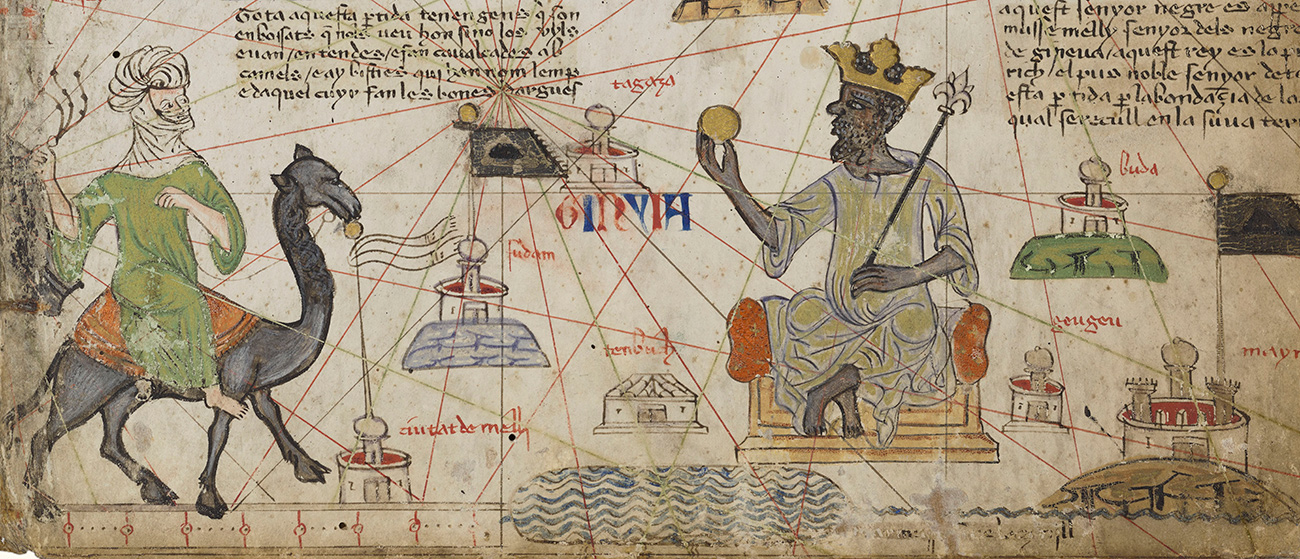
Mansa Musa and the Sahara Desert in the Catalan Atlas of Abraham Cresques, 1375, made in Majorca, Spain (Paris, Bibliothèque nationale de France, Ms. Espagnol 30, fol. 5v.)
The detail of the map above was created by the Spanish Jewish cartographer Abraham Cresques. It contains a rare medieval depiction of Mansa Musa, who ruled the West African Mali Empire, a territory the covered parts of present-day Mauritania and Mali, from 1312 to 1337. Mansa Musa’s holdings in gold were so great that to this day he is unsurpassed in personal wealth.
A pious Muslim who embraced charitable almsgiving as one of the five pillars of Islam, Mansa Musa made the hajj (pilgrimage) to Mecca with an entourage reportedly consisting of 60,000 subjects, 80 camels, and thousands of pounds of gold dust. His donations to the poor and diplomatic gifts along the way pumped so much gold into the economy of the Mediterranean that it devalued gold currency in the wealthy European mercantile cities such as Florence for decades.
The 14th-century Arab scholar Ibn Fadl Allah al-Umari lived in Cairo at the time and later reported on the ruler in his encyclopedia: “This man flooded Cairo with his gifts. He left no court emir nor holder of a royal office without the gift of a load of gold. The people here profited greatly from him and from his entourage in buying, selling, giving, and taking. They traded gold until these lessened its value in Egypt, making its price fall…”
Mediterranean diplomacy with Muslim African rulers
Italian artists from Florence to Venice traveled frequently throughout the Mediterranean to broker political, religious, and mercantile partnerships with their Muslim neighbors. One powerful individual in the 1400s was the Mamluk sultan of Egypt called Qaitbay, who reigned from 1468 to 1496.
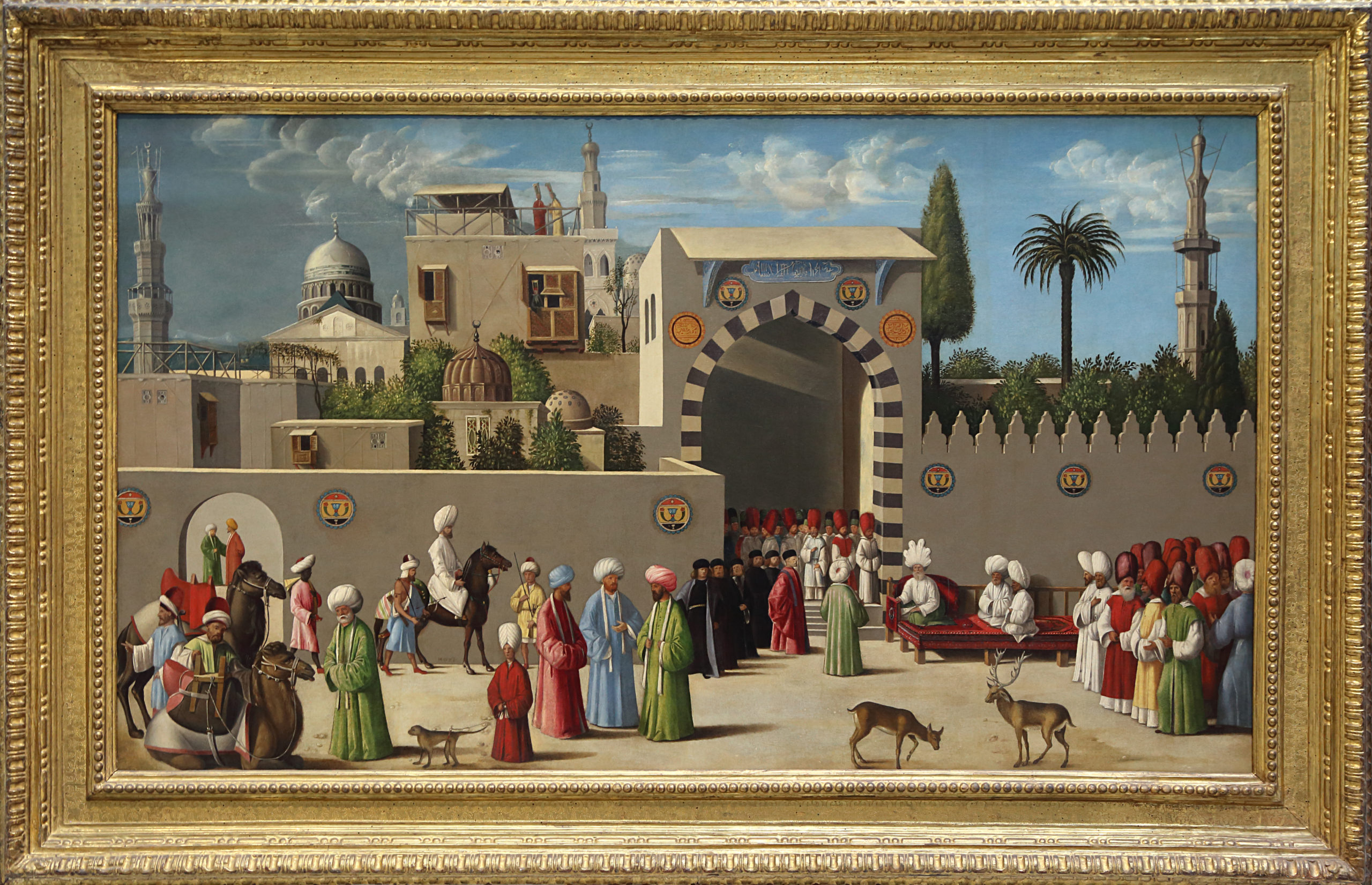
Reception of a Venetian delegation in Damascus, 1511, Venice, Italy, oil on canvas (Louvre)
An anonymous Venetian painter depicted a reception scene in Damascus, Syria, between Europeans and representatives of the sultan, whose escutcheon is emblazoned on the gates of the city in the painting. “Glory to our Sultan, the master, the king of kings, the wise, the ruler, the just al-Ashraf Abu al-Nasr Qaitbay, the Sultan of Islam,” reads the gilded inscription, proclaiming the sovereignty of Qaitbay. His dominions stretched from the Nile basin of the southeastern Mediterranean to Israel, Syria, and Saudi Arabia.
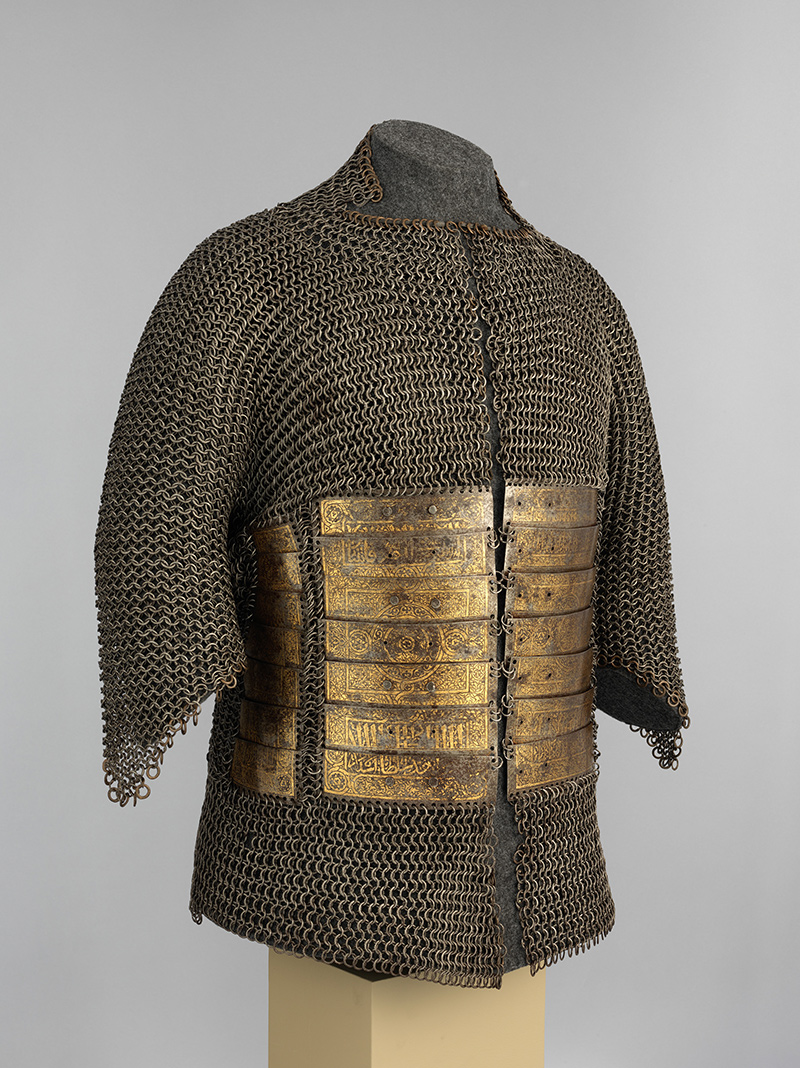
Shirt of Mail and Plate of Qaitbay, probably Egyptian, about 1468–96 (The Metropolitan Museum of Art, 2016.99).
Like Mansa Musa, Qaitay made a pilgrimage to Mecca and as an act of piety, he commissioned brass candlesticks for the shrine of the Prophet Muhammad in Medina. Architectural monuments built under his reign are still major destinations for curious travelers and the faithful alike.
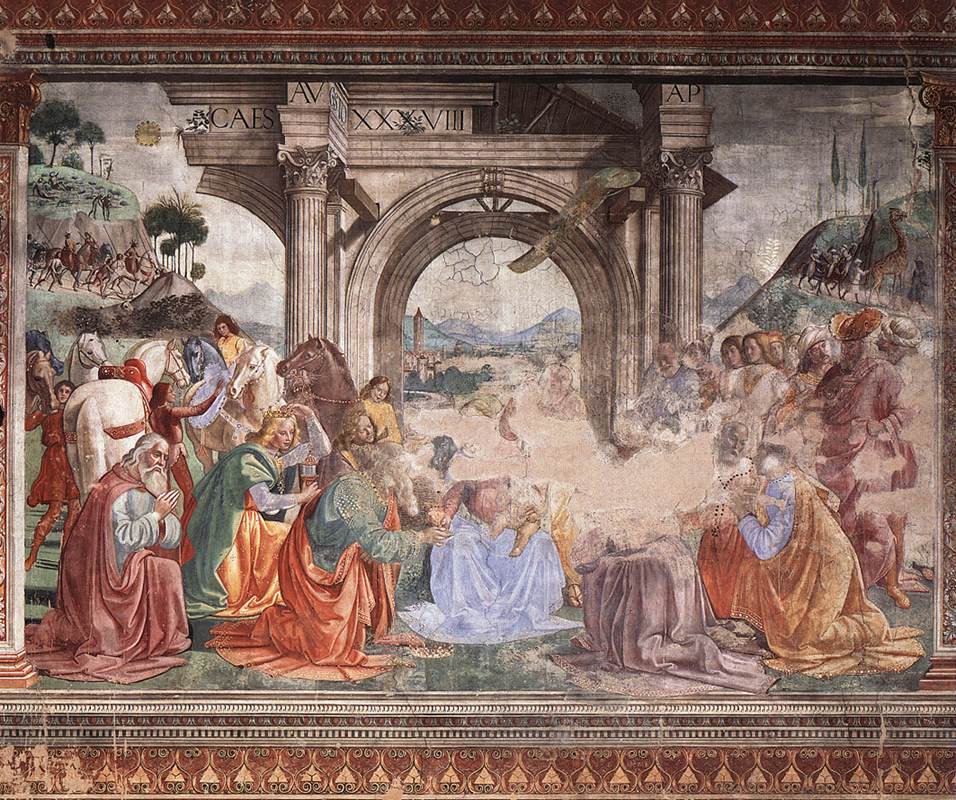
Domenico Ghirlandaio, Adoration of the Magi, 1486–90, fresco, 450 cm wide (Tornabuoni Chapel, Santa Maria Novella, Florence)
Qaitbay’s diplomatic relationships included the wealthy Medici merchants in Florence, who received rare and valuable gifts from the Sultan. The most notorious gift that the sultan sent to the Tuscan city-state was a giraffe, which was memorialized in works of art, including a fresco of The Adoration of the Magi by Ghirlandaio in the Tornabuoni Chapel in the church of Santa Maria Novella. The arrival of the giraffe with a retinue of Egyptian delegates may have evoked the pageantry of gift-giving reenacted in the annual magi processions in Florence, commemorated each January 6 on epiphany day.
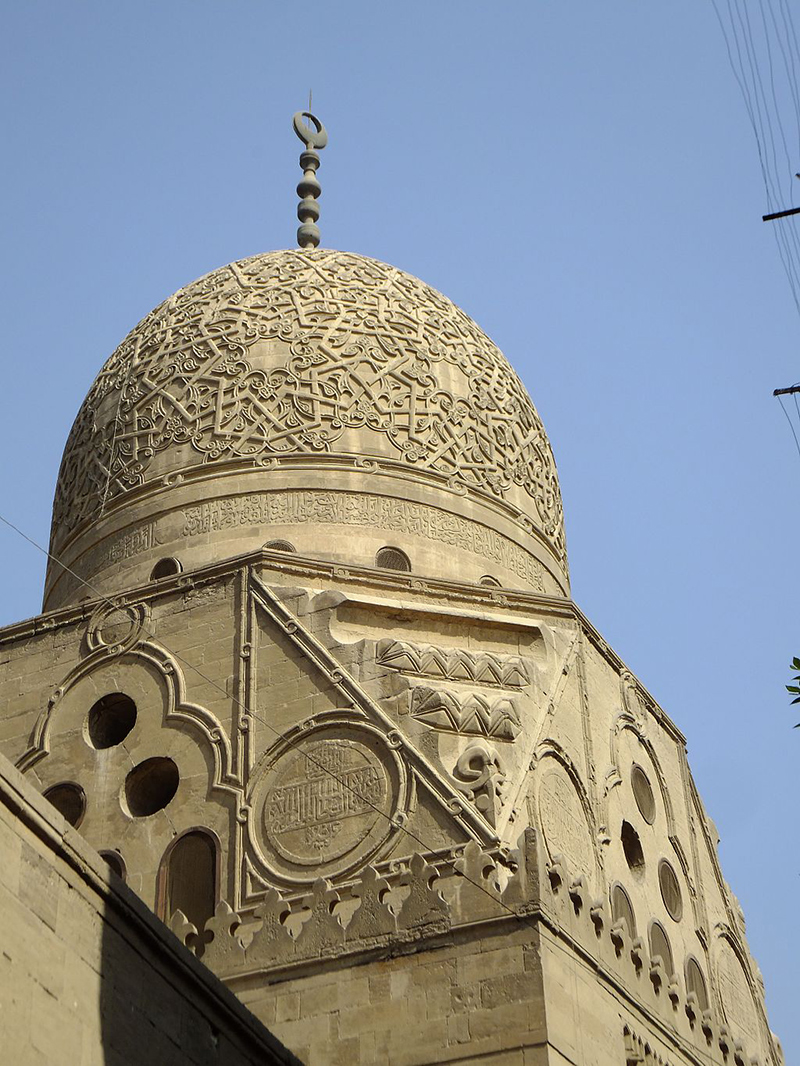
Qaitbay’s Mausoleum, Cairo, Egypt (photo: Casual Builder, CC BY-SA 3.0).
For Qaitbay, such relationships with the Italian courts could lead to financial and military support against their shared rival in the northeastern Mediterranean: the Ottoman Turks. European princes and popes also feared Ottoman expansion and thus maintained ties with the Mamluks. Trade goods from Egypt—including metalwork, manuscripts (from Coptic Christian and Muslim communities), and glassware—had a great impact on European art at the time.
Zar’a Ya’eqob and the medieval Christian Kingdom of Ethiopia
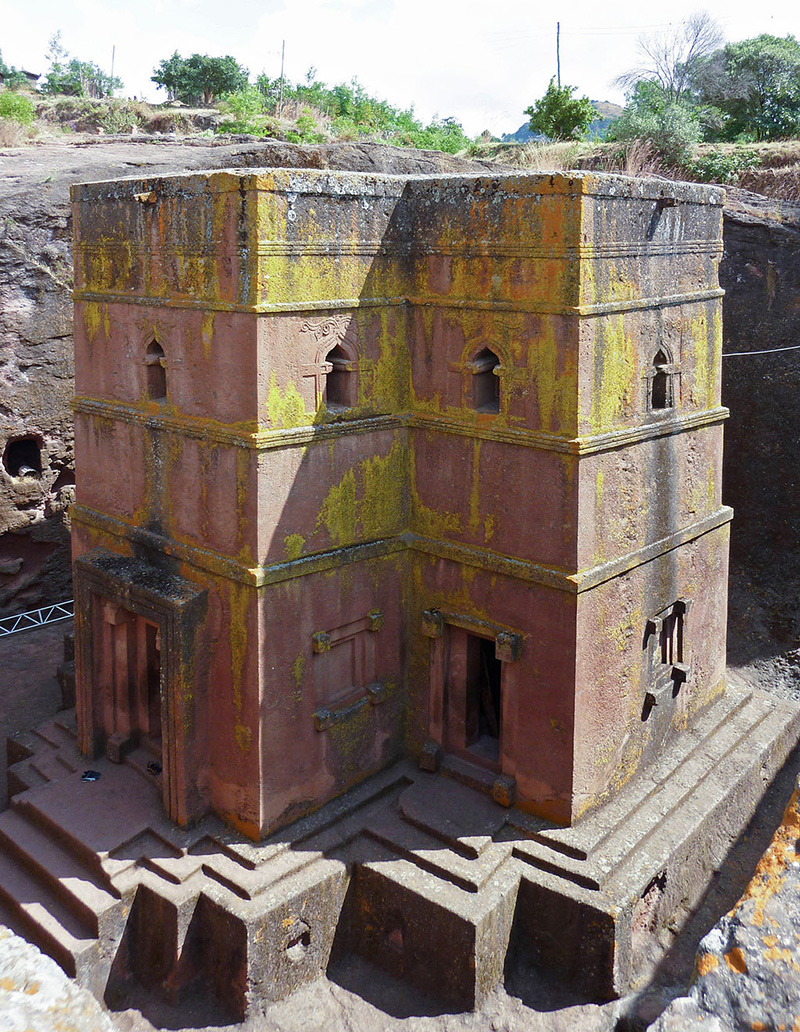
Bete Giyorgis (Church of Saint George), Lalibela, Ethiopia (photo: Bernard Gagnon, CC BY-SA 3.0)
Ethiopia has a long history as a powerful Christian kingdom, as an empire, and later, as a nation. By the end of the third century, the four great powers of the ancient world were considered to be Rome, Persia, China, and the African kingdom of Axum—which occupied parts of present-day Eritrea and northern Ethiopia. The later kingdom of Ethiopia, an early adopter of Christianity, developed a vibrant artistic tradition that included rock-hewn churches, illuminated manuscripts, and liturgical crosses. In the 15th century, successive Ethiopian nägäst (rulers) sent church delegations to Italy in an attempt to forge alliances, both religious and military, with Rome.
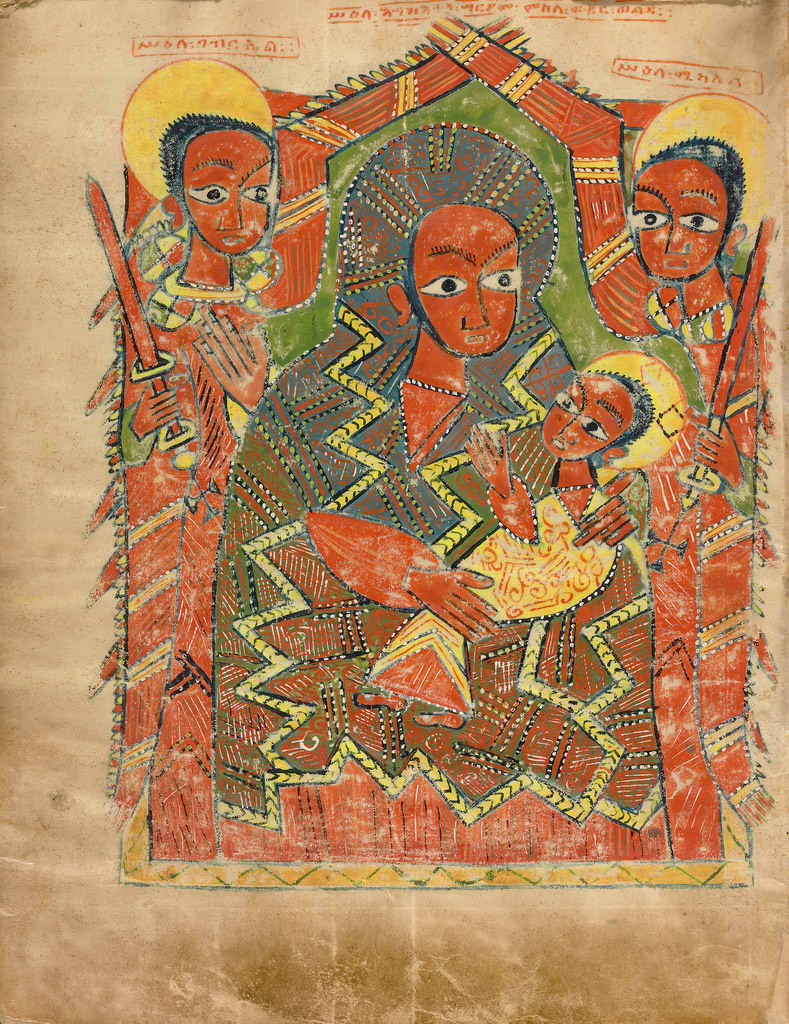
The Virgin and Child with the Archangels Michael and Gabriel in a Gospel book, about 1504–5, made in Ethiopia, probably Gunda Gunde (The J. Paul Getty Museum, Ms. 102 (2008.15), fol. 19v).
The 15th-century Ethiopian emperor Zar’a Ya’eqob was known for his strength and diplomacy. Zar’a Ya’eqob, who reigned from 1434 to 1468, resolved a major internal theological strife, a debate over the observance of the Sabbath (holy day of worship) that had been waged for over a century prior to his rule. It was also during his reign that the 1441 delegation joined the Council of Florence, one of the great church gatherings of that century. In Florence, his subjects were perplexed at Europeans’ continued identification of Zar’a Ya’eqob with the legendary priest-king Prester John.
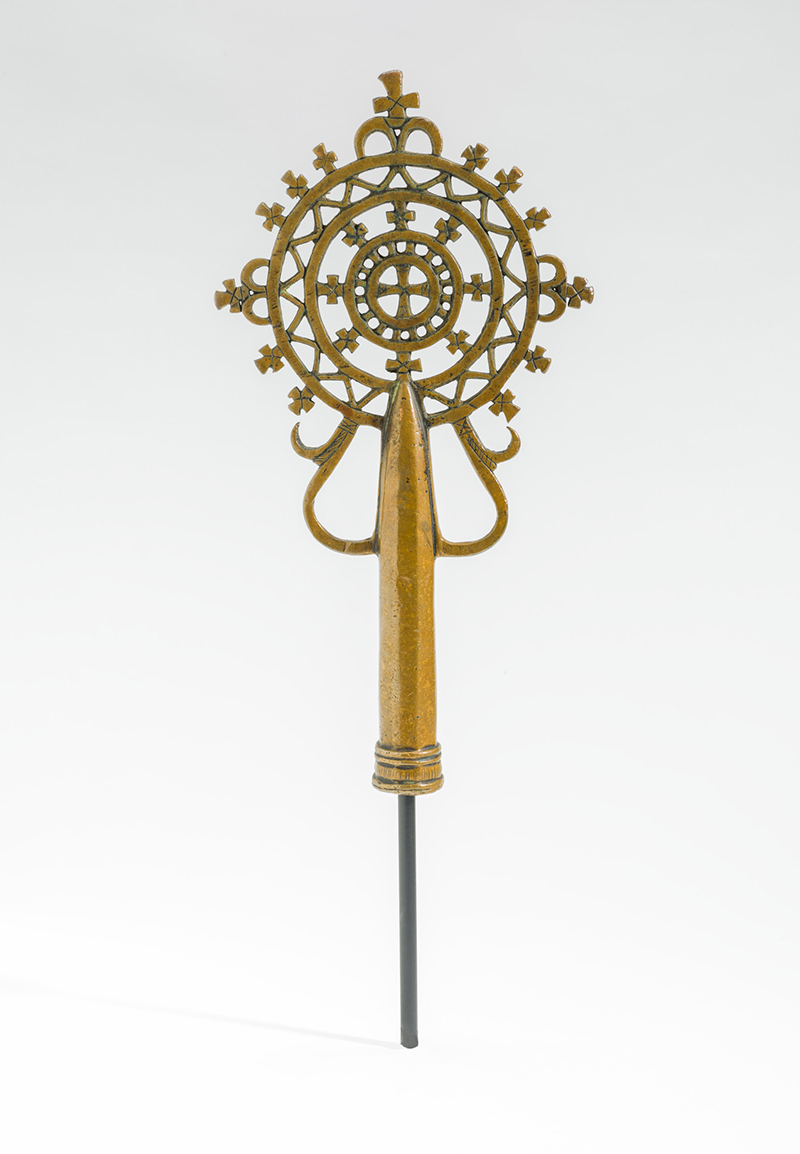
Cross, about 1200–1400, Ethiopia, Zagwe or Solomonic dynasty (Los Angeles County Museum of Art, M.2015.18.1).
At home, Zar’a Ya’eqob reportedly had an honor guard that stood to either side of his throne, holding drawn swords. The opening image of a Gospel book made at the Gunda Gunde monastery shows the Virgin Mary and Christ child similarly flanked by the archangels Michael and Gabriel. The Ethiopian kingdom had been Christian since the fourth century, but Zar’a Ya’eqob had Muslim subjects as well. The emperor’s wife, Eleni, was a Muslim convert and she continued to rule and exert significant influence after Zar’a Ya’eqob’s death.
Servant or King? Constructing Balthazar
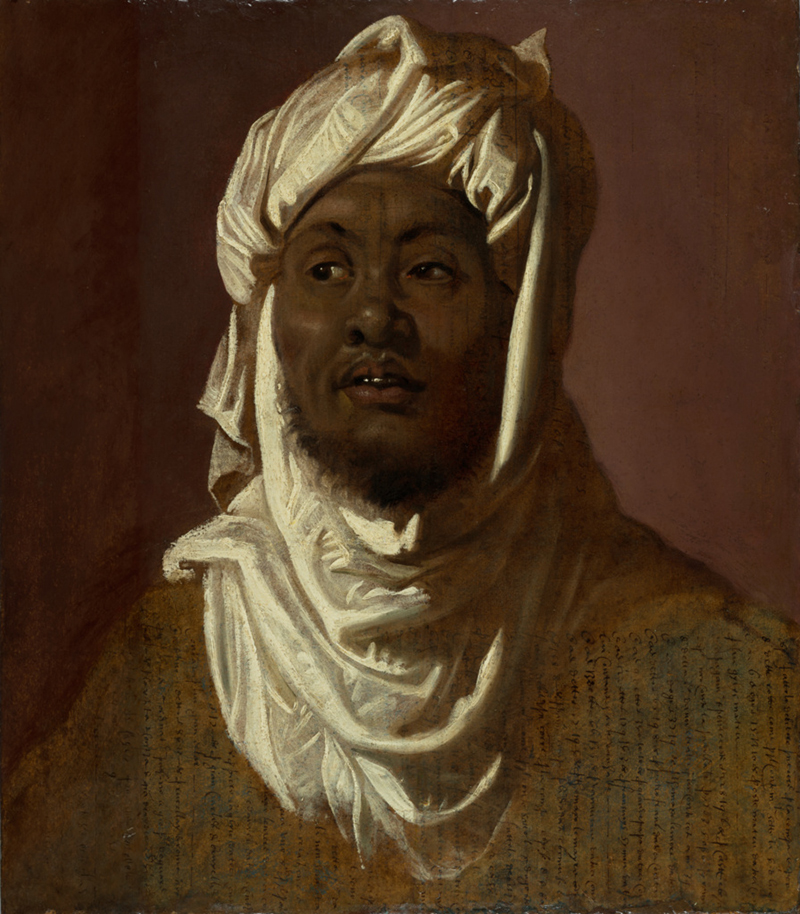
Peter Paul Rubens, Head Study for Balthazar, about 1609–11 (The J. Paul Getty Museum, 2018.48).
This study for Balthazar helped Peter Paul Rubens refine the figure of the king for a large painting of The Adoration of the Magi, commissioned by the town council of Antwerp, in Flanders (northern Belgium). The biblical story of three kings traveling from afar with gifts for the Christ child resonated in Catholic Antwerp, Rubens’s home city and a center of international commerce. The cult of the magi so captured the imagination of local inhabitants that many children were named Balthazar, Melchior, or Caspar after the kings. This oil sketch of a Head Study for Balthazar was painted on repurposed ledger paper; the marks of mercantile transactions are visible through the figure’s robe, face, and turban.
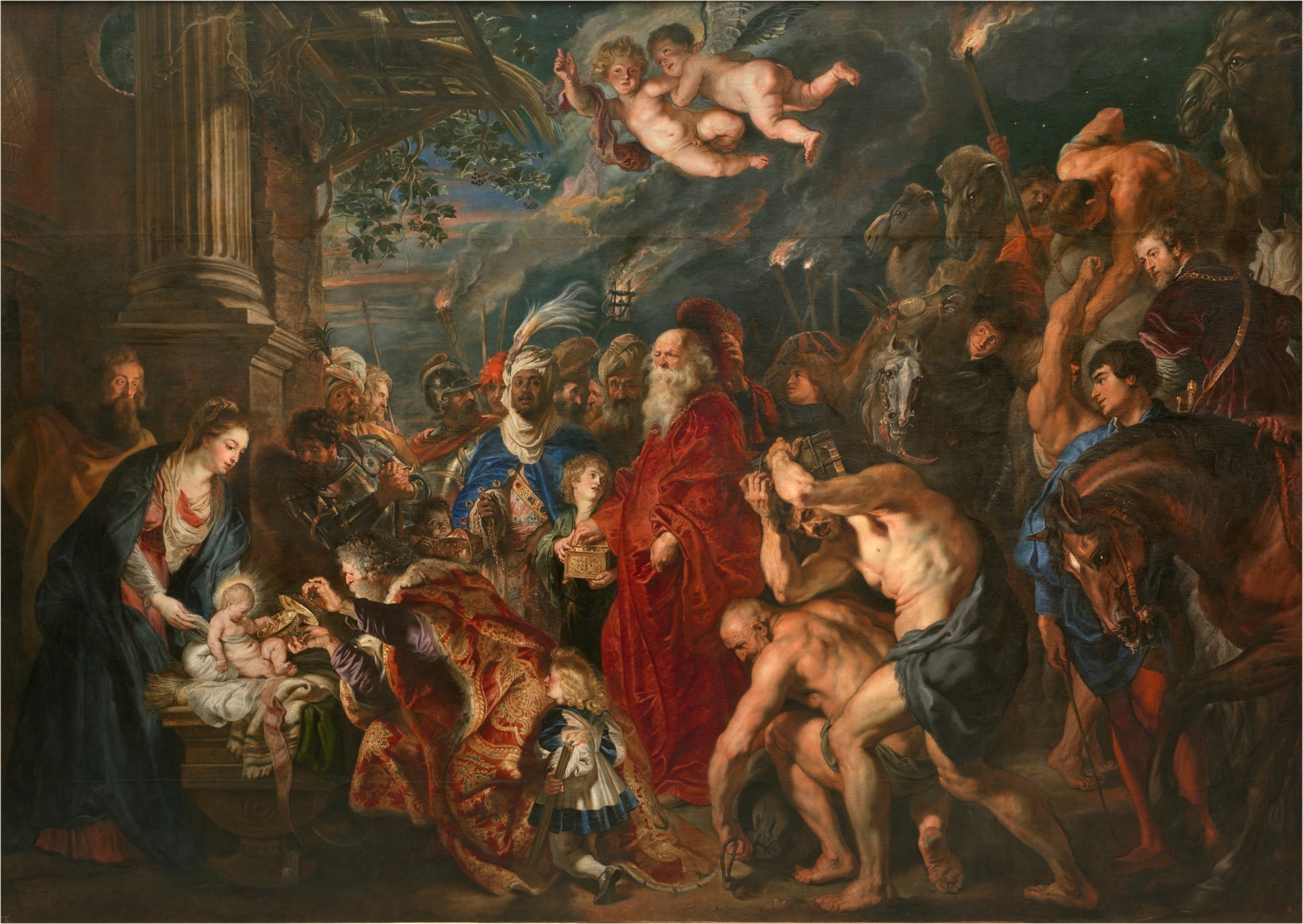
Peter Paul Rubens, The Adoration of the Magi, 1609, oil on canvas, 349 x 488 cm (Prado Museum, Madrid)
The immediacy and vibrancy of Rubens’s figure, with his parted mouth and gaze directed to the side, suggest an individual captured in a moment of speech and motion. Was this depiction inspired by an actual person, and if so, whom? Rubens often drew from life (a practice used by other artists. One of Rubens’s patrons in Antwerp had Black African servants in his household, and Rubens made other studies using them as models. The Flemish city of Antwerp was a major center for the slave trade. Much research remains to be done on the status of forcibly Christianized Black Africans living there, specifically their positions and rights within domestic settings.
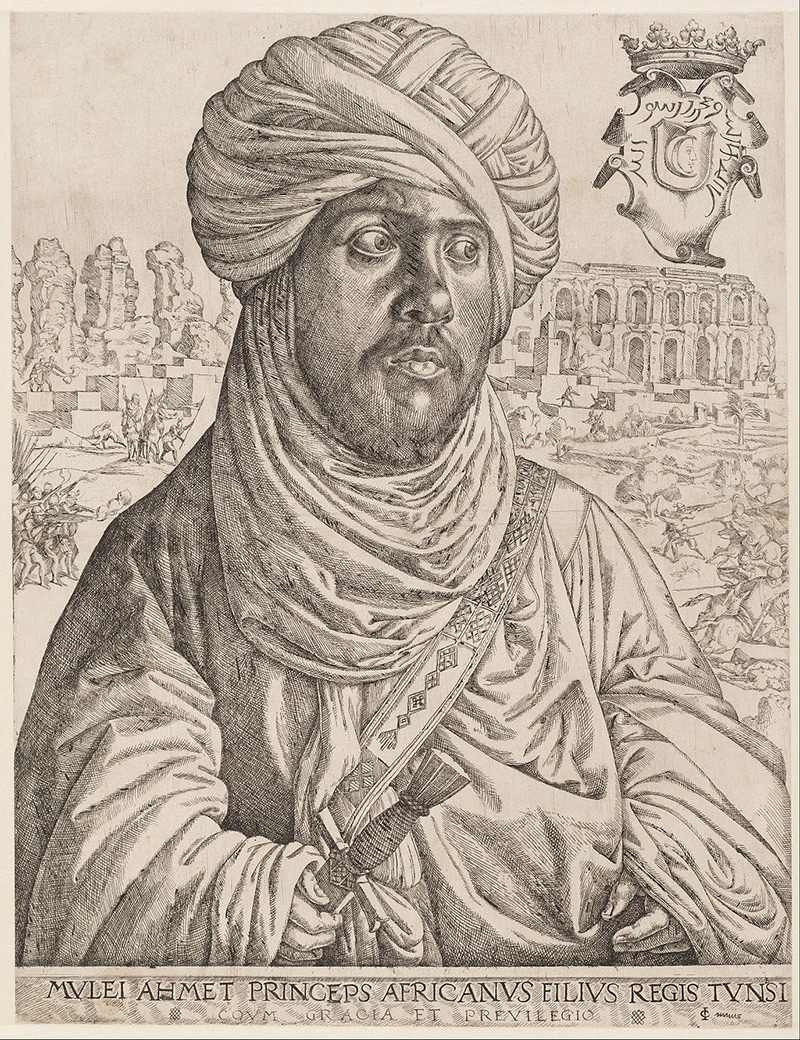
Jan Cornelisa. Vermeyen, Mulay Ahmad, about 1535–36 (Rotterdam, Museum Boijmans Van Beuningen).
We also know that Rubens used an earlier print of Mulay Ahmad, the Hafsid Muslim ruler of Tunis, as inspiration for other works. The Tunisian turban in Rubens’s head study above casts the biblical character of Balthazar as a sixteenth-century North African king.
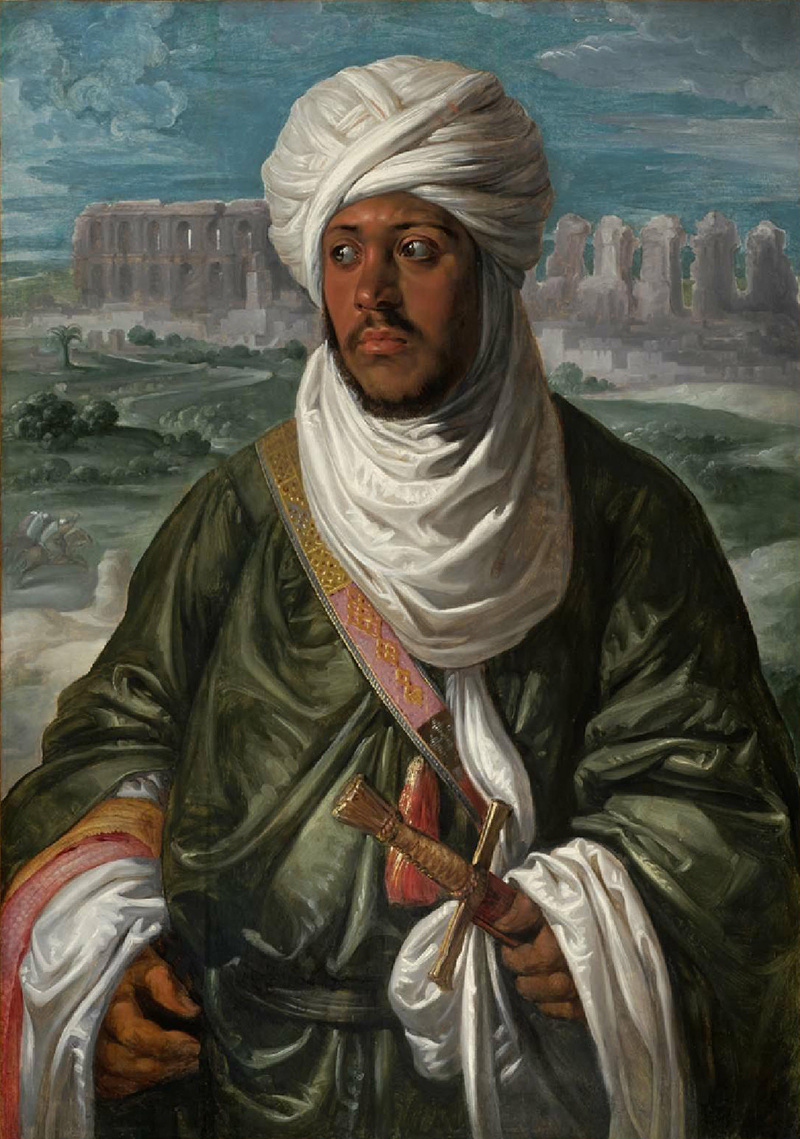
Peter Paul Rubens, Mulay Ahmad, about 1609 (Boston, Museum of Fine Arts, M. Theresa B. Hopkins Fund, 40.2.)
Thus Rubens’s Balthazar may be an amalgam of an unidentified sitter, likely a servant or enslaved person, and a nearly contemporary ruler. The artist’s image speaks to the intersections of power, faith, and race in commercial Antwerp at the height of its global reach.
African Europeans in the Courts of Europe
Europeans came to know African people in many different ways. While rulers made their way into the imagination of European artists, Africans living in Europe also became part of the art being produced at the time.
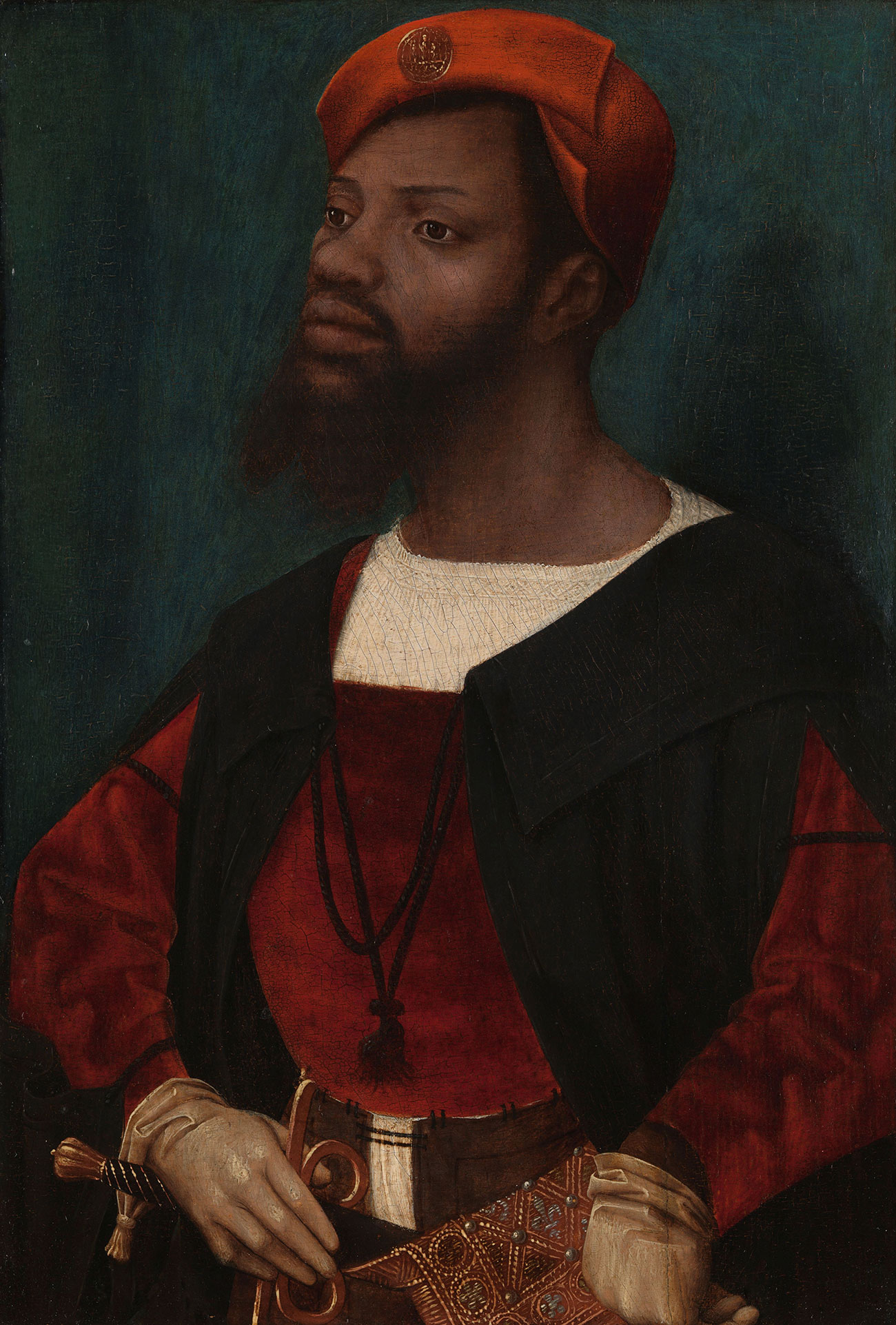
Jan Jansz Mostaert, Portrait of an African Man, c. 1625–30, oil on panel, 30.8 cm x 21.2 cm (Rijksmuseum, Amsterdam)
A significant number of Africans or members of the African diaspora in Europe occupied positions in the courts or noble households. Little documented, their histories can be guessed at from the evidence in archival documents and in art. Portrait of an African Man was long speculated to have been a painting of Christophle le More, a Black man, formerly a slave and groom, who went on to become an archer for the bodyguard of Emperor Charles V.
This painting by Jan Jansz Mostaert has long been celebrated as the only surviving European portrait of a Black man during this early period. Unlike images of Balthazar or other biblical figures, he wears the attire of a Flemish courtier. Moreover, he does not appear as a member of an entourage, but in the context of an individualized portrait. Who was this man?
Unlike the institution of slavery that became codified in the Americas at the time, it was possible for enslaved people in Europe to gain their freedom and to possess social mobility, working in positions as disparate as the elite bodyguard of the Holy Roman Emperor or as gondaliers in Venice.
Recent research has discouraged the identification of this sitter with Christophle, which leaves us only with the frustrating hints provided by his costume, such as the pilgrimage badge in his cap (to Our Lady of Halle, near Brussels), his gloves appropriate for a court setting, or for the embroidered bag at his waist, perhaps a gift from a wealthy patron. Although his identity is unknown, he nevertheless offers a potent reminder of the lived experiences of Africans in medieval and Renaissance Europe.
This essay first appeared in the iris (CC BY 4.0)


