

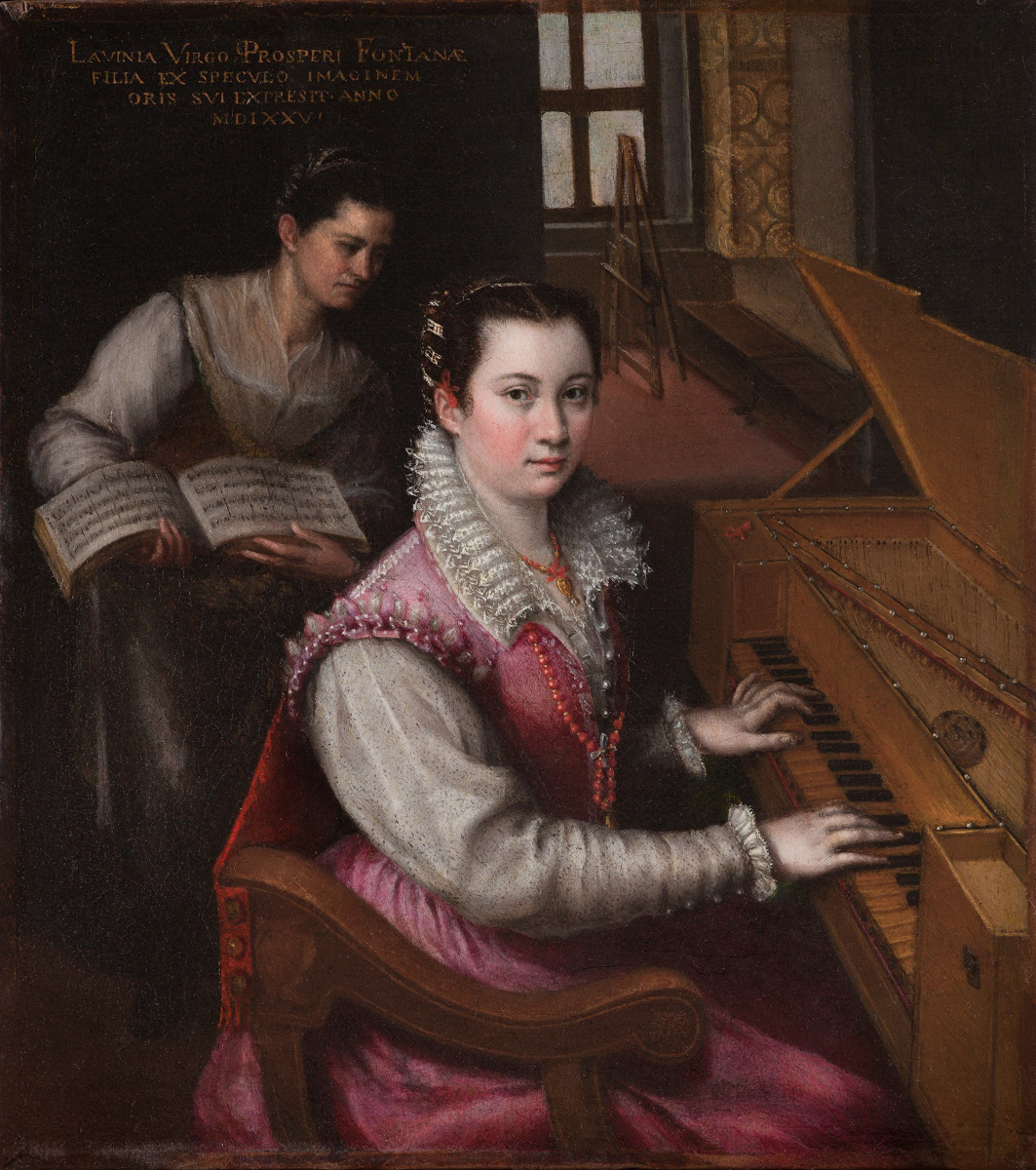
Lavinia Fontana, Self-Portrait at the Spinet, 1577, oil on canvas, 27 x 24 cm (Accademia Nazionale di San Luca, Rome)
Lavinia Fontana’s Self-Portrait at the Spinet does not present the artist as a painter so much as it packages her as the ideal bride—or so it seems at first glance. Dressed in costly garments, Fontana portrays herself as a well-to-do woman who has no need to work so thus fills her ample leisure time demurely at the spinet. Indeed, so great is her musical talent, she need not even glance at the maid holding the score behind her. The easel stands silently at the window in the room behind. Genteel virtues take the foreground; her profession resides in the background.
Structural challenges
By 1577, the date of this self-portrait, Lavinia Fontana was on the cusp of a promising career. Twenty-four years old, she learned to paint in her painter father’s workshop at home. Studying artworks by modern artists including Raphael and Sebastiano del Piombo in prints had prepared her to paint portraits, devotional works, and even history painting, considered then to be the province of men. Her father, Prospero Fontana, had ensured she was known to the potential clients in Bologna’s artistic and intellectual circles. The future looked bright. There was only one problem: her gender.
Lavinia had circumvented training restrictions for women by learning painting from her father at home. It was a path followed by other early modern Italian women artists including Marietta Robusti, Fede Galizia, Artemisia Gentileschi, and Elisabetta Sirani, all of whom learned how to paint from a father who was a professional artist. Education was one matter, running a workshop was another. Legal prohibitions made it nearly impossible for a single woman to run a business. A guardian, i.e. a father or husband, had to sign her contracts and all her earnings belonged to him. Speaking with clients or looking directly at male portrait subjects risked the modesty required from an unmarried woman in her society at her social level. [1] Prospero went about finding a suitable husband—one who would enable rather than prevent what was sure to be a meteoric career.
A self-portrait for marriage
Self-Portrait at the Spinet was one of two self-portraits Lavinia gave to Severo Zappi when she and her father met with him to discuss marriage to his son Gian Paolo Zappi in February 1577. Since she prepared the paintings in advance, Lavinia likely felt a great deal of confidence that the marriage negotiations would progress. A portrait given to the bridegroom was a typical introduction for higher class couples though a self-portrait was not. Severo had journeyed approximately 45 kilometers from Imola to Bologna to meet the potential bride. [2] Nevertheless, Self-Portrait at the Spinet takes pain to present Lavinia as an accomplished, self-contained young woman and not a painter—while still alluding to her potential future earnings. [3]
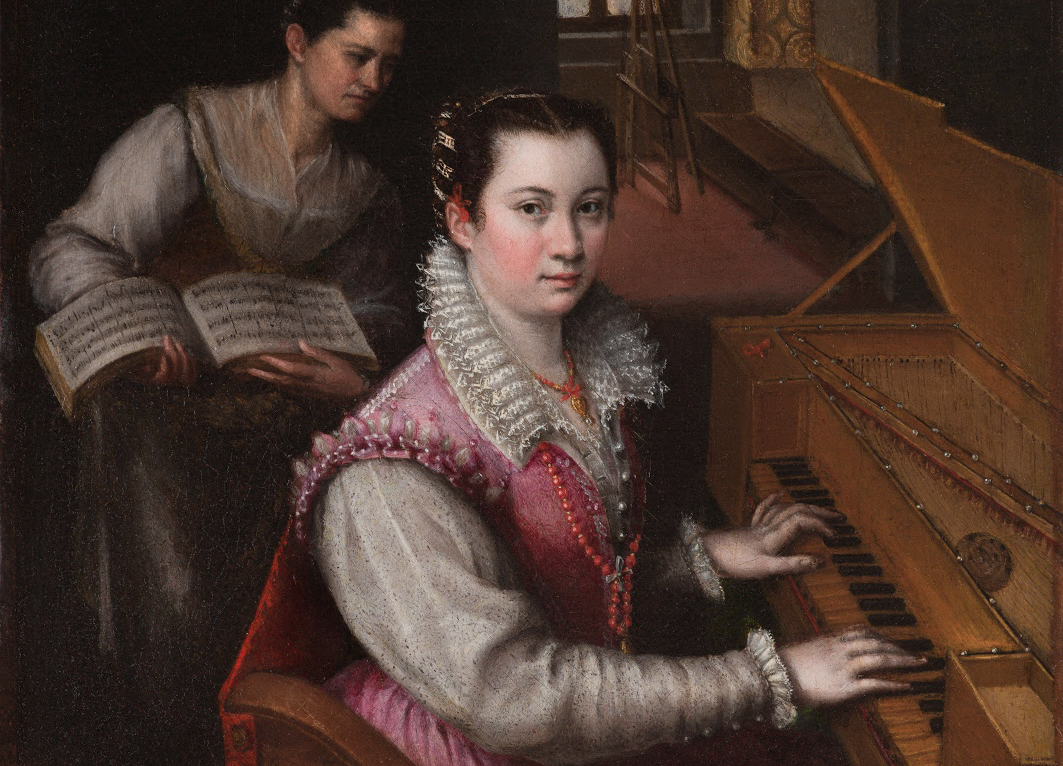
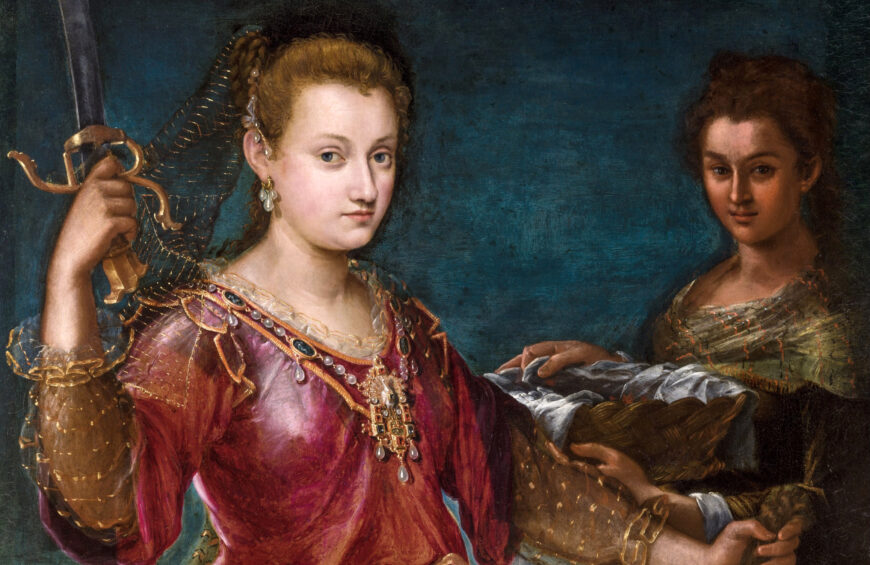
Lavinia with chaperone (detail), Lavinia Fontana, Self-Portrait at the Spinet, 1577, oil on canvas, 27 x 24 cm (Accademia Nazionale di San Luca, Rome)
The self-portrait gives several indications it is meant for a betrothal. Lavinia wears a red love knot above her ear and a second is placed on the spinet. Her red and white garments may refer to the Petrarchan colors of love. The literary allusion would have only emphasized Lavinia’s erudition. Contemporary authors including Francesco Barbaro, Alessandro Piccolomini, and Baldassare Castiglione recommended women be literate and knowledgeable about music and art since a good wife should be a good friend, i.e. someone interesting. [4]
Like a proper young lady, Lavinia appears at home with a chaperone. The opaque window obscures any suggestion of an exterior world. The musical instrument, Lavinia’s two coral necklaces, and the presence of a hired domestic servant attest to her family’s economic achievement and ability to keep their daughter properly sheltered.
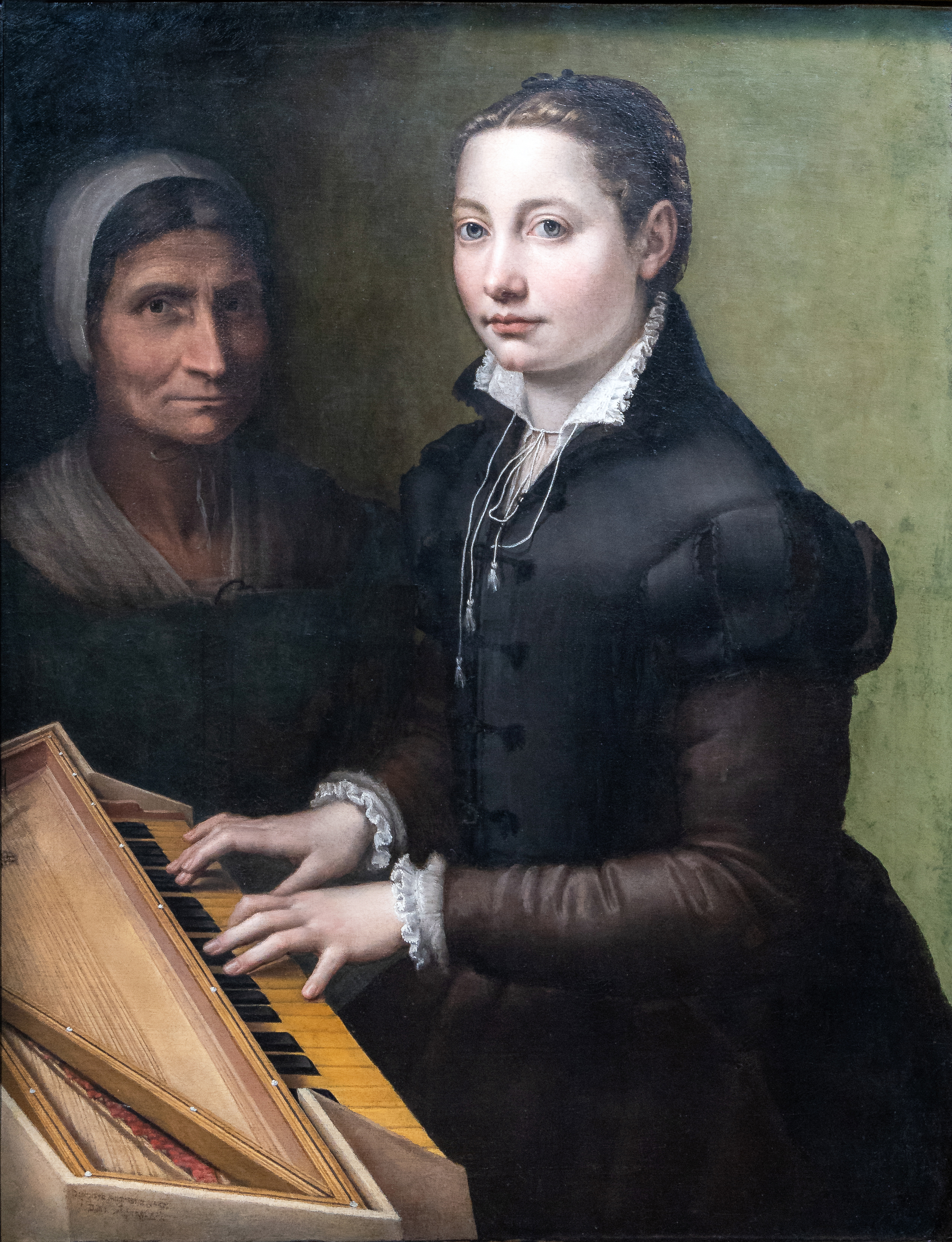
Sofonisba Anguissola, Self-Portrait at Clavichord with Servant, 1561, oil on canvas, 81 x 63 cm (Althorp House, Northamptonshire)
Further presenting herself as a well-off woman, Lavinia presents herself playing a musical instrument much like an earlier self-portrait made by Sofonisba Anguissola, the noblewoman painter from Cremona. The keyboard has been identified as a clavicembalo or cembalo, a domestic instrument associated with upper-class women rather than professional musicians since it required very little immodest bodily movement to play. [5] But while the noblewoman Sofonisba could afford attesting to her sober character with a plain black dress, Lavinia, born to an artisan family, risked an accusation of vanity in order to demonstrate her family’s financial means. Her lace collar and cuffs demonstrate this.
Severo Zappi had been advised that marrying his son to Lavinia would be advantageous given the young lady’s future earning potential. Perhaps it was Prospero Fontana’s advanced age that led the elder Zappi to sign a marriage contract so disadvantageous to his son. They may have expected Prospero, then aged 65, to expire shortly, passing rights to Lavinia’s earnings to Gian Paolo. The contract also required the couple to reside in the Fontana home and established Prospero as Lavinia’s guardian, entitled to all of her earnings. [6] Gian Paolo only became Lavinia’s legal guardian after Prospero died—20 years later.
Artistic sampler
Though modest in scale (the easier for Severo Zappi to carry home to Imola), Self-Portrait at the Spinet is high on ambition. While Lavinia designed the painting to secure a marriage contract, she also used the opportunity to showcase her knowledge of artistic developments in 16th-century Italy and her own painterly prowess.
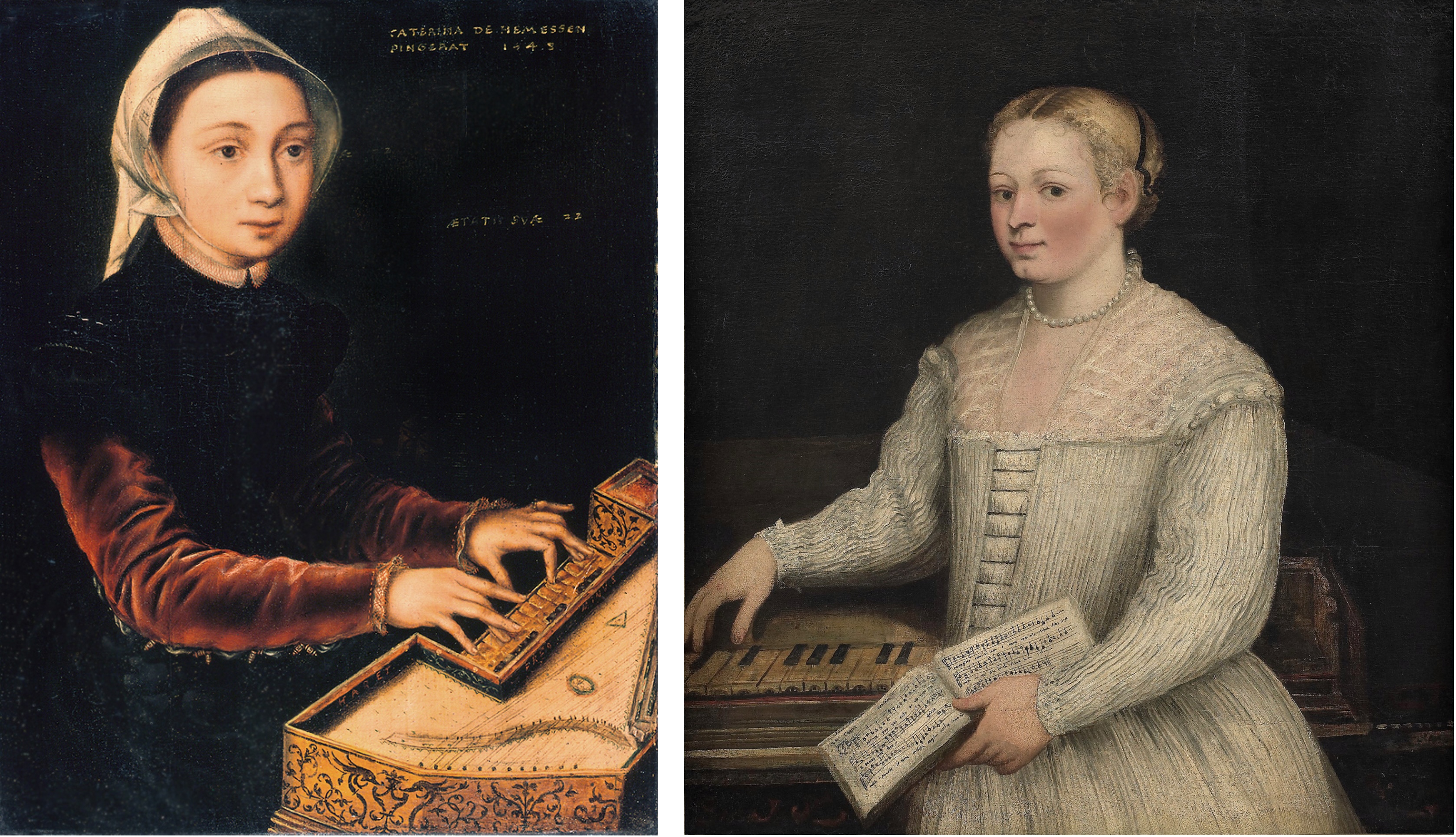
Left: Catharina van Hemessen, Self-Portrait at Virginal, 1548, oil on oak wood, 30.5 x 24 cm (Wallraf-Richartz Museum, Cologne); right: Marietta Robusti (Tintoretto/Tintoretta), Self-Portrait with Madrigal, 1578, oil on canvas, 93.5 x 91.5 cm (Gallerie degli Uffizi, Florence)
For a woman artist, a self-portrait playing music was a convenient way to show general accomplishment and artistic ability. Both the Flemish artist Catharina van Hemessen and Sofonisba Anguissola had previously depicted themselves in half-length images against plain backgrounds. Marietta Robusti, daughter of Tintoretto, would paint herself similarly standing next to a keyboard holding a score around 1580. Lavinia, unlike the others, created a perspectival multi-roomed space able to hold two figures, an instrument, and a second room.
The painting showcases Lavinia’s ability to use perspective to create a sense of three-dimensional space. It was an important skill for an early modern professional artist. The musical instrument is convincingly foreshortened and its orthogonal line directs the viewer’s eye to the easel standing in a second room. Like the Self-Portrait at the Spinet, many of Lavinia’s other portraits use what is known as “Passarotti perspective,” in which a room opens onto another room. [7] The ability to create believable three-dimensional space meant Lavinia could produce more complex compositions that would bring both her and any client of hers credit for artistic sophistication.
The Latin inscription in the upper left corner establishes Lavinia’s virginity, essential to her marriageability, and, importantly, her authorship. The inscription Lavinia Virgo Prosperi Fontane/Filia Ex Speculo Imaginem/Oris Sui Expressit Anno/MDLXXVII translates as “Lavinia Virgin, daughter of Prospero Fontana, depicted herself from the image in a mirror, year 1577.” One might read Lavinia’s half twisted position as gazing upon herself in a mirror, though her hands remain occupied playing. The easel painted next to her head is empty. Has the artist made a clever pun that the painting missing on the easel is the one we now behold?
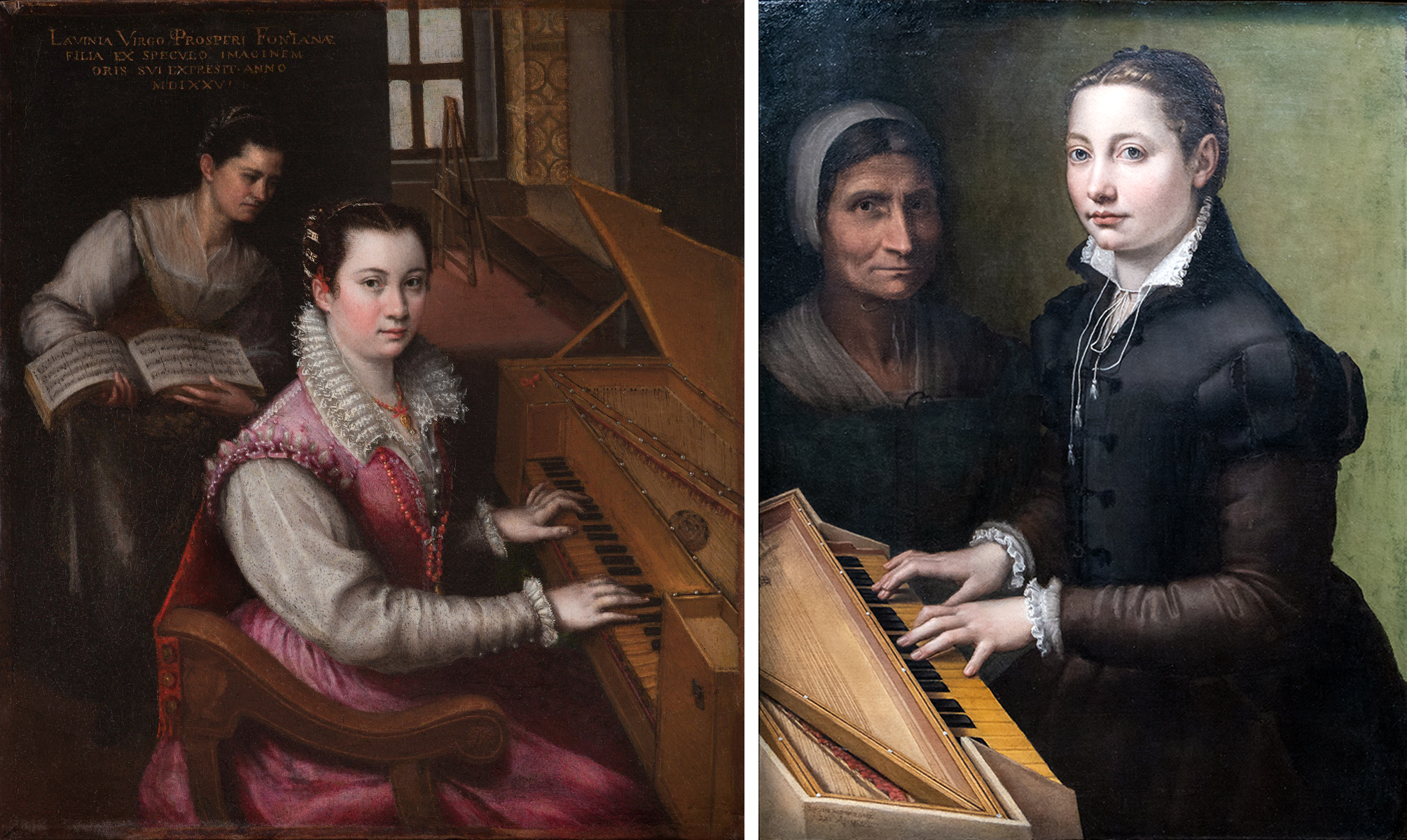
Left: Lavinia Fontana, Self-Portrait at the Spinet, 1577, oil on canvas, 27 x 24 cm (Accademia Nazionale di San Luca, Rome); right: Sofonisba Anguissola, Self-Portrait at Clavichord with Servant, 1561, oil on canvas, 81 x 63 cm (Althorp House, Northamptonshire)
Lavinia portrays herself as accompanied by a servant as Sofonisba had in 1561, but Lavinia takes pains to render the entire body of the maid and set her in space. The servant bends her knee and body towards the painted Lavinia, giving her posture movement and simultaneously suggesting Lavinia, as a painter, is able to handle multi-figure compositions. Lavinia became the first Italian woman artist to paint multiple altarpiece commissions throughout her career.
Career success
The marriage gambit worked. Lavinia won her first documented public commission in 1584 for the Assumption of the Virgin with Saints Peter Chrysologus and Cassian. By 1589, Lavinia Fontana ran her own bottega producing large religious paintings, mythological scenes, and portraits. She worked regularly in Florence and Rome. There is no recorded profession for her husband throughout his life, but his presence and legally favored gender facilitated Lavinia’s career. It was she who earned the family income and consequently, it was she who returned to work soon after each of her eleven pregnancies. Documentation attests to Lavinia producing over 100 paintings during the course of her career.
Self-Portrait at the Spinet now hangs in Rome at the Accademia Nazionale di San Luca, the professional artists society approved by papal brief in 1577, the same year Lavinia made the painting. She was the first woman inaugurated into their membership years later. She died at age 61 on August 11, 1614 and is buried in the church of Santa Maria sopra Minerva in Rome.