

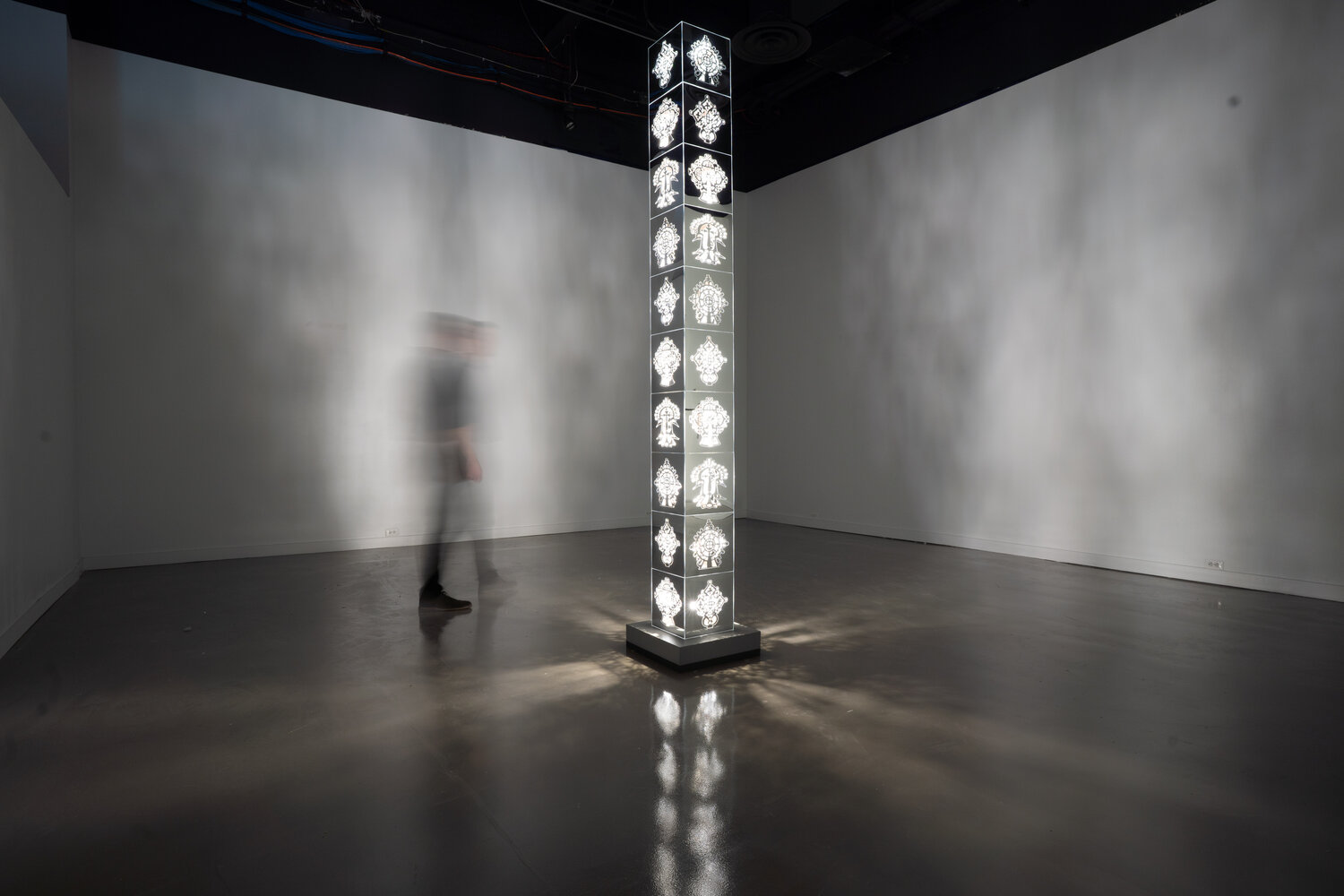
Tsedaye Makonnen, Aberash አበራሽ You Give Light II, 2023, mirrored stainless steel, plexiglass, LED tubes, and assembly bolts and nuts, 304.8 x 30.5 x 30.5 cm (Collection of the artist; photo: Anna-Marie Kellen) © Tsedaye Makonnen
How can light become a portal for memory, mourning, and resistance? Tsedaye Makonnen’s sculptural and performative works compel us to ask what it means to carry memory across oceans, generations, and fractured geographies. In pieces such as Aberash | አበራስ | You Give Light II and Tsehai | ጠሐይ | Sunlight, Makonnen constructs luminous monuments to Black and African lives shaped by migration, displacement, and the ongoing search for sanctuary. Her light sculptures are not passive memorials; they are active spaces of ritual, remembrance, and renewal.
A pantheon of care and memory
Constructed from mirrored stainless steel, plexiglass, LED tubes, and modular lightboxes, these sculptures evoke the verticality of ancient obelisks and the architectural memory of Ethiopia’s sacred sites, such as Lalibela and Aksum. Each tower glows from within, emitting patterned light inspired by Ethiopian crosses, or mäsqäl, projecting them onto surrounding surfaces. These projections are not merely decorative; they extend the sculpture’s protective energy outward, enveloping viewers in a temporary cosmos of reflection and reverence.
Makonnen inscribes the names of Black women and girls lost to state violence and migration onto the illuminated surfaces. These names are accompanied by those of gender-nonbinary people and elder matriarchs. In doing so, she constructs a pantheon of care and memory. Her naming practice is liturgical, insisting that these lives are not forgotten. They form the sculpture’s architecture. The modular cubes speak to flexibility, adaptability, and the manner in which memory is carried, stacked, restacked, and built anew.
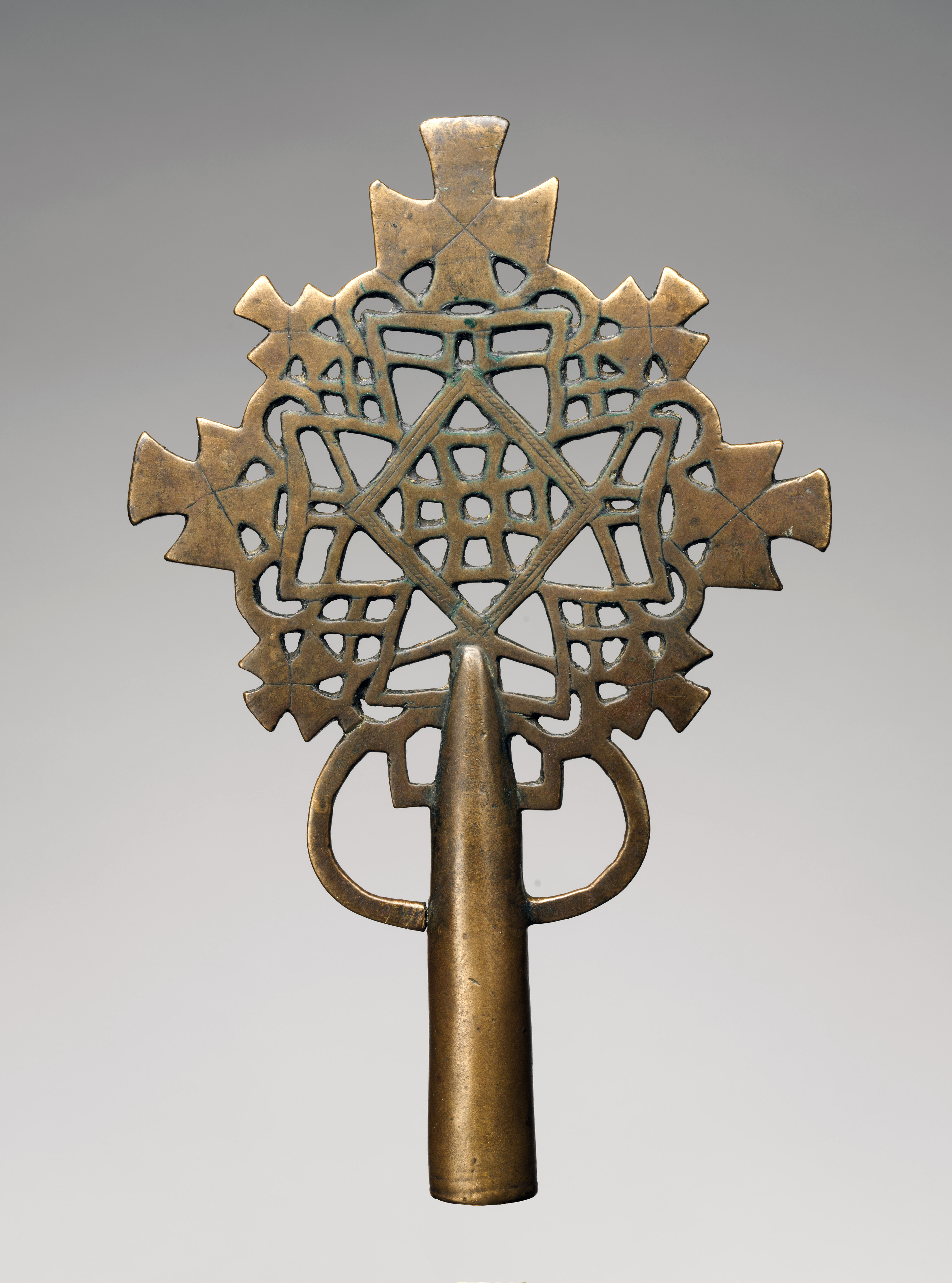
Processional Cross (qäqwami mäsqäl), 15th–16th century (Amhara or Tigrinya peoples; Ethiopia), bronze, 24.1 x 16.5 cm (The Metropolitan Museum of Art, New York)
The Ethiopian Orthodox cross, reimagined and restudied during her fellowship at the Smithsonian, serves as a central symbol of Makonnen’s work. She traced its lineage beyond Christianity, discovering in its form a constellation of African spiritual technologies. The mäsqäl is a protective geometry, a carrier of stories, and for Makonnen, a cosmological map. These crosses manifest in her sculptures, projected and engraved, as guardians and guides. Their meaning is not fixed but felt, shaped by light, history, and intention.

Tsedaye Makonnen, Nefsé Nets’a Mawt’at Däbtäras ነፍስን : ነፃ : ማውጣት :: ደብተራ :: The Soul Is Set Free Magic Scrolls I–V, 2023, cotton, water-based screenprinting ink, and mirror acrylic; and Tsedaye Makonnen, Tsehai | ጠሐይ | Sunlight, 2023, mirrored stainless steel, plexiglass, LED tubes, wall-mounted cleats with corresponding hardware, 152.4 x 30.5 x 30.5 cm (Collection of the artist; photo: Anna-Marie Kellen) © Tsedaye Makonnen
Textile and performance
Makonnen’s textile work and performance practice extend these explorations. In The Soul Is Set Free | ነፍስ : ነዜ : ማይጣት, she collaborates with her mother, Asnakech Ayele, and her son, Senai Makonnen Livingston. The work unfolds through Ethiopian netelas (white scarves), each inscribed with prayers written in Amharic. These textiles are like wombs, veils, maps, and coverings that shield, reveal, and transmit. Their very materiality carries diasporic histories: gifted, inherited, and carried from Ethiopia, they are records of migration in thread and breath.
In 2023, Ethiopian-American multidisciplinary artist Tsedaye Makonnen contributed multiple textiles from her series “Astral Sea” to The Met’s “Africa & Byzantium” exhibition. As part of the exhibition, Makonnen and several collaborators activated the textiles with “The Need for Collective Refuge,” a new site-specific performance that journeyed through the history of the Byzantine Era’s African diaspora. Now, we’re thrilled to share this unique processional meditation on resilience, memory and migration, Recorded on Thursday, February 29, 2024 in Gallery 199 and Gallery 548, The Carroll and Milton Petrie European Sculpture Court.
Performance activates these objects. At the Venice Biennale in 2019, Makonnen staged a protest against Christoph Büchel’s Barca Nostra, wrapping herself in mirror-adorned textiles and standing before a salvaged ship turned spectacle. Her body became a sculpture, her presence a counter-monument. The mirrored surfaces, drawn from her light sculptures, fractured the surrounding space, offering not a single reflection but many—an astral sea of seeing and being seen. In that moment, she called upon African spiritualities, Black feminism, and diasporic futurities, all expressed through fabric, light, and gesture.
Acknowledging the traces of trauma
Language also plays a central role. As a first-generation Ethiopian American, Makonnen navigates Amharic with both intimacy and estrangement. Her intentional misspellings and her requests for her mother to revise her texts become rituals of linguistic return. They highlight the challenges of translation, not only between languages but also across generations, geographies, and griefs. Through this call-and-response with her mother, Makonnen reclaims Amharic not just as a language but as a lineage.
Mirrors are ubiquitous in Makonnen’s work, both literally and metaphorically. The mirrored acrylics in her sculptures invite viewers into the pieces, fracturing, multiplying, and complicating their reflections. This material evokes both water and glass, memory and rupture. The sea, particularly the Mediterranean, often a site of Black death and disappearance, is never far from these reflections. Makonnen does not reproduce trauma but acknowledges its traces. Her mirrored crosses diffuse light, offering a visual balm, a protective field, and a gentle refusal to forget.

Tsedaye Makonnen, Senait & Nahom | ሰናይት :: እና :: ናሆም | The Peacemaker & The Comforter, 2019, acrylic mirror, LED light, and hardboard, 7 towers of different heights (National Museum of African Art, Smithsonian Institution, Washington, D.C.) © Tsedaye Makonnen
Contemporary relics
Her practice is shaped by and engages in conversation with a global geography of loss and survival. The Black Mediterranean, the Black Atlantic, the U.S.-Mexico border; these are the coordinates of her work. Yet within these geographies, she builds sanctuaries. Her art is not merely reactive; it is generative, healing, and assertive.
Makonnen’s sculptures are contemporary relics. They evoke Ethiopia’s spiritual traditions while anchoring themselves in the urgencies of the present. They serve as beacons and altars, made not of stone or gold, but of light, name, and breath. In their glow, we are asked to remember—not as historians, but as kin.
These works refuse to be silenced. They glow, they speak, they gather. In doing so, they teach us how to mourn, how to honor, how to carry the light forward.