

Can relief sculpture help define historical memory, memories that shaped the civic life of the ancient city of Rome?

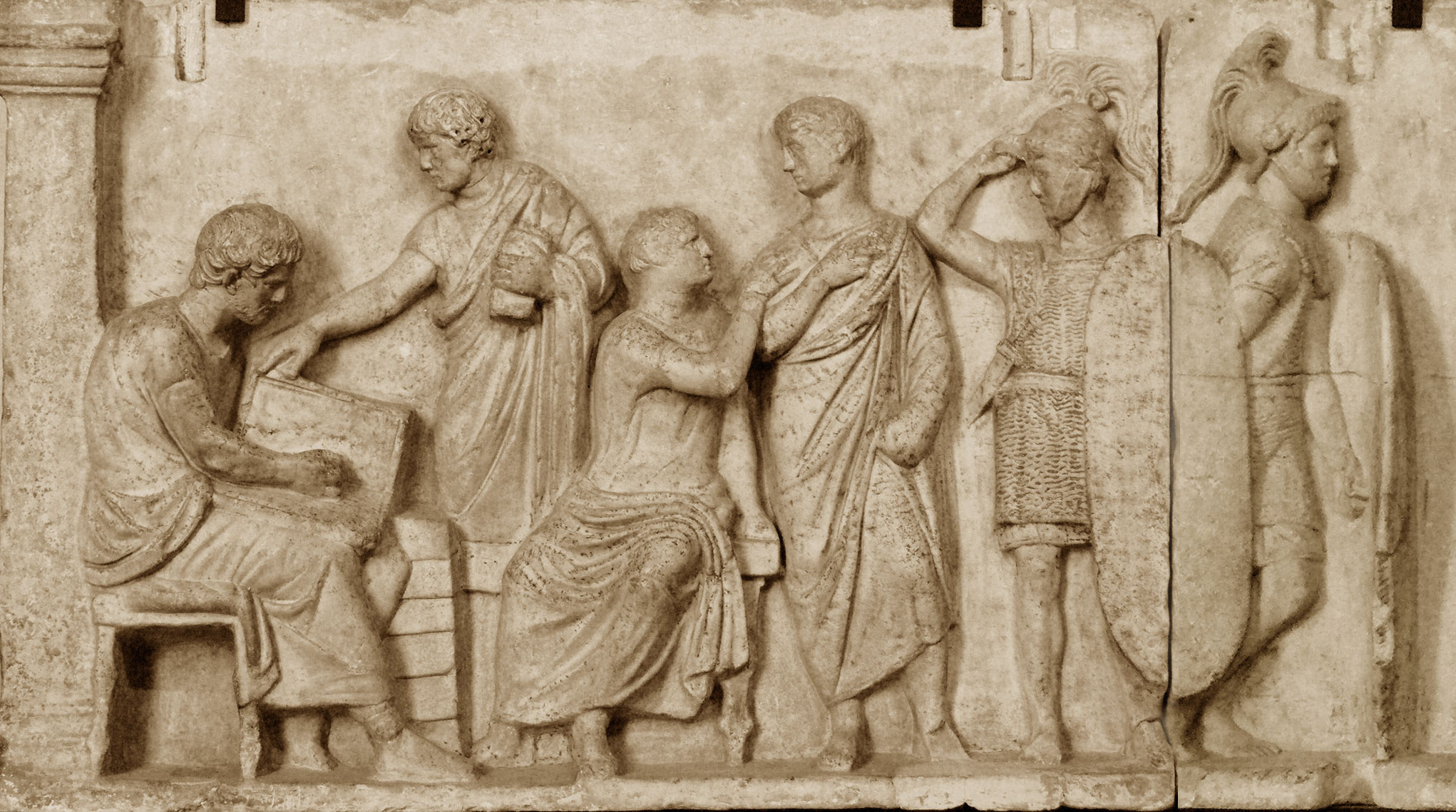
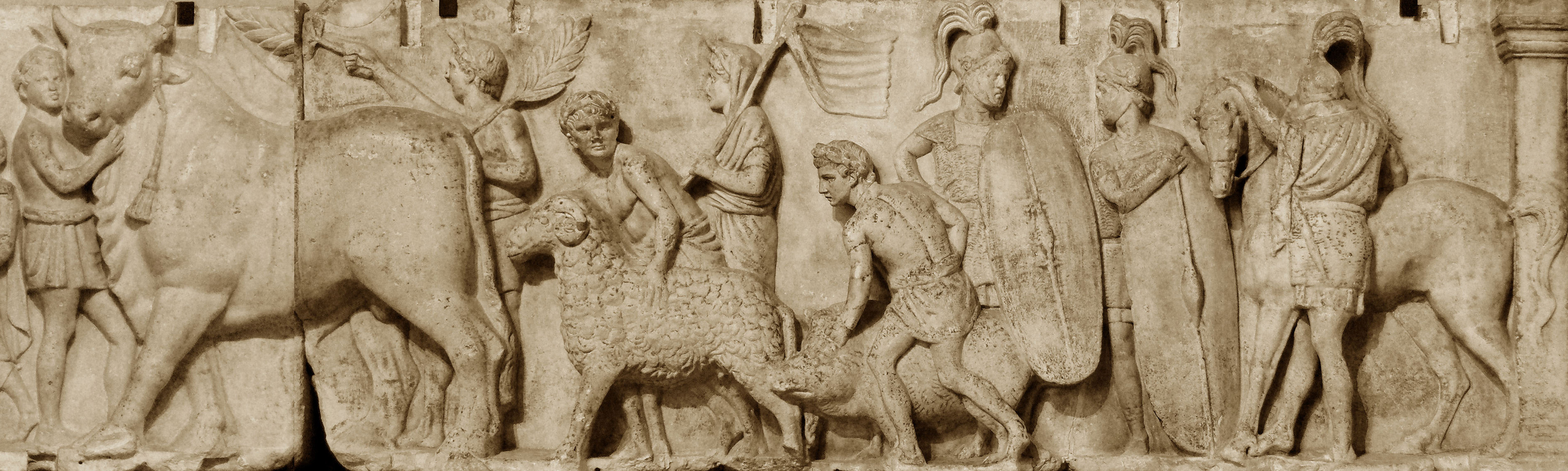
Altar of Domitius Ahenobarbus (left half), late 2nd century B.C.E. (Roman), marble, 84 x 566 cm (Musée du Louvre, Paris)
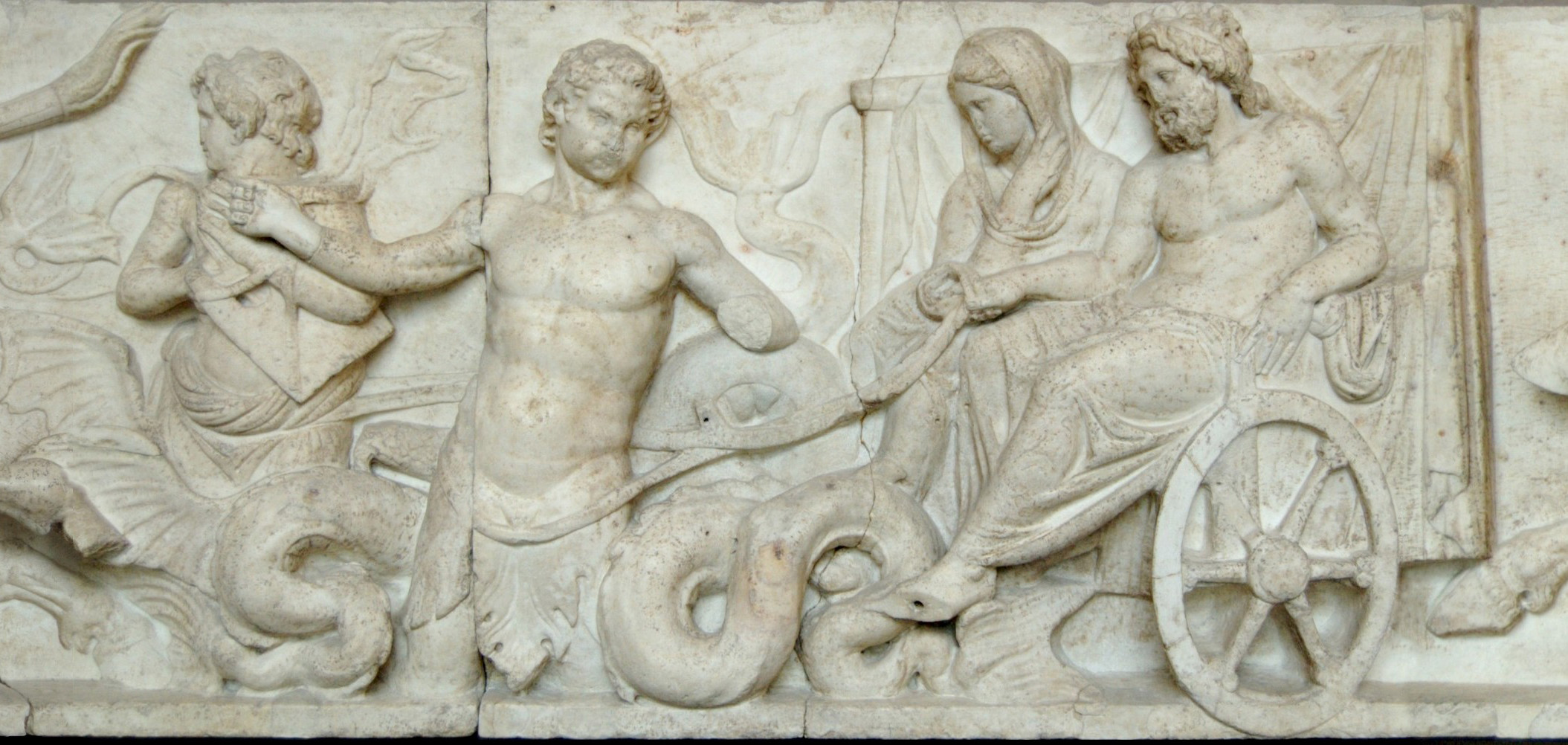
A late Republican marble monument base from the Campus Martius in Rome has come to be known as the “altar (ara) of Domitius Ahenobarbus.” While its common name may be a misnomer and the interpretation of its pictorial scene remains a matter of debate, this fragmentary monument remains an important waypoint in the development of historical relief sculpture in ancient Rome. The fragments of this monument, now dispersed among several museums, notably the Louvre in Paris and the Glyptothek in Munich, depict two separate scenes. One of these is a mythological marine wedding procession (thiasos), and the other is a civic scene, interpreted by scholars as either the occasion of census-taking in Rome or a deductio (the ritual activity connected with founding a new colony).
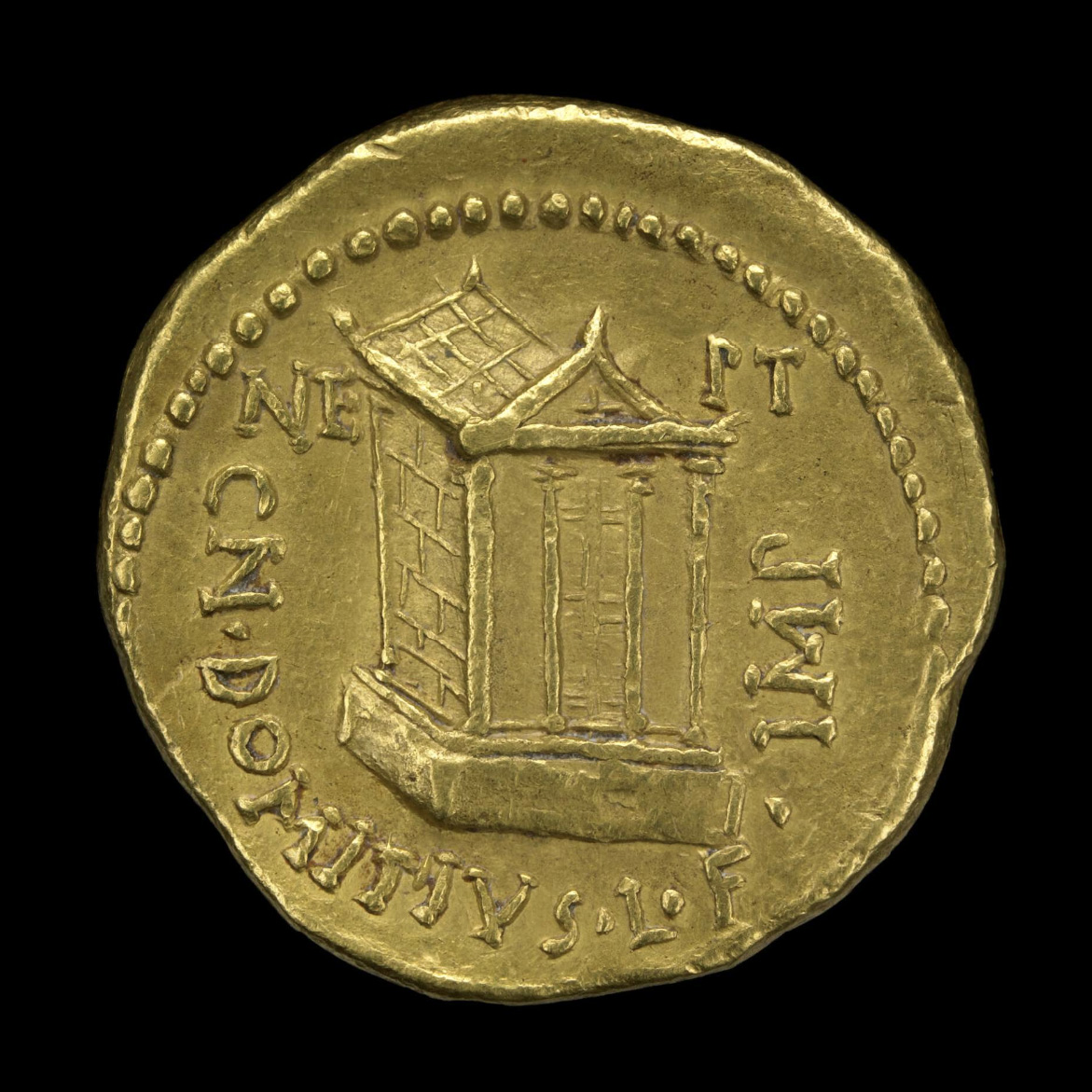
Gold coin, possibly depicting the now-lost Temple of Neptune in Rome, minted by Domitius Ahenobarbus, grandson of the the altar’s patron, c. 41 B.C.E., gold (© The Trustees of the British Museum, London)
Original location and use
It is possible that the monument base—and the now-lost monument it supported—originally stood outside the Temple of Neptune located in the Circus Flaminius, a southern portion of the larger Campus Martius in Rome. This area of the Campus Martius was associated with the route of the triumphal parade along which victorious generals would process when they were granted the right to celebrate a triumph following certain military victories. The monument is often connected with the Roman Cnaeus Domitius Ahenobarbus who vowed a Temple of Neptune in the Campus Martius following a naval victory in either 129 or 128 B.C.E. A 1st-century B.C.E. descendant of Ahenobarus minted a coin that may depict the façade of the temple.
Iconography
The civic relief receives a great deal of attention and is often referred to as the “census-taking frieze” (now in the Louvre LL 399 ; Ma 975.1 ; Ma 975). These interpretations are based on the view that the activity depicted in the sculpted scene is related to the decennial collection of the Roman census by magistrates called censors. A recent reinterpretation of the scene prefers instead to link the scene to the ritual foundation of a Roman colony.

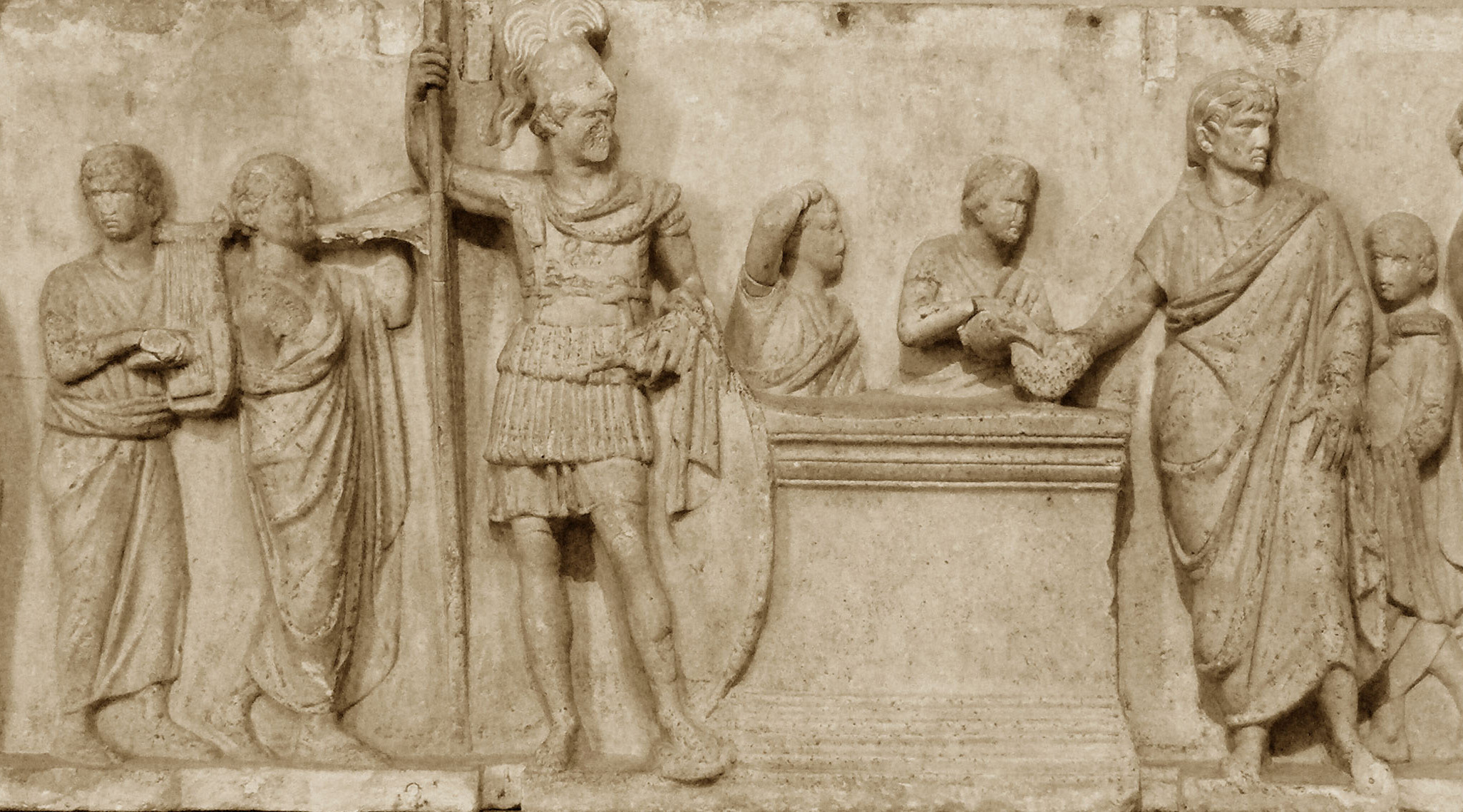
Altar of Domitius Ahenobarbus, late 2nd century B.C.E. (Roman), marble, 84 x 566 cm (Musée du Louvre, Paris)
The iconography of the relief can be broken down into three groupings, from the viewer’s left to right. At the left extreme are six figures—four standing, two seated. The seated figures are magistrates whose attendants/assistants stand nearby; looking on are two soldiers. The central grouping of the relief is focused on activity taking place at an altar where a male wearing a toga and looking right is about to preside over a blood sacrifice. A standing figure in a warrior’s kit stands to the left of the altar; some have suggested that he represents the god Mars, who gives his approval to the sacrificial activities. Several sacrificial attendants assist the sacrificant. The rightmost grouping in the relief comprises the three sacrificial animals—the top-flight Roman state sacrifice of pig, sheep, and bull known as suovetaurilia. There are several more soldiers at the far right.

Altar of Domitius Ahenobarbus, late 2nd century B.C.E. (Roman), marble (Glyptothek, Munich; photo: Cassius Ahenobarbus, CC BY-SA 3.0)
The fragments of the so-called marine thiasos relief are housed in Munich today. The thiasos scene has its roots in the mythology of the god Dionysus, often representing the god’s ecstatic return to Mount Olympus. Here, the marine variant is employed to depict the wedding of the Nereid Amphitrite (Salacia in Roman terminology) to the sea god Poseidon/Neptune. At the center of the processional scene is the wedding party; we also see a hippocamp, a mythological sea creature with the forequarters of a horse and the tail of a fish. This marine scene seems to match the topographic setting of this monument facing the temple of Neptune.
Implications
While the precise interpretation of the fragments of the monument remains debated, the implications of this relief are nonetheless significant in any discussion about the emergence of an iconographic system of Roman “state art” in the Republican period, a system that will prove enormously influential as the “republic” transitioned to “empire.” The so-called altar of Domitius Ahenobarbus demonstrates that a fairly consistent and legible iconographic system was developing. The viewer could rely on this system to be dependably legible; civic and ritual acts could be commemorated in static art, and the meaning and symbolism of those acts communicated to the viewership.
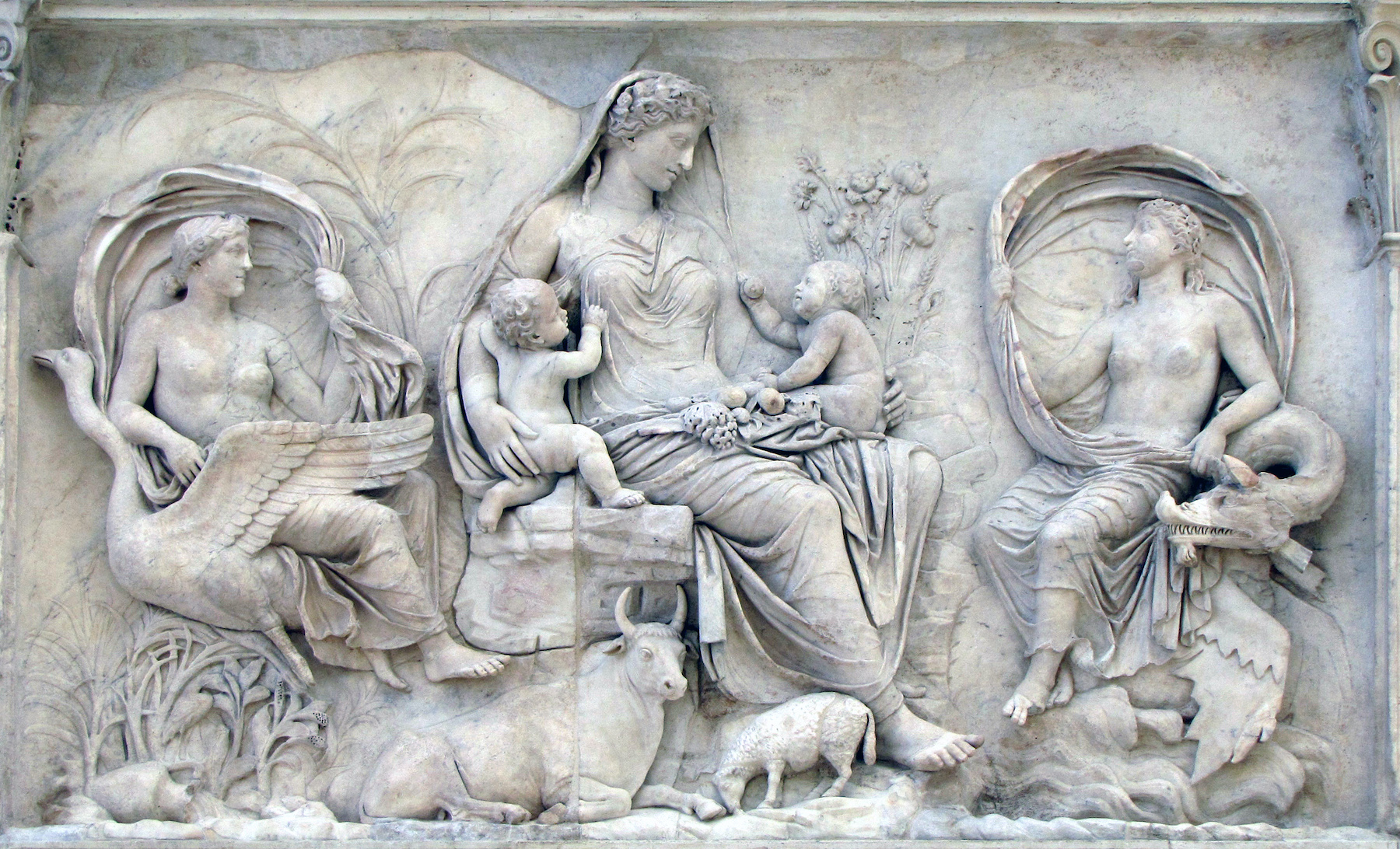
Relief from the Ara Pacis Augustae (Altar of Augustan Peace), 9 B.C.E., marble (Museo dell’Ara Pacis, Rome; photo: Steven Zucker, CC BY-NC-SA 2.0)
These mechanisms of communication played a vital role in encoding the represented activities in shared, collective memories. It is possible, then, that we might see this set of fragmentary reliefs as an early example of what will become a long and well-established tradition of Roman historical relief sculpture, meaning sculpture that purposefully depicts “real world” events in static form, using this legible system of iconography. Patrons of such art forms, whether they are high-ranking citizens or the state itself, play an outsize role not only in deciding what to commemorate but also in deciding what comes to be “remembered” by the collective conscience of the community of citizens.