Donatello, Annunciation

Donatello reinvents classical vocabulary to tell the Christian story of the Annunciation.

Donatello, Annunciation, 1433–35, pietra serena, gilding; putti made of terracotta and stucco, 420 x 274 x 30 cm, south aisle, Basilica of Santa Croce, Florence; commissioned by Niccolò di Giovanni Cavalcanti, brother-in-law of Lorenzo de’ Medici. Speakers: Dr. Beth Harris and Dr. Steven Zucker

0:00:06.9 Dr. Beth Harris: We’re in the church of Santa Croce in Florence. This is a very important Franciscan church and a place where many of the wealthy families of Florence established chapels, were buried here. We’re looking at a relief sculpture by Donatello that once formed part of a chapel and below it would have been a table for an altar.

0:00:29.4 Dr. Steven Zucker: But over time, churches as old as this are transformed and so we’re seeing the sculpture now in a more public environment than it would have been seen earlier. It would have been contained within the family chapel.

0:00:40.5 Dr. Beth Harris: What’s so fun about this relief sculpture is that Donatello has returned from Rome. He’s made a trip to study the remains of ancient Roman sculpture and that’s evident when we look at this Christian scene of the Annunciation where on the left, the angel Gabriel announces to Mary that she will bear Christ and Mary reacts very humbly to that news.

0:01:05.2 Dr. Steven Zucker: And I can just imagine, Donatello returning to Florence, his head filled with ideas that he had taken back from Rome, the fragments of antiquity. And his work is almost a collage of these ideas that he’s brought back.

0:01:17.2 Dr. Beth Harris: Donatello is not making an attempt here to strictly follow the arrangement of the forms of classical antiquity. He’s been inventive here.

0:01:27.3 Dr. Steven Zucker: Donatello may not have even understood that there were rules. And so we have invented columns. We don’t have Doric or Corinthian or Ionic columns. There are volutes at the bottom of these squared columns rather than as a capital at the top. And as capitals, we have human faces. This is a reinvention of classical vocabulary.

0:01:48.2 Dr. Beth Harris: We also see volutes at the top of this curved pediment, very reminiscent of Alberti’s exterior of Santa Maria Novella. And below that a string of rosettes, and a frieze of the egg and dart pattern. We also see curving vines and vegetal and floral patterns. All of this is borrowed piecemeal in a way from ancient Roman architecture.

0:02:13.7 Dr. Steven Zucker: And in just a few years, Alberti will write down, in a sense, the rules of ancient architecture.

0:02:19.8 Dr. Beth Harris: And yet here we are looking at a Christian scene of the Annunciation.

0:02:24.4 Dr. Steven Zucker: All of those architectural elements function as a framing device for the scene within. But even the figures have elegance that we might associate with ancient Rome.

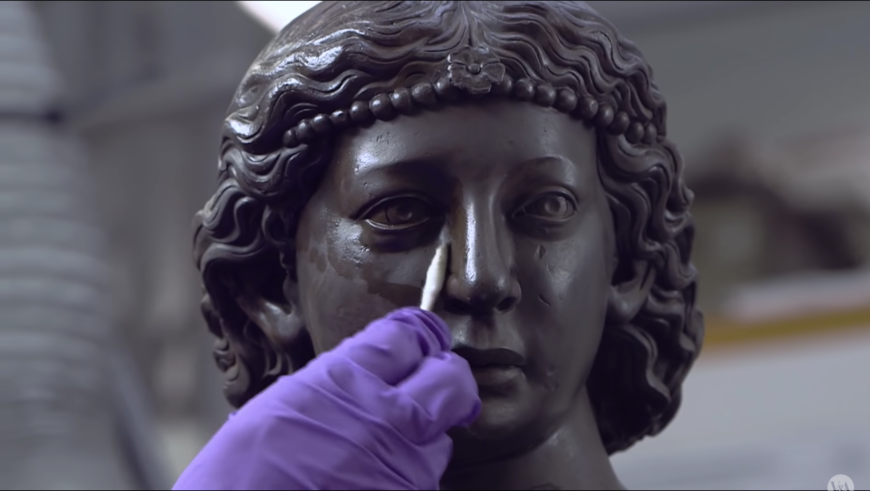
0:02:34.2 Dr. Beth Harris: Particularly the face of Mary, she looks as though she was taken straight from an ancient Roman sculpture.

0:02:39.6 Dr. Steven Zucker: But it’s their bodies as well. There’s a kind of ease and movement that we associate with the classical world and the close study of anatomy. The Virgin Mary’s right leg has a bent knee. It’s not a weight-bearing leg. And clearly Donatello is inspired by the careful observation of the human body that is evident in so much ancient Roman sculpture.

0:02:59.4 Dr. Beth Harris: The figure of Mary and the figure of the angel Gabriel are represented in high relief. In fact, they cast shadows on the fictive doorway behind them. He’s playing with different levels of relief. So, the figures are in high relief. The lectern behind Mary is in slightly lower relief. And then the decorative patterning on the doorway that we see with touches of gilding is incised.

0:03:21.9 Dr. Steven Zucker: And that sense of dimensionality is emphasized because the figures are set back in a stage-like space. The squared columns on either side are quite forward in comparison to the figures.

0:03:32.4 Dr. Beth Harris: One of the things that I really love are the gestures of the figures. The angel Gabriel crosses her left arm over her body and reaches toward her right leg, pulling at the drapery there. Mary, too, has enclosed her body with the gesture of her hands, her left hand holding a book. Both figures are self-contained, but also through their glances communicating with one another.

0:03:56.0 Dr. Steven Zucker: Look at the way that the arcs of Gabriel’s arms are echoed by the arc of the lectern and then echoed by the turn of Mary’s body. There’s this continuity in the composition of the work that creates a unity across the surface of the sculpture.

0:04:08.2 Dr. Beth Harris: The sculpture is gray, this is a stone that was commonly used in Florence. We see it in the architecture of Brunelleschi. It’s called pietra serena. It’s a grayish, almost greenish sandstone. And originally we think that parts of it were painted white so that it appeared like marble.

0:04:25.6 Dr. Steven Zucker: And, you’ll notice that there’s gilding on selected elements. This is restored but follows the original.

0:04:30.9 Dr. Beth Harris: And, perhaps the most playful part of the sculpture is the terracotta putti, or little angels at the top, who seem to be reacting to the scene below. One of them lifts his foot and appears as though he’s about to step off the cornice while a little angel behind him holds onto him to make sure he doesn’t fall.

Title Annunciation
Artist(s) Donatello
Dates 1433–35
Places Europe / Southern Europe / Italy
Period, Culture, Style Renaissance / Italian Renaissance
Artwork Type Sculpture / Relief sculpture
Material Sandstone, Gold, Terracotta, Plaster
Technique Carving, Incising, Gilding, Contrapposto

This work at the Basilica di Santa Croce

H. W. Janson, The Sculpture of Donatello (Princeton: Princeton University Press, 1963, first published 1957).

Joachim Poeschke, Donatello and His World: Sculpture of the Italian Renaissance (New York: H. N. Abrams, 1993).

Jim Harris, “Donatello and the Making of a Florentine Annunciation,” Thomas Puttfarken Workshops I & II Proceedings, edited by E Mavromichali and I Assimakopoulou, 1st edition (Thessaloniki: University Studio Press, 2023), pp. 137–70.

Cite this page as: Dr. Beth Harris and Dr. Steven Zucker, "Donatello, Annunciation," in Smarthistory, September 22, 2025, accessed December 14, 2025, https://smarthistory.org/donatello-annunciation/.