Hans Memling, Christ Blessing

Resting his hand on the edge of the frame, Christ seems to meet the viewer in real space.

Hans Memling, Christ Blessing, 1481, oil on panel, 35.1 x 25.1 cm (Museum of Fine Arts, Boston). Speakers: Dr. Christopher D.M. Atkins, Van Otterloo-Weatherbie Director, Center for Netherlandish Art, Museum of Fine Arts, Boston, and Dr. Beth Harris, Smarthistory

VISITFLANDERS has joined forces with Smarthistory and the Center for Netherlandish Art at the MFA Boston to bring you a series of video conversations with curators on important Flemish paintings by artists such as Jan van Eyck, Hans Memling, Peter Paul Rubens, and James Ensor.


 

Visit Flanders logo

Center for Netherlandish Art, MFA Boston logo

0:00:06.6 Dr. Beth Harris: We’re standing in the galleries at the Museum of Fine Arts in Boston. We’re looking at a painting by Hans Memling, one of the great painters of the Northern Renaissance. And when you’re walking through the galleries, you might at first mistake this for a portrait because it’s so real-looking and so specific.

0:00:25.2 Dr. Christopher D.M. Atkins: While this painting has many portrait elements to it, it is not a portrait. It is an image of Christ blessing.

0:00:31.6 Dr. Beth Harris: That Northern Renaissance mastery of oil paint to create an amazing illusion of reality.

0:00:39.3 Dr. Christopher D.M. Atkins: That palpable sense of texture and form.

0:00:42.3 Dr. Beth Harris: We even have a sense of the softness of his beard because of what oil paint can do in terms of imitating textures. And it has that frontality that we expect of an image of a holy person.

0:00:56.6 Dr. Christopher D.M. Atkins: Memling’s the second generation of the great oil painters in the early Netherlandish-Flemish tradition, generation after Rogier van der Weyden and Jan van Eyck. And so he learned from what they could do and taking it to the next level. Memling did an amazing job of creating the sense of volume as if there’s a real person here. We get the light and shadow on the neck, on the nose and forehead as if this person exists in three-dimensional space. And the particularities of very distinctive eyes and nose and mouth structure too.

0:01:27.8 Dr. Beth Harris: And so this is, in a way, a portrait of Christ.

0:01:32.7 Dr. Christopher D.M. Atkins: An imagined portrait based on text, based on earlier images, including Byzantine icons, which people in Northern Europe were aware of. But it is also an updating or contemporizing by making Christ have some elements that make him look like a real person and also existing in real space, our space. I think what unlocks the picture for me, or at least for a modern viewer, is that left hand where the fingers are resting on the edge of the frame, which disrupts the traditional iconic approach. And that gesture transforms our figure into a three-dimensional person who is existing within the boundaries of the frame.

0:02:10.9 Dr. Beth Harris: I’m just noticing his left thumb. We see one side in shadow, one side of the thumb that’s illuminated, the fingernails. This is an image that reminds us of Christ’s humanity. The idea of a figure who you could focus your devotion on, your meditation, and in a way almost have a personal conversation with that was really important for people in the 15th century.

0:02:35.9 Dr. Christopher D.M. Atkins: The relatively small scale tells us this too. This was not an image for display on an altarpiece in a church. It was a private devotional image where you could have that direct experience through prayer.

0:02:48.2 Dr. Beth Harris: And this is a kind of spiritual practice that emerges in the 14th and then in the 15th century. And artists are in a way answering that need by producing these very personal images. So we could say that this is a 15th century version of a long line of similar images. We can think of images that were said to have not been created by man, miraculous images of Christ, like the one that appeared on the cloth that Veronica gave Christ to wipe his face when he was on his way to the crucifixion.

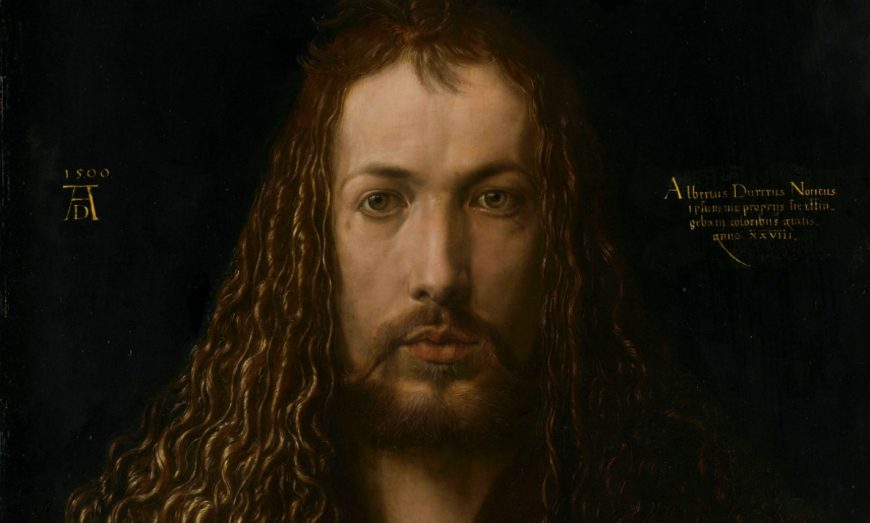
0:03:22.8 Dr. Christopher D.M. Atkins: If you place this within the history of art, this is the exact type of image of Christ that Albrecht Dürer is responding to when he paints his self-portrait. This painting exists at this pivotal moment where we’re transitioning from the iconic into the era of art. And we have a date at the top of the frame, which identifies this as 1481, which marks it as a created object, as the work of art by someone at that specific moment.

0:03:50.6 Dr. Beth Harris: And that contrasts so perfectly with the icons that were venerated earlier in the medieval world, where the images that were holiest were those that were not created by human hands, but had a miraculous origin. But here, the importance of the artist, and that is a sign that we’ve entered the early modern world.

0:04:12.7 Dr. Christopher D.M. Atkins: Absolutely. This is the era where we know artists by name. This is all part of this dialogue of the changing perceptions of what art is and can be.

Title Christ Blessing
Artist(s) Hans Memling
Dates 1481
Places Europe / Western Europe / Belgium
Period, Culture, Style Renaissance / Northern Renaissance
Artwork Type Painting
Material Oil paint, Canvas
Technique Chiaroscuro

This work at the Museum of Fine Arts, Boston

Till-Holger Borchert, editor, Memling’s Portraits, exhibition catalogue (London: Thames & Hudson, 2005).

Debra Cashion, Henry Luttikhuizen, and Ashley West, editors, The Primacy of the Image in Northern European Art, 1400–1700 (Leiden: Brill, 2017).

Craig Harbison, “Visions and Meditations in Early Flemish Painting,” Simiolus: Netherlands Quarterly for the History of Art, volume 15, number 2 (1985), pp. 87–118.

Barbara Lane, Hans Memling, Master Painter in Fifteenth-Century Bruges (Turnhout: Brepols, 2009).

Alfred Michiels, Hans Memling (New York: Parkstone Press International, 2007).

Cite this page as: Dr. Christopher D.M. Atkins, Van Otterloo-Weatherbie Director, Center for Netherlandish Art, Museum of Fine Arts, Boston and Dr. Beth Harris, "Hans Memling, Christ Blessing," in Smarthistory, August 14, 2025, accessed December 14, 2025, https://smarthistory.org/hans-memling-christ-blessing/.