Statue of a Victorious Youth
Getty Conversations

Would you believe that this ancient Greek statue was found at the bottom of the ocean by fishermen in the 1960s?

A conversation with Dr. Kenneth Lapatin, Curator of Antiquities, Getty Museum and Dr. Beth Harris, Executive Director, Smarthistory, in front of Statue of a Victorious Youth, Greek, c. 300–100 B.C.E. Bronze with inlaid copper, 151.5 x 70 x 27.9 cm. Getty Museum, Los Angeles.

Would you believe that this ancient Greek statue was found at the bottom of the ocean by fishermen in the 1960s? What was once a shining emblem of Olympic achievement underwent a physical transformation and now tells of its journey far from home.

Getty has joined forces with Smarthistory to bring you an in-depth look at select works within our collection, whether you’re looking to learn more at home or want to make art more accessible in your classroom. This six-part video series illuminates art history concepts through fun, unscripted conversations between art historians, curators, archaeologists, and artists, committed to a fresh take on the history of visual arts.
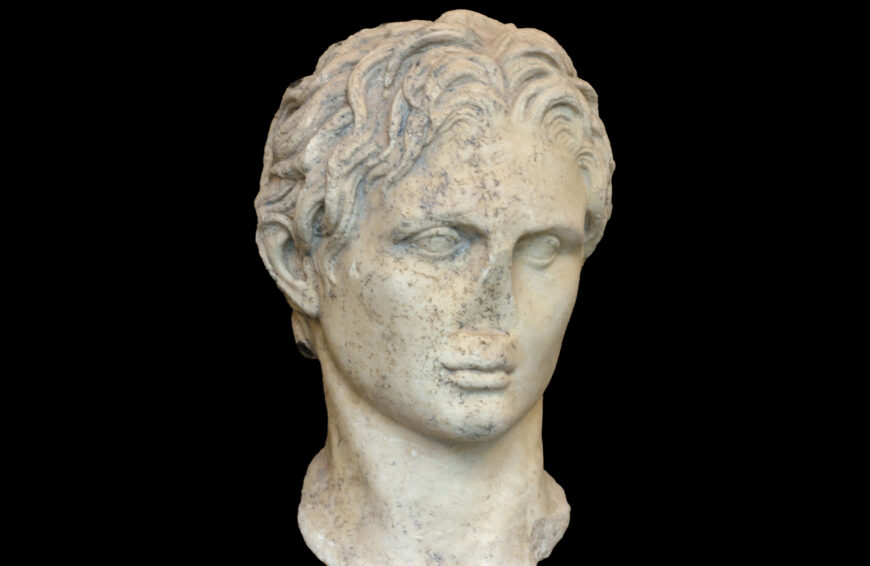
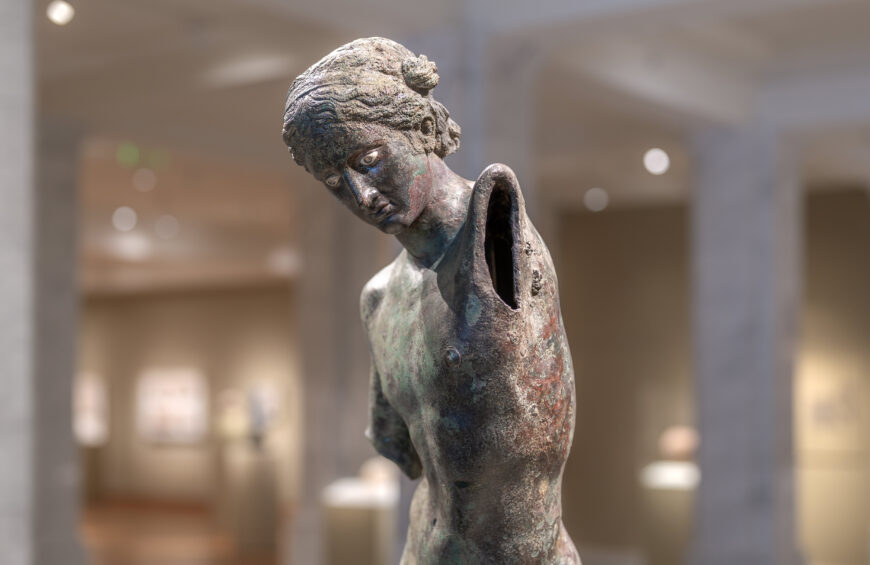
0:00:05.0 Dr. Beth Harris: We’re in the Getty Villa, and we’ve walked into a gallery, and we’re immediately confronted by this idealized male nude.

0:00:14.3 Dr. Kenneth Lapatin: This rare, stunning ancient Greek bronze looks very different today than he did in antiquity. He’s a mottled greenish, brownish, reddish, orangish color, where in antiquity he was a golden, metallic yellow. He’s designed to stand outdoors. We don’t know exactly where he stood, but victor statues of this type stood either in the place where they won their victories, such as the Sanctuary of Zeus at Olympia, where the Olympic Games were, or in their hometowns, where they were culture heroes, like Olympic victors today go on the covers of Wheaties boxes. But he’s a different color. He’s lost his feet. They were torn off at some point in his long history. He’s lost his eyes, which would have been inlaid in colored glass or polished stone or maybe ivory, and those would have given him vivacity.

0:01:12.8 Dr. Beth Harris: These are the result of the fact that he spent years, we’re not sure how long, under the water.

0:01:18.4 Dr. Kenneth Lapatin: He was found by fishermen in the Adriatic Sea in the 1960s, and he was covered with barnacles and other marine growth, which have all been removed by conservators, and that’s why he has this mottled skin. He does preserve metallic inserts. His nipples and lips were covered in copper, so he would have had this golden yellow, brownish skin and bright red nipples and lips, inlaid colored eyes, and his hair and his wreath would have probably been patinated a darker color. The wreath maybe was gilded, and it’s from the wreath, only fragments of which survive, but we can identify as an olive wreath, makes us think he was a victor at the Games at Olympia. And here, either he’s just put it on his head, or maybe he’s reaching for it to take it off, because this is something victors did. They dedicated their victories to the gods. This was a form of humility, although he doesn’t look very humble. He still has to be humble to the gods.

0:02:22.3 Dr. Beth Harris: Although bronze sculptures of athletes are very rare today, they were very common in antiquity.

0:02:28.3 Dr. Kenneth Lapatin: We have literary descriptions from ancient authors of hundreds, if not thousands of them. We have statue bases with the footprints of bronze statues that have been taken and over the years melted down to reuse, so they were turned into shields and spears and buckets and hinges. And so the ones that we have today, paradoxically, we have because of disaster, earthquake, landslide, shipwreck.

0:02:53.9 Dr. Beth Harris: So this immediately raises the question why he was in transit. So at some point, his location, his context, his reason for being changed.

0:03:04.0 Dr. Kenneth Lapatin: And we can come up with various scenarios without answers. Was he taken from Greece to Italy as plunder, as a great work of art, and the ship went down? But maybe he was knocked off of his statue base and broken at the ankles, and he was being transported to be melted down. A lot of information originally would have been contained on his base. The base would have had an inscription that would give us his name, his father’s name, where he was from, probably what event he won the games in. His body tells us a little bit. He was maybe a runner or wrestler, javelin thrower. He doesn’t seem to be a boxer. And of course, the base could even have given us the name of the artist. The height of the base is also important because it would tell us how he was designed to be seen. Personally, I think he looks better if we bend down and look up at him.

0:03:56.2 Dr. Beth Harris: His face appears so idealized, but from the side, seems more individualized.

0:04:02.3 Dr. Kenneth Lapatin: And that has led some people to try to identify him as a specific historical individual, which is in some ways very optimistic.

0:04:10.7 Dr. Beth Harris: One of the questions that art historians have raised is, could this sculpture be by the great 4th-century sculptor that we know about from literary sources, Lysippos?

0:04:22.0 Dr. Kenneth Lapatin: Lysippos was the favorite sculptor of Alexander the Great, and he’s reported to have made over 1,500 statues in bronze, which is a staggering number.

0:04:33.0 Dr. Beth Harris: None of which survive.

0:04:34.4 Dr. Kenneth Lapatin: Although there are ancient replicas of his works. One of the things that Lysippos is known for is coming up with new proportions of thinner figures, of representing movement, of having figures with smaller heads. So this statue conforms to Lysippian ideals and proportions as we know them, but to say that it is an original by Lysippos is a stretch. We don’t even know his date. He might be from the late 4th century, the period of Lysippos, but he could be from the 3rd or the 2nd century. These statues were made in molds. From what we know about this statue and other bronzes, it seems that someone like Lysippos would have a lot of models and body parts in different positions. That’s how he and his workshop could produce 1,500 statues.

0:05:22.6 Dr. Beth Harris: Let’s talk about his lifelikeness, his sense of movement.

0:05:27.8 Dr. Kenneth Lapatin: I think there are a couple of factors that lead to that. One is the subtle and accurate understanding and depiction of anatomy. Not only the soft bulge of, say, his abdomen or the firmness of his biceps, but the way these muscles seem to respond to one another as the body shows movement, but also as they respond to gravity. This is very much an illusion. Our bodies are chaotic. They’re imperfect, and what Greek sculptors did is they filtered that chaos, and they selected certain attributes and highlighted them, and they suppressed others. He’s shown at this flower of youth, this period the Greeks praised. He’s very toned. We can see traces in his hands of tendons and veins under the skin. And these elements, when you catch one or two, they trigger your brain. You think, well, this is accurate. It’s not accurate. We would say realistic rather than real.

0:06:31.0 Dr. Beth Harris: And there’s this smooth transition between the parts of his body.

0:06:35.4 Dr. Kenneth Lapatin: We have to remember the Greeks did their athletic events in the nude. The gymnasium comes from the Greek word gumnos, meaning nude. And so they saw a lot more nude bodies, and so they would have done a lot simply by observation.

0:06:53.4 Dr. Beth Harris: So let’s talk about his left hand.

0:06:55.5 Dr. Kenneth Lapatin: The left hand may have held a palm branch. It’s a very common attribute of victors. But this hand could have also, in the sculptor’s workshop, been applied to a statue of a young warrior and could have held a sword. This is how flexible and pragmatic the sculptor’s workshops were.

0:07:14.5 Dr. Beth Harris: To me, this epitomizes this Greek love of the male nude.

0:07:19.9 Dr. Kenneth Lapatin: And if we go back a few centuries, we still had nude male figures, the very stiff frontal so-called kouroi standing with arms at their sides. And those were used for victory statues, for funerary statues, for commemorative statues. And with time, there was almost a race to make things more naturalistic and more idealized and beautiful. And he seems to really reach that height where he’s confident in his own beauty, his own youth, his own prowess. He’s just won the games. He has his olive crown, and he’s submitting to the gods but to no one else.

Title Statue of a Victorious Youth
Artist(s) Unrecorded artist
Dates c. 300–100 B.C.E.
Places Europe / Southern Europe / Greece
Period, Culture, Style Ancient Greek / Hellenistic
Artwork Type Sculpture
Material Bronze
Technique Casting

Cite this page as: Dr. Kenneth Lapatin, Dr. Beth Harris and The J. Paul Getty Museum, "Statue of a Victorious Youth
Getty Conversations," in Smarthistory, March 28, 2022, accessed December 14, 2025, https://smarthistory.org/statue-of-a-victorious-youth-getty-conversations/.