

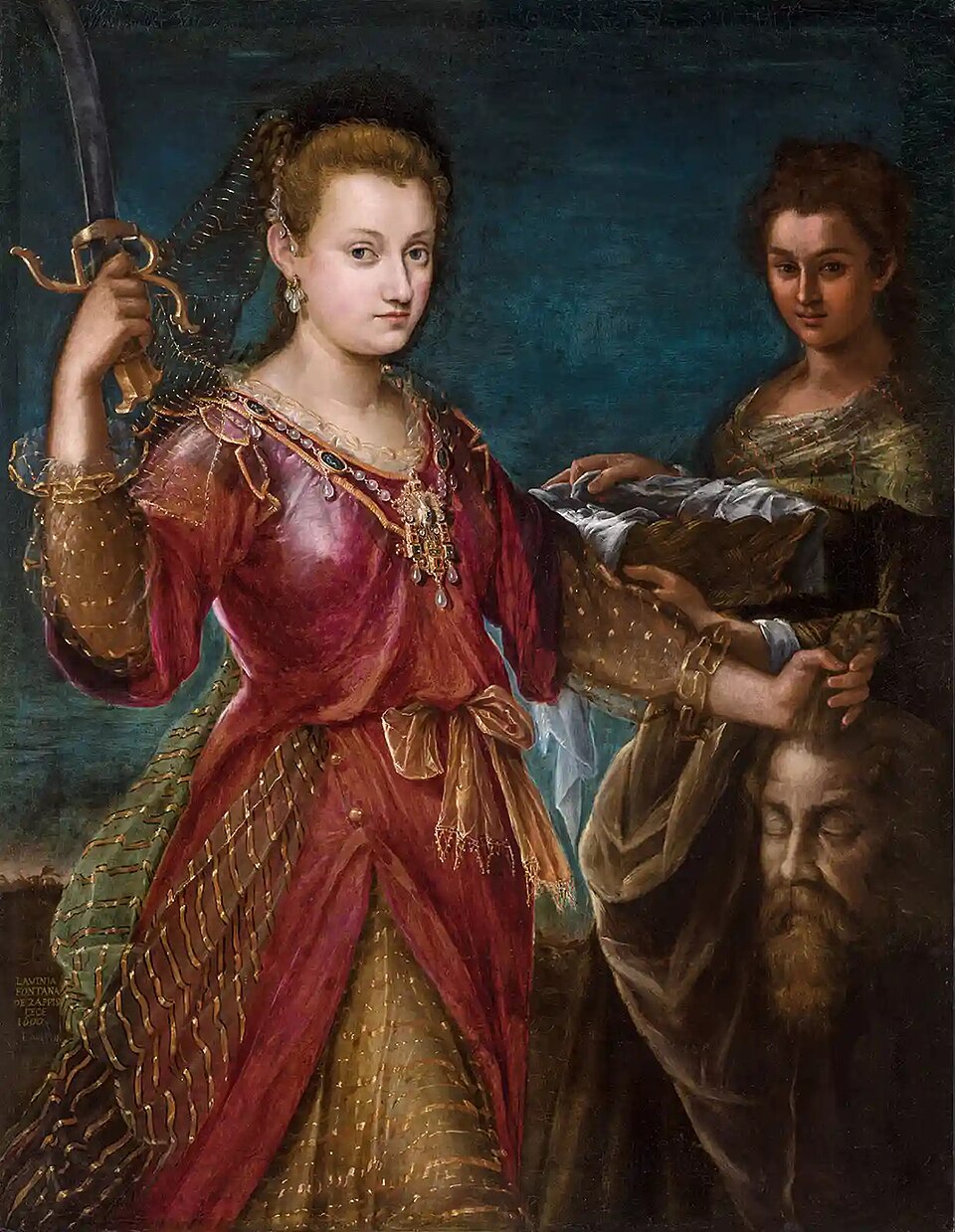
Lavinia Fontana, Judith with the Head of Holofernes, c. 1600, oil on canvas, 123 x 97 cm (Museo Davia Bargellini, Bologna)
The story was irresistible to Early Modern Europeans: a heroine using her seductive powers to violently overcome an enemy general, saving her people. The story of Judith and Holofernes comes from the Book of Judith, a part of the Catholic Bible. It relates how the Jewish widow rescued the Jews from the Assyrian army. When the Assyrian general Holofernes was besieging Bethulia, a city near Jerusalem, Judith plotted to eliminate him. Judith dressed in her finest clothes, snuck into the enemy camp, and inebriated Holofernes before cutting off his head and returning triumphant.
Violence, seduction, and heroism
The story combines violence, seduction, and heroism. It places a woman in the role of savior hero. (Her status as a widow excused Judith’s otherwise unchaste behavior.) Unlike other religious heroines who triumphed through passive action (e.g. virgin saints who accept death rather than marry a pagan), Judith wins by acting boldly, violently. Artists could depict a scene of high action, one of furtive stealth, or depict Judith as a steady virtuous exemplar akin to a saint.
In Lavinia Fontana’s Judith with the Head of Holofernes, today at the Davia Bargellini museum, the artist exults in the rich detail of the story without sacrificing the drama. Gold-threaded transparent organdie fabric forms the sleeves, underskirt, and adornment on Judith’s sumptuous red dress. The biblical heroine wears a full compliment of large pearls on a weighty necklace. In full command of both herself and the narrative, the Jewish widow stands upright, holding her sword aloft and gripping the Assyrian general’s severed head for the viewer to see. She and her maid Abra, who is standing behind her, together steadily meet the beholder’s gaze.
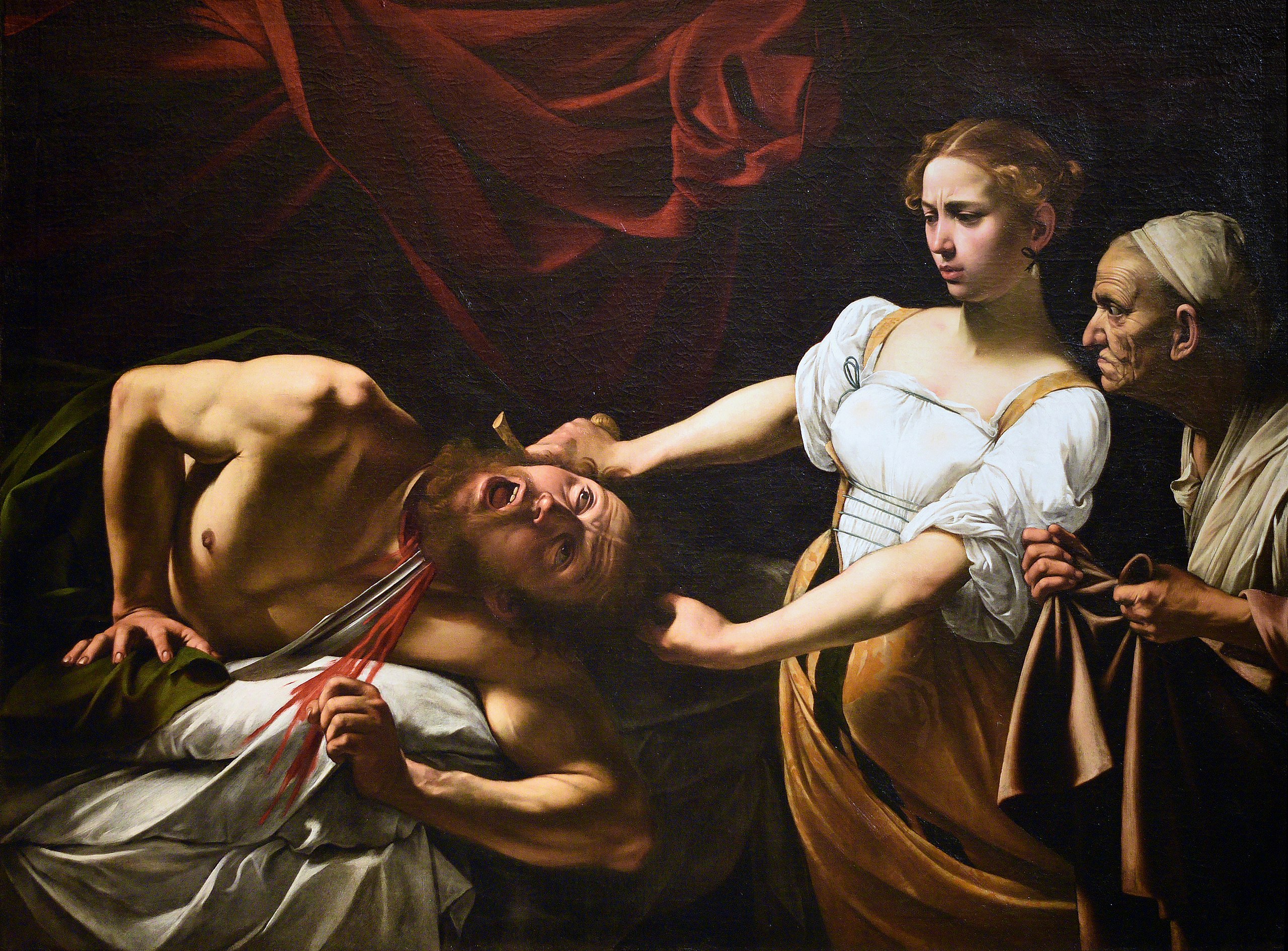
Caravaggio (Michelangelo Merisi), Judith Beheading Holofernes, c. 1599, oil on canvas, 145 x 195 cm (Palazzo Barberini, Rome)
A polyvalent figure
This particular rendition by Fontana focuses on Judith’s power. It was one approach of many that Early Modern artists took with the multivalent figure. In comparing Caravaggio’s contemporaneous rendition, both artists portrayed Judith as an active figure within a narrative rather than an isolated static figure, though Caravaggio’s Judith shrinks away from the gory scene she enacts as if she can’t believe her own actions.
Judith’s ability to embody different meanings was part of her appeal in the 16th and 17th centuries. Judith could represent a generic virtuous woman, serve as an allegory of the Church, a prefiguration of the Virgin Mary, an allegory for Fortitude or Justice, the personification of Wisdom, and a defender against foreign enemies. [1] Early Modern Europeans often understood Judith-as-the-Church in the context of Catholic-Protestant struggles and Judith-as-defender against conflicts with the Ottoman Empire.
While the self-possessed Judith is the ostensible subject, the prominent signature reads LAVINIA FONTANA DE ZAPPIS FECE 1600, i.e., “Lavinia Fontana of Zappi (her husband’s last name) made this in 1600.”
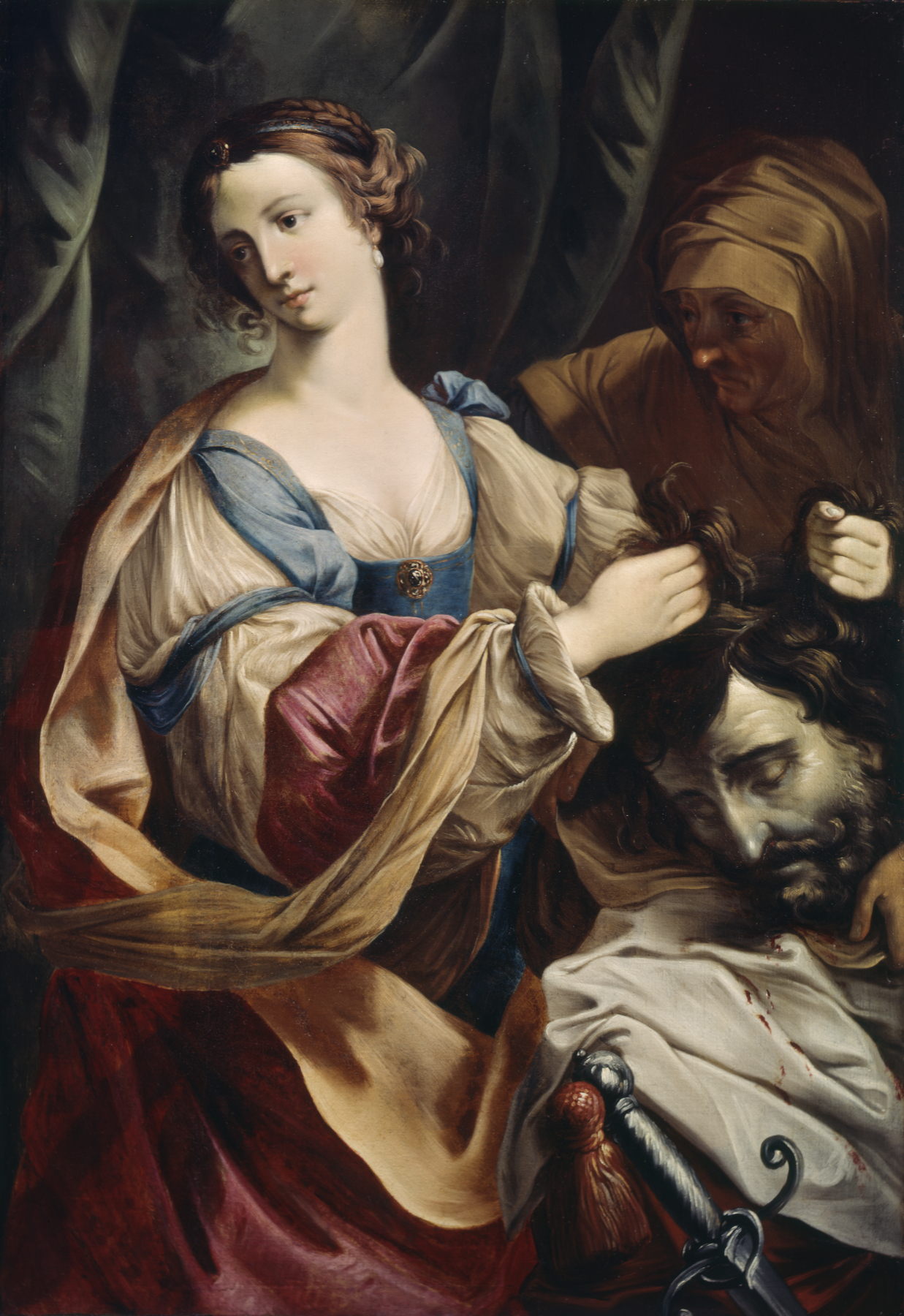
Elisabetta Sirani, Judith with the Head of Holofernes, 1638–55, oil on canvas, 129.5 x 91.7 cm (The Walters Art Museum, Baltimore)
A woman protagonist, a woman painter, and a woman patron?
Lavinia Fontana, who painted three iterations of Judith during her career, was both an early example of a successful woman artist and one of the first women artists to paint istoria, the prestigious genre of narrative painting when the lesser-valued genres of still life and portraiture were considered more appropriate for her gender. Lavinia’s career success would set a model for later artists, including fellow Bolognese painter Elisabetta Sirani and Artemisia Gentileschi, famous for her own interpretations of Judith and Holofernes.
Women faced difficulty accessing training and networking because of social restrictions on their movements in public. Many women painted, but struggled to be recognized as professionals. [2] They also faced prejudice from patrons who valued men’s work more highly. Despite these significant challenges, some women artists found ways to leverage their gender as an advantage. For example, Lavinia and her contemporary Sofonisba Anguissola specialized in portraiture of women; their gender made them more suitable for long sessions sharing a space with a woman sitter. Artemisia Gentileschi portrayed herself as the allegory of painting.
The story of Judith presented a potent opportunity to make a woman artist’s gender an advantage. In the 17th century, the Judith story would become associated with women artists due to the obvious connection between a woman protagonist and a woman artist. Lavinia’s painting in the Davia Bargellini may have been commissioned by a woman patron, one Costanza Bianchetti Bargellini.
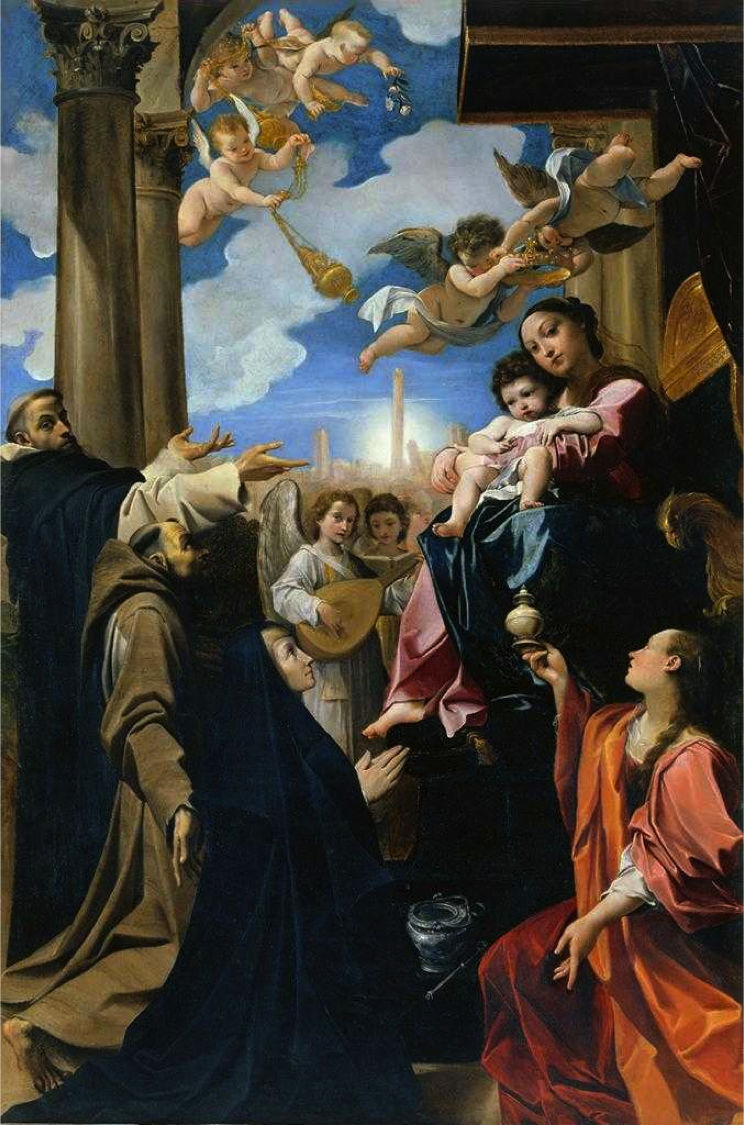
Since the painting remains in the family collection at the Davia Bargellini museum, it’s likely that it was commissioned by a member of the Bargellini family. The Bargellini had appeared previously as the faces of their name saints in a 1588 altarpiece they commissioned from Ludovico Carracci.
Costanza, the widow of Galeazzo Bargellini, may have found it appealing to commission a painting of Judith, also a widow. [3] Lavinia had cultivated a sizable clientele among Bologna’s patrician widows who commissioned work for their homes and public spaces throughout the city. Appealing to women patrons was yet another way in which the artist leveraged her gender for an unexpected advantage in a society that limited socialization between men and women.
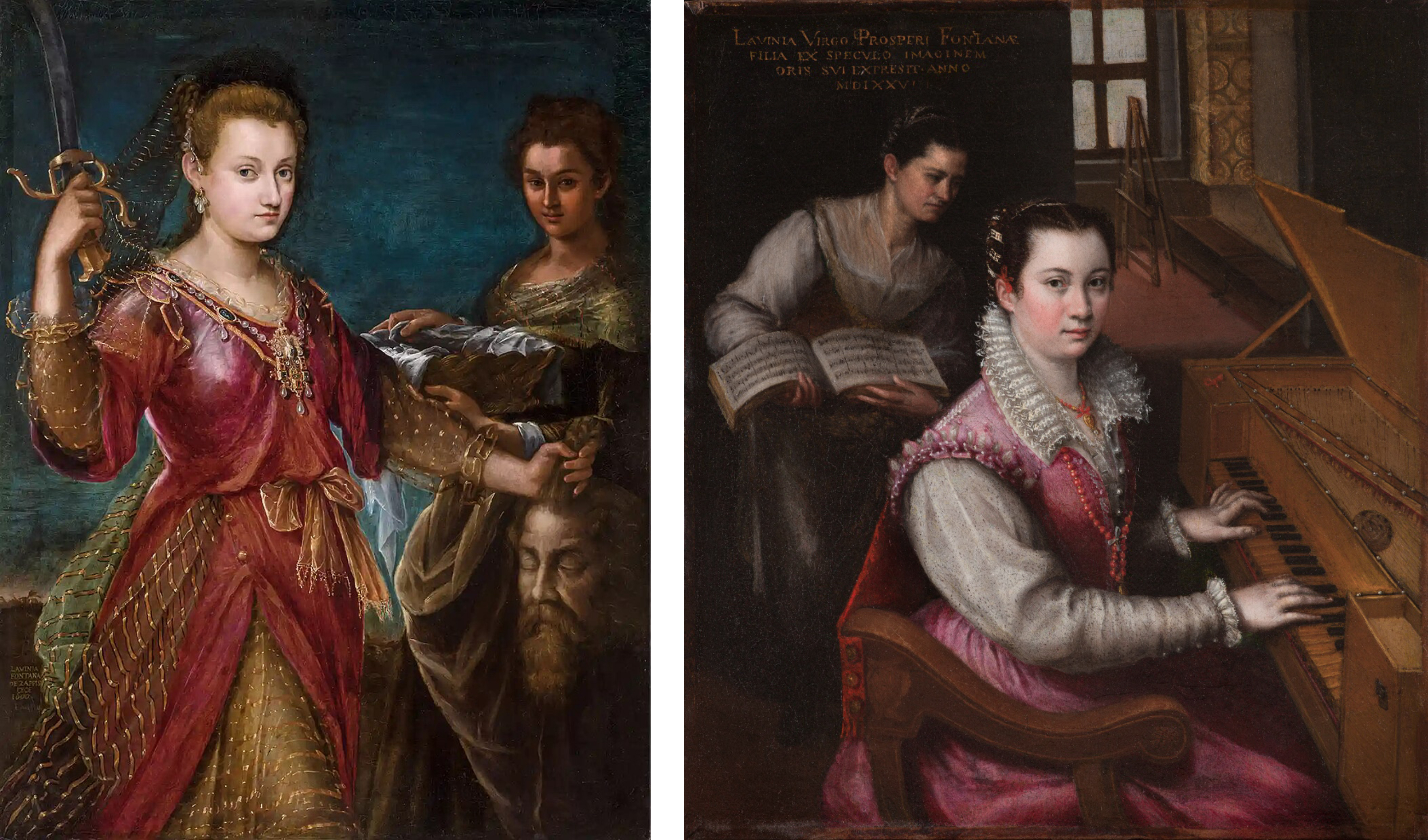
Left: Lavinia Fontana, Judith with the Head of Holofernes, c. 1600, oil on canvas, 123 x 97 cm (Museo Davia Bargellini, Bologna); right: Lavinia Fontana, Self-Portrait at the Spinet, 1577, oil on canvas, 27 x 24 cm (Accademia Nazionale di San Luca, Rome)
A self-portrait?
More than a few scholars have noted the resemblance of Judith’s visage to Lavinia’s self-portraits made during her younger years. [4] Indeed, the Davia Bargellini Judith bears more similarity to Lavinia’s early self-portraits than to the features of Lavinia’s other Judith and Holofernes paintings, such as the more active rendition now conserved at the Pinacoteca Stuard in Parma. In fact, Judith’s maid resembles Lavinia’s servant in her 1577 self-portrait at a spinet. The compositional prominence of Judith’s face in full light despite the nocturnal setting suggests the figure’s face is of more importance that only the narrative would warrant. It’s possible that the patron requested Lavinia’s features on the painted protagonist.
Identifying self-portraits in paintings made centuries ago carries historical risk. Confirmation bias can trick us into seeing self-portraits everywhere. Worse, a focus on self-portraiture can lead us into seeing women artists as objects to be viewed, an image, more than as the agentive creators they were. [5] But should we entertain the possibility, there’s an intriguing potential explanation for finding a self-portrait of the artist in a composition of a biblical heroine likely commissioned by a woman patron.
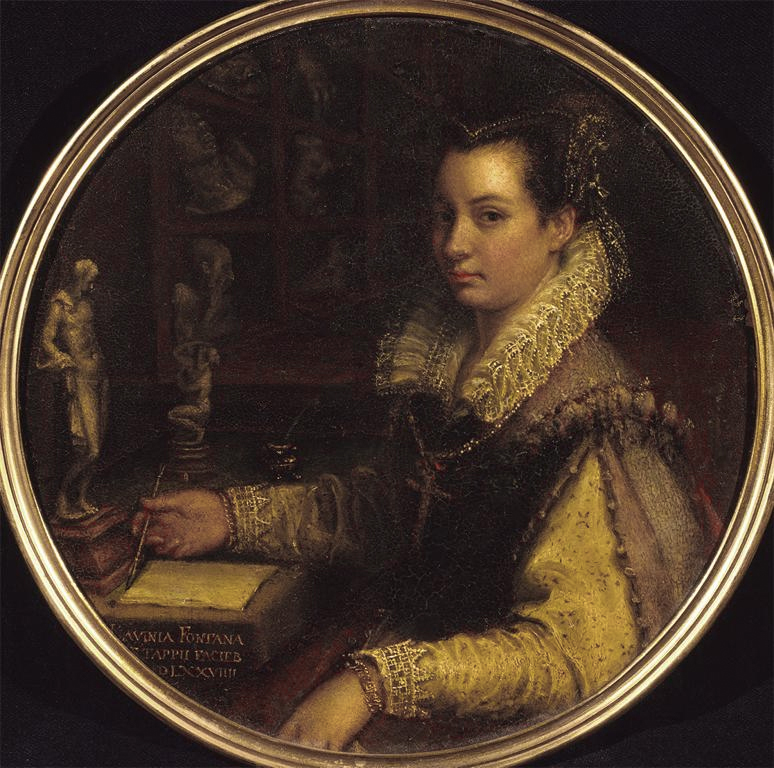
Lavinia Fontana, Self-Portrait in Studio, 1579, oil on copper, 15.7 cm diameter (Gallerie degli Uffizi, Florence)
Illustrious women
Lavinia-as-Judith may have been an image destined for a collection of images of famous persons commissioned by Costanza Bianchetti Bargellini. Some Early Modern patrons, in emulation of ancient and medieval collectors, assembled images of accomplished men and women. Highly lauded artists can be found among them. In fact, Lavinia had previously been asked to provide an image of herself for a patron’s gallery of illustrious men and women.
Twenty years prior to the Judith painting for Costanza Bargellini, the Spanish prelate, antiquarian, and art collector Alfonso Ciacón wrote Lavinia following receipt of three portraits of Bolognese scholars she had painted for him. They joined Ciacón’s planned gallery of illustrious men and women. He also requested she send a self-portrait for this gallery. [6] The painting Lavinia delivered, Self-Portrait in Studio, portrays her as a wealthy well-dressed woman whose erudite collection of antique statuettes coincides rather than contradicts with her Christian faith indicated by a large cross necklace. A painting of Judith bearing the features of Lavinia and combining the illustriousness of both would have been a potent addition to the Bargellini collection.
Compiling a set of illustrious men and women had a long history. The 1st-century Greek writer Plutarch wrote the lives of illustrious men, portraying them as paragons. In the Middle Ages, authors Giovanni Boccaccio in De Mulieribus Claris (“Concerning famous women,” 1374) and Christine de Pizan in La Cité des Dames (“The city of ladies,” 1405) wrote about excellent women. In the 16th century, Paolo Giovio published his collection of portrait paintings in the Elogia veris clarorum virorum imaginibus apposita (“Praise for the true images of famous men,” Venice, 1546), in a project similar to the one Ciacón envisioned. The biblical Judith was lauded as a model of womanly virtue in Tomaso Garzoni’s Le vite delle donne illustri della scrittura sacra (“The lives of illustrious women from holy scripture,” 1586).
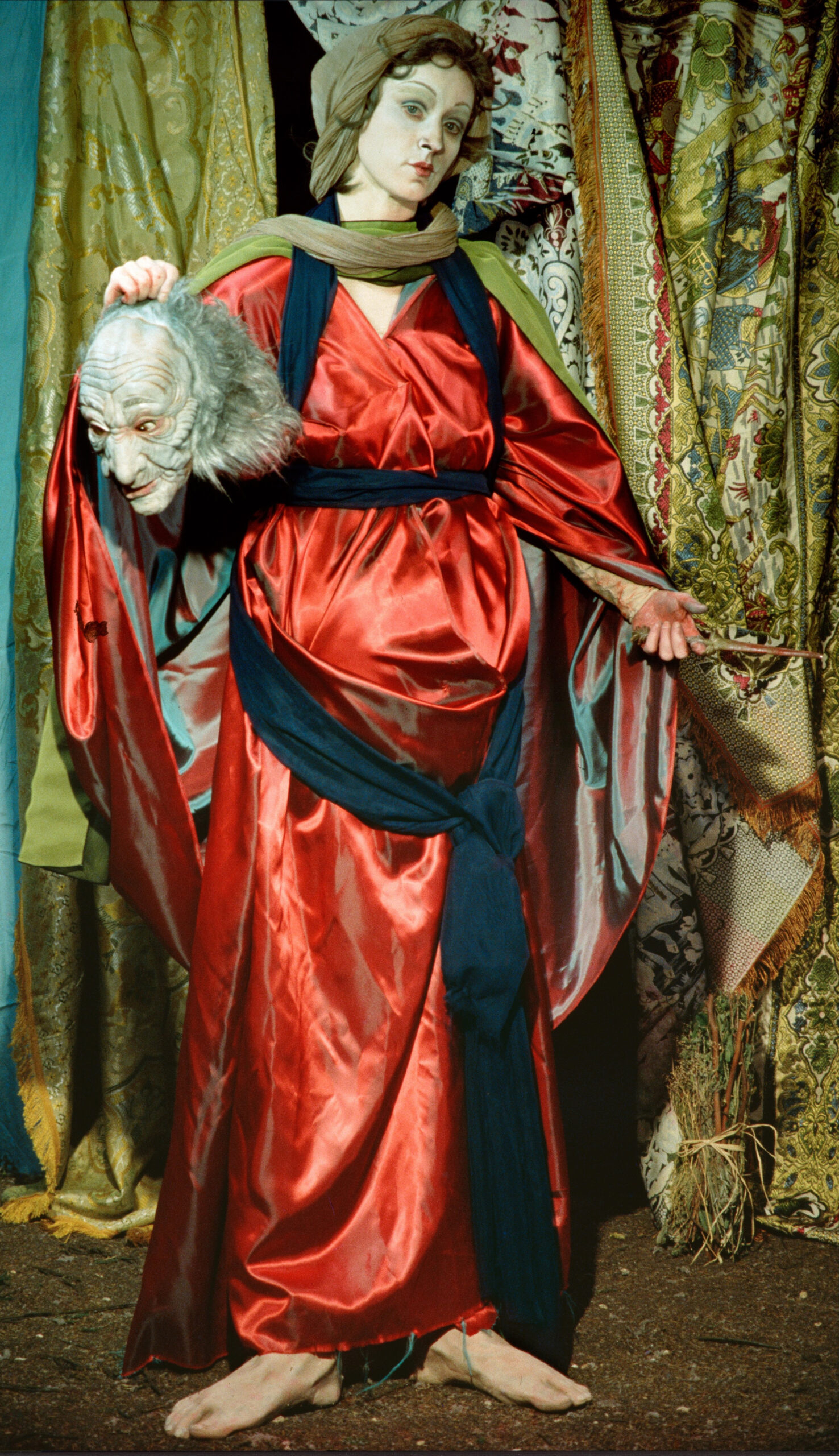
Early Modern images of Judith have remained compelling to modern artists. Cindy Sherman, Untitled #228, from the History Portraits series, 1990, chromogenic color print, 208.4 x 122 cm (The Museum of Modern Art, New York) © 2023 Cindy Sherman,
A gender benefit
Many renditions of Judith and Holofernes were produced in Early Modern Europe, but they’re not all alike, not interchangeable. Each iteration warrants a closer look. Lavinia’s Davia Bargellini Judith navigates a complex gendered terrain—the probable patron’s widow status, the artist’s gender, the heroine subject—in a way that draws attention to womanhood, turning a marginalized status into a benefit.
Lavinia’s creative use of her own image became a model for the next generation of women artists. Artemisia Gentileschi frequently used her own features in paintings of a variety of women subjects creating equivocation between the artist and subject. [7] Eliding the creator with the creation draws attention to the craft of art making beyond the immediate story subject on the canvas surface. In doing so, the artist underscores her status as the artist.