Nicholas of Verdun, Shrine of the Three Kings, Cologne Cathedral

Gleaming with gold, the shrine houses three of the most sacred relics in all of Christendom.

Nicholas of Verdun (and workshop), Shrine of the Three Kings, c. 1181–1220, oak, gold, silver, copper, enamel, and gems, 155 x 112 x 224 cm (High Cathedral Church at Cologne). Speakers: Dr. Beth Harris and Dr. Steven Zucker

0:00:06.4 Dr. Steven Zucker: We’ve come to Cologne to visit Cologne Cathedral, like countless pilgrims before, in order to gaze upon one of the most magnificent, one of the most opulent objects in western Europe. It is this enormous reliquary. It’s gold and studded with gems. This is the shrine of the Three Kings.

0:00:27.6 Dr. Beth Harris: Today, this is located behind the altar at the very east end, the holiest end of the church. It’s in the shape of a church itself and it’s gleaming with gold. Now, much of it is a wooden core covered with silver and gold, but one end of it is solid gold.

0:00:46.5 Dr. Steven Zucker: The shrine was built in order to house three of the most sacred relics in all of Christendom. In fact, this cathedral was rebuilt with the impetus to house and celebrate the contents of this reliquary. The reliquary is famous for holding three skulls. These are the relics of the Three Kings, the three magi that had come from the east to pay homage to the newly born Christ child.

0:01:11.6 Dr. Beth Harris: So, in a way, the Three Kings are the very first Christian pilgrims.

0:01:17.2 Dr. Steven Zucker: And they’re also credited as the very first Christian kings. And in that way, they become extremely important to the kings of the Holy Roman Empire, who, for centuries after they were crowned at the Palace Chapel in Aachen, would come to Cologne to pay homage to the relics within this reliquary. And that gold came from the Holy Roman Emperor, Otto IV, who was part of the Ottonian dynasty that had come after the Carolingian dynasty, after Charlemagne.

0:01:45.6 Dr. Beth Harris: So we’re going way back to the year 800, when Charlemagne reconstitutes the Roman Empire in western Europe. Charlemagne’s empire dissolves and a new dynasty emerges, and that’s the Ottonians, and it’s Otto IV who not only gives the gold for this one end of the shrine of the Three Kings, but who also appears on the shrine itself.

0:02:12.4 Dr. Steven Zucker: But this object is fascinating not only for its history, its symbolism, but also because of its extraordinary metalcraft. This is some of the most beautifully wrought gold work in all of medieval history.

0:02:24.0 Dr. Beth Harris: Well, it was crafted by the workshop Nicholas of Verdun, the most famous goldsmith of his age. He’s responsible primarily for the figures on the lower bands on the long sides of the reliquary. And there we see prophets from the Old Testament. Above we see apostles. At the very top, which no longer exists, were scenes from the life of Christ and scenes from the Book of Revelation.

0:02:53.0 Dr. Steven Zucker: But the reliquary doesn’t just hold these wonderful repoussé figures. The object is also studded with gems and with elements from ancient Rome.

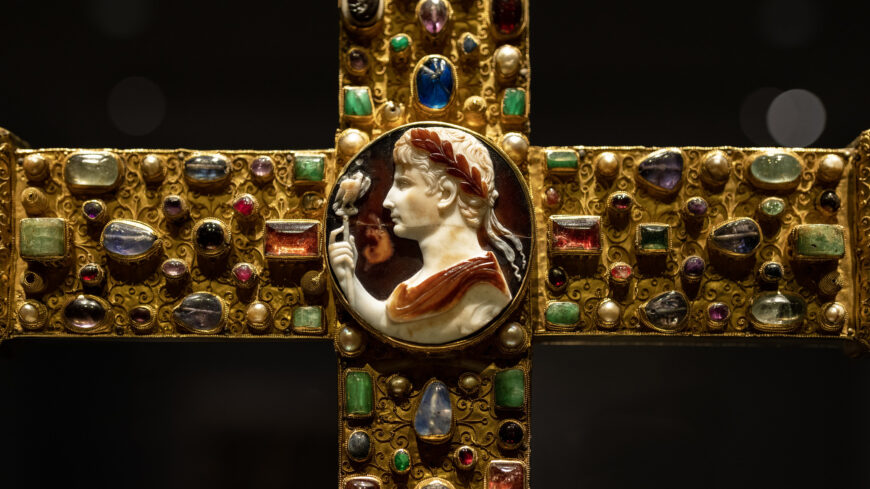
0:03:01.9 Dr. Beth Harris: The Ottonian kings often used spolia, that is, in this case, carved gems and stones and ancient cameos. What the Ottonians were doing was connecting their reign across time to the reign of Charlemagne and before that, to Constantine and to Augustus and the idea of reconstituting that Roman Empire under their rule.

0:03:27.6 Dr. Steven Zucker: Another question that you can ask is, how did the skulls of the three Magi end up in what is now Germany?

0:03:33.4 Dr. Beth Harris: By legend, the Emperor Constantine’s mother, Helena, went to the Holy Land in search of the True Cross. While there, she also discovered, by legend, the relics of the three kings who had given gifts to the Christ child. She brought them back to Constantinople to her son Constantine.

0:03:53.1 Dr. Steven Zucker: Constantine, in turn, gives these precious relics to the Archbishop of Milan. And so now the remains of the three kings are in Italy, and they remain there until the early 12th century, when they’re transported to Cologne. And the reliquary that we’re looking at is begun soon after.

0:04:10.1 Dr. Beth Harris: Having these relics here in Cologne made this city an incredibly important destination for religious pilgrims.

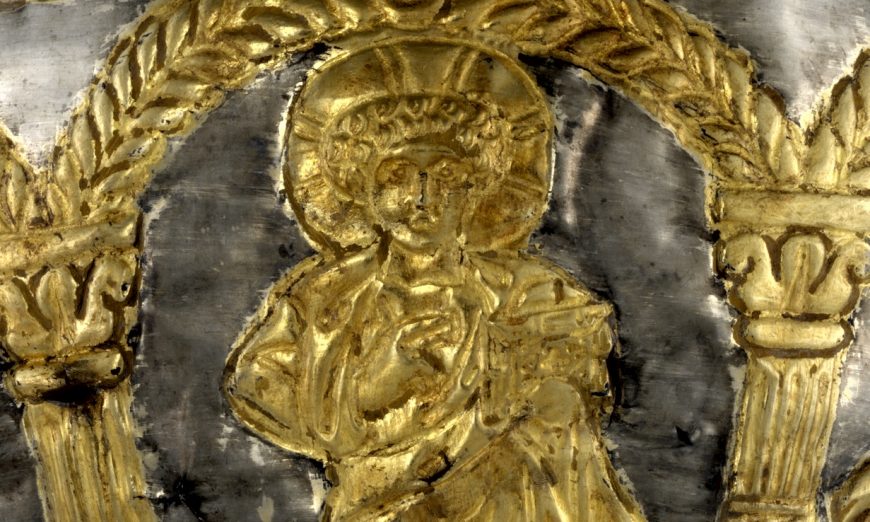
0:04:18.5 Dr. Steven Zucker: Cities in western Europe were transformed by the importance of their relics. The body of Saint Mark for Venice. The crown of Thorns held at Sainte-Chapelle in Paris. Let’s take a close look at some of the workmanship. The figures of the prophets that occupy the lower register on the right flank are magnificent, and we can get a good close look at them. I’m struck by the classicism of these figures. The forms remind me of ancient Roman sculpture.

0:04:44.3 Dr. Beth Harris: Nicholas of Verdun does seem to be drawing on classical models. In fact, one art historian has talked about how the prophet Daniel looks especially like an ancient Roman portrait of an emperor, specifically the emperor Marcus Aurelius. In both cases, the figures are individualized. They express emotion. The prophet Daniel looks up. He raises his eyebrows as though he’s looking up to God. In one hand, he holds his scroll. We see his name written above him. And we also see, when we look closely, the richness of the decorative work around him. Look at that enamel work on those columns.

0:05:21.9 Dr. Steven Zucker: There’s also such wonderful attention to the drapery, the way that the drapes wrap around his waist. His knees are pushed off to one side, his feet to the other. There’s a sense of dynamism, a sense of careful articulation of the body below those folds. This is such a wonderful reminder that, in fact, we don’t have to wait until the Renaissance to see a revival of interest in ancient Roman art, that there are episodes during the medieval when the classical plays an important role.

0:05:49.4 Dr. Beth Harris: This amazing gold reliquary that holds the skulls of the three kings. These small human remains are the inspiration for this enormous Gothic cathedral.

Title Shrine of the Three Kings
Artist(s) Nicholas of Verdun (and workshop)
Dates c. 1181–1220
Places Europe / Central Europe / Germany
Period, Culture, Style Medieval / Gothic
Artwork Type Metalwork / Sculpture
Material Gold, Silver, Copper, Gems, Wood
Technique Casting, Repoussé and chasing, Incising

Learn more about the relics of the Three Wise Men from Cologne Cathedral

Shirley Neilsen Blum, The New Art of the Fifteenth Century: Faith and Art in Florance and The Netherlands (Abbeville Press, 2015).

Lisa Victoria Ciresi, “A liturgical study of the Shrine of the Three Kings in Cologne,” Objects, Images, and the Word: Art in the Service of the Liturgy, edited by Colum Hourihane (Princeton, NJ:  Princeton University Press, 2003).

Moritz Woelk, The Magi: Legend, Art and Cult (Munich: Hirmer Publishers, 2014).

Erika Zwierlein-Diehl, “‘Interpretatio christiana’: Gems on the ‘Shrine of the Three Kings’ in Cologne,” Studies in the History of Art, volume 54, Symposium Papers XXXII: Engraved Gems: Survivals and Revivals (1997), pp. 62–83.

Cite this page as: Dr. Beth Harris and Dr. Steven Zucker, "Nicholas of Verdun, Shrine of the Three Kings, Cologne Cathedral," in Smarthistory, October 17, 2025, accessed December 14, 2025, https://smarthistory.org/nicholas-verdun-shrine-three-kings-cologne/.