

This serene statue of the pharaoh and the queen is from a temple of the Pyramid of Menkaure, undisturbed for millennia.
King Menkaure (Mycerinus) and queen, c. 2490–2472 B.C.E. (Egyptian, Old Kingdom, Dynasty 4, reign of Menkaure), greywacke, 142.2 x 57.1 x 55.2 cm (Museum of Fine Arts, Boston). Speakers: Dr. Beth Harris and Dr. Steven Zucker
0:00:05.0 Dr. Steven Zucker: We’re in the Egyptian Galleries at the Museum of Fine Arts Boston, looking at one of their most celebrated sculptures. This is a dyad, that is, it’s a sculpture of two standing figures. We know the identity of one of them, a prominent king from the Old Kingdom, King Menkaure, and a female figure that is thought now to be the king’s mother.
0:00:28.6 Dr. Beth Harris: More than a hundred years ago, the MFA and Harvard University were involved in a joint archaeological expedition on the Giza Plateau. The Giza Plateau is most famous as the site for the three Great Pyramids.
0:00:42.2 Dr. Steven Zucker: And in fact, the smallest of the three primary pyramids was the burial place for King Menkaure.
0:00:47.8 Dr. Beth Harris: The pyramids were not standalone structures, they were surrounded by subsidiary pyramids. There was also a temple at the base of the pyramid and a temple further away, connected by a causeway called the Valley Temple.
0:01:00.7 Dr. Steven Zucker: On January 10th in 1910, an amazing cache of sculptures were uncovered, including this dyad. And it’s important to understand that because the temples were so prominent, they had for thousands of years been the target of looting. And in fact, we know that this sculpture was not in its original location, but it is our good fortune that the sculpture was left.
0:01:22.3 Dr. Beth Harris: We think that the sculptures were placed in niches in the Valley Temple, and because the left feet are forward, they might have appeared as though they were moving out of the niche.
0:01:31.5 Dr. Steven Zucker: We know that the sculpture was placed in the Valley Temple, but curiously, even though the sculpture was painted, its carving was never completed.
0:01:38.7 Dr. Beth Harris: Menkaure died before his funerary complex was completed.
0:01:43.3 Dr. Steven Zucker: If you look very carefully, you’ll notice that Menkaure is not actually looking straight ahead, that the king is instead looking very slightly to his right, whereas the woman beside him, who holds both his arm and his waist, is looking straight ahead. And this is one piece of evidence that has suggested that the king may not be the central focus of this dyad, that in fact, it may be the female figure.
0:02:08.2 Dr. Beth Harris: While it’s really common for pharaohs to have their left feet forward, it’s not at all common for the female figure. And so this unusual feature makes us wonder who this figure could be.
0:02:19.4 Dr. Steven Zucker: But there have been compelling arguments suggesting that this could be either the goddess Hathor or the king’s mother, or even more compellingly, this is the king’s mother with attributes of Hathor that is embodying the goddess Hathor.
0:02:33.9 Dr. Beth Harris: Hathor was an important goddess who was worshipped on the Giza Plateau.
0:02:38.1 Dr. Steven Zucker: And one of her roles was the protection of the king.
0:02:40.8 Dr. Beth Harris: So I find this sculpture so interesting because in so many ways, it seems so real. This very naturalistic treatment of areas of the body, for example, the musculature in the chest and the rib cage, or the beautiful carving around the female figure’s abdomen. But we also have a real sense that these figures are idealized. They’re made perfect. The pharaoh unlikely had a body as perfectly athletic and in such beautiful proportions as to what we see here. And so we know that although these figures have some sense of portraiture, some sense of being individualized, they’ve also been perfected. They also adhere to a standard of idealized figures that remove them from this world.
0:03:29.6 Dr. Steven Zucker: I would also add that their facial features have a kind of individualized quality to them. The high cheekbones, a little bit of a pout on the lip of the king, the fleshiness of the cheeks of the female figure. And actually, we can just make out under her wig, a representation of her natural hair.
0:03:48.9 Dr. Beth Harris: And then there’s this way that they’re part of the stone that’s behind them. And so they move their left leg forward, but they also are quite immobile at the same time.
0:04:00.8 Dr. Steven Zucker: One of the ways that we know that the figures are unfinished is because of the series of absences. In every representation that we know of, of the king’s headdress, there is a cobra that emerges from the far head. There isn’t even here a hole to attach a cobra. The headdress itself is always decorated with horizontal striping, and that’s absent here. The kilt is also incised, and that’s absent here. There is the potential that some of this was represented in paint, and in fact, there are traces of red that can be seen clearly on the king’s ears, and apparently some yellow, which I’m having a hard time seeing, on the face of the female figure. And it was common for even stone of very high quality like this, greywacke, otherwise known as schist, to be painted, which would have helped make it more visible in the shadows of the temple.
0:04:48.6 Dr. Beth Harris: We can see the unfinished nature of the sculpture when we look at the female figure’s feet, where we see the act of carving. But then as our eye gazes up the sculpture, we find these very subtly modeled forms in this shining, smooth, grey stone, and it’s really impressive to come across this in the galleries.
0:05:11.4 Dr. Steven Zucker: 4,500 years collapsed, bringing the ritual and beauty of this ancient Egyptian culture into our world.
[music]
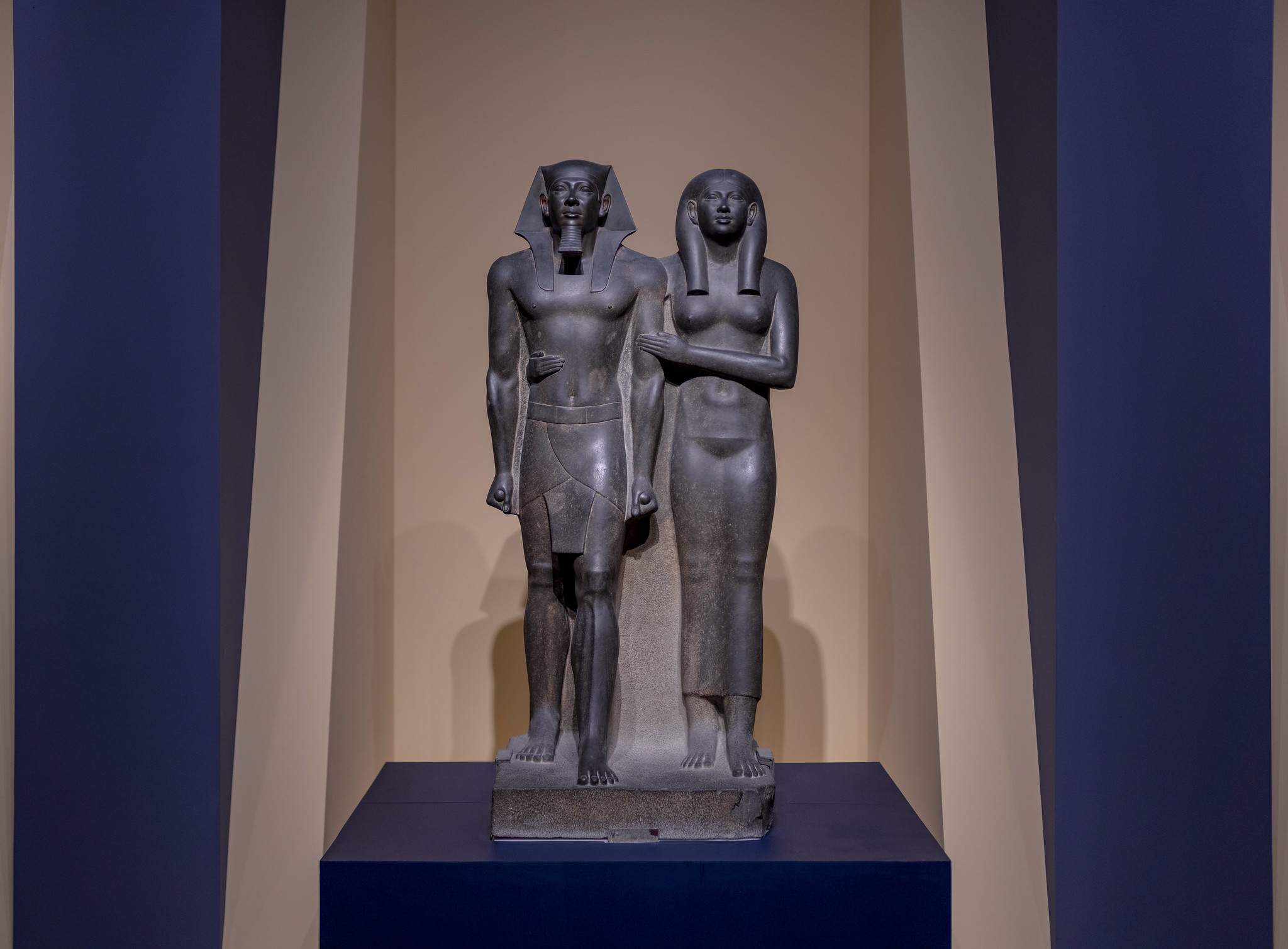
King Menkaure (Mycerinus) and queen, 2490–2472 B.C.E., greywacke, 142.2 x 57.1 x 55.2 cm (Museum of Fine Arts, Boston, photo: Steven Zucker, CC BY-NC-SA 2.0)
Serene ethereal beauty, raw royal power, and evidence of artistic virtuosity have rarely been simultaneously captured as well as in this breathtaking, nearly life-size statue of the pharaoh Menkaure and a queen from c. 2490–2472 B.C.E. Smooth as silk, the meticulously finished surface of the dark stone captures the physical ideals of the time and creates a sense of eternity and immortality even today.
Undoubtedly, the most iconic structures from Ancient Egypt are the massive and enigmatic Great Pyramids that stand on a natural stone shelf, now known as the Giza plateau, on the south-western edge of modern Cairo. The three primary pyramids at Giza were constructed during the height of a period known as the Old Kingdom and served as burial places, memorials, and places of worship for a series of deceased rulers—the largest belonging to King Khufu, the middle to his son Khafre, and the smallest of the three to his son Menkaure.
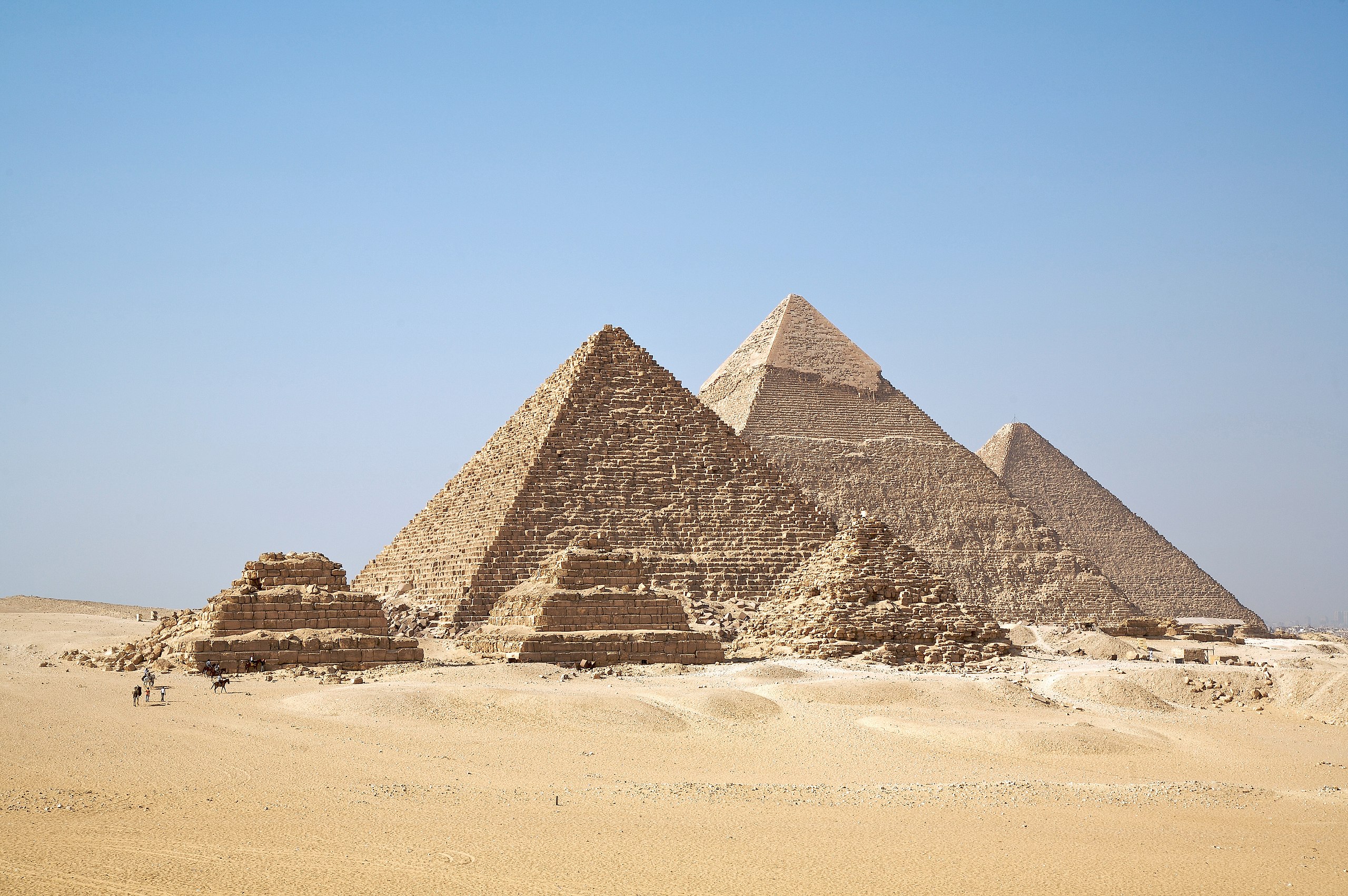
Giza plateau (photo: Ikiwaner, CC BY-SA 2.0)
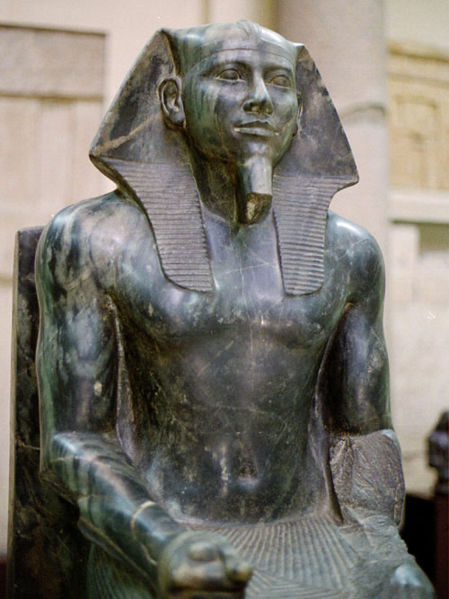
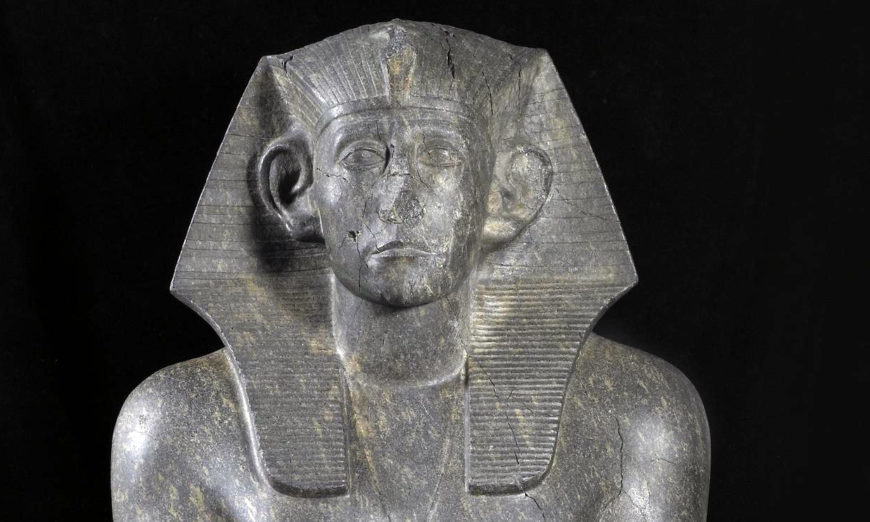
Head and torso (detail), Khafre enthroned, from Giza, Egypt, c. 2520–2494 B.C.E., diorite. 5’ 6 inches high (Egyptian Museum, Cairo)
Pyramids are not stand-alone structures. Those at Giza formed only a part of a much larger complex that included a temple at the base of the pyramid itself, long causeways and corridors, small subsidiary pyramids, and a second temple (known as a valley temple) some distance from the pyramid. These Valley Temples were used to perpetuate the cult of the deceased king and were active places of worship for hundreds of years (sometimes much longer) after the king’s death. Images of the king were placed in these temples to serve as a focus for worship—several such images have been found in these contexts, including the magnificent enthroned statue of Khafre with the Horus falcon wrapped around his headdress.
On January 10, 1910, excavators under the direction of George Reisner, head of the joint Harvard University-Museum of Fine Arts, Boston, Expedition to Egypt, uncovered an astonishing collection of statuary in the Valley Temple connected to the Pyramid of Menkaure. Menkaure’s pyramid had been explored in the 1830’s (using dynamite, no less). His carved granite sarcophagus was removed (and subsequently lost at sea), and while the Pyramid Temple at its base was in only mediocre condition; the Valley Temple was—happily—basically ignored.
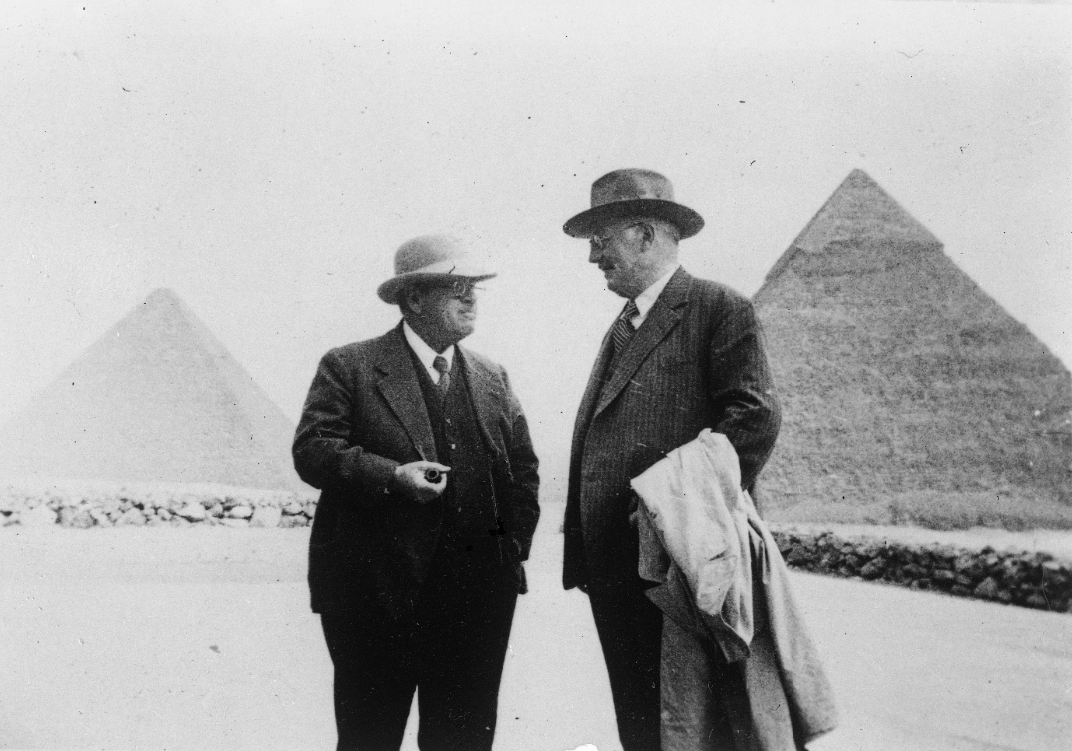
George Reisner and Enno Littmann at Harvard Camp, looking E toward Khufu and Khafre pyramids, 1935, photo by Albert Morton Lythgoe (Giza archives)
Reisner had been excavating on the Giza plateau for several years at this point; his team had already explored the elite cemetery to the west of the Great Pyramid of Khufu before turning their attention to the Menkaure complex, most particularly the barely-touched Valley Temple.
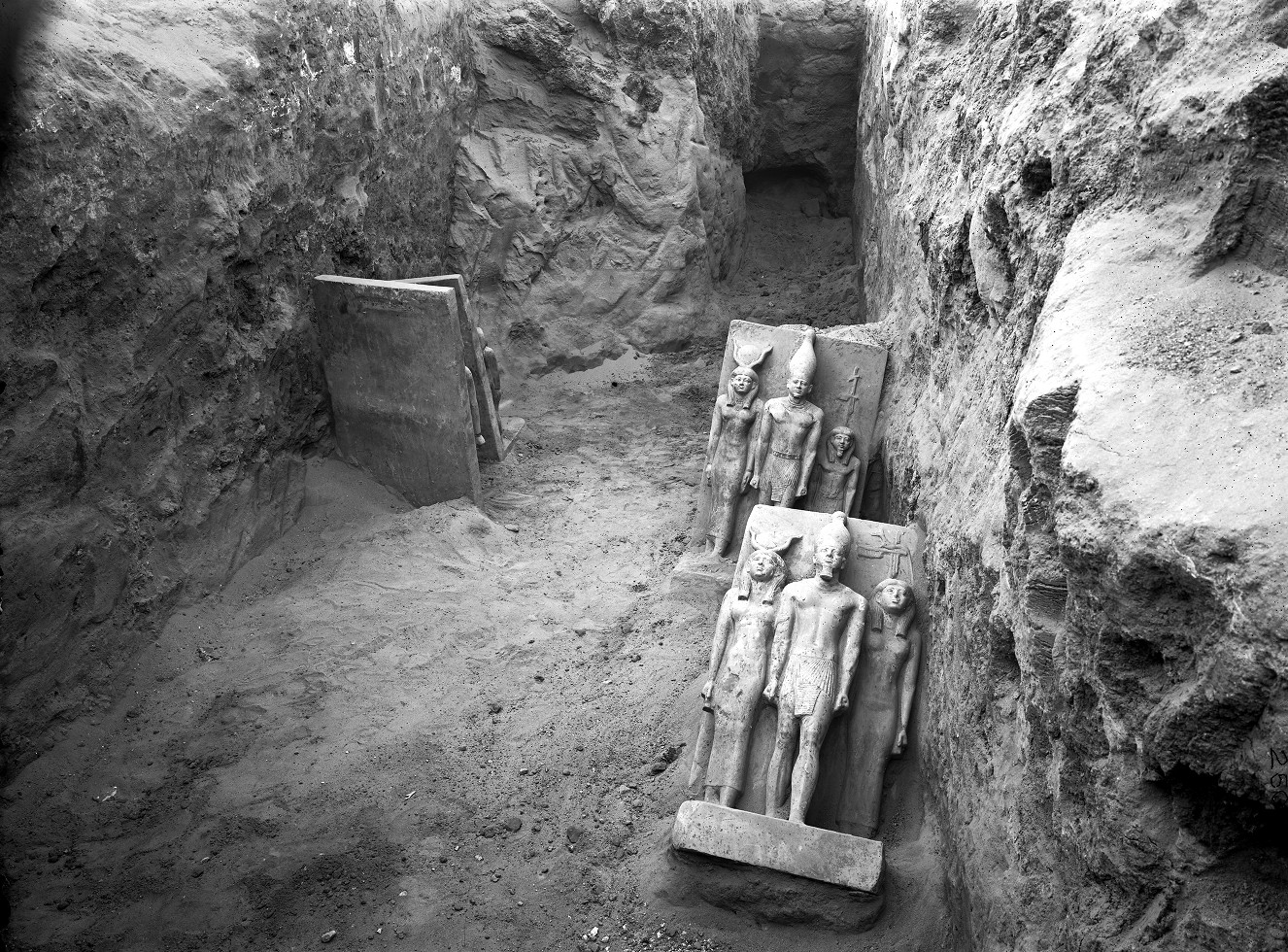
Four greywacke triads, Menkaure valley temple, S magazines, corridor III 4, photo: 1908 (The Giza Archives). View one of the triads in the Museum of Fine Arts, Boston.
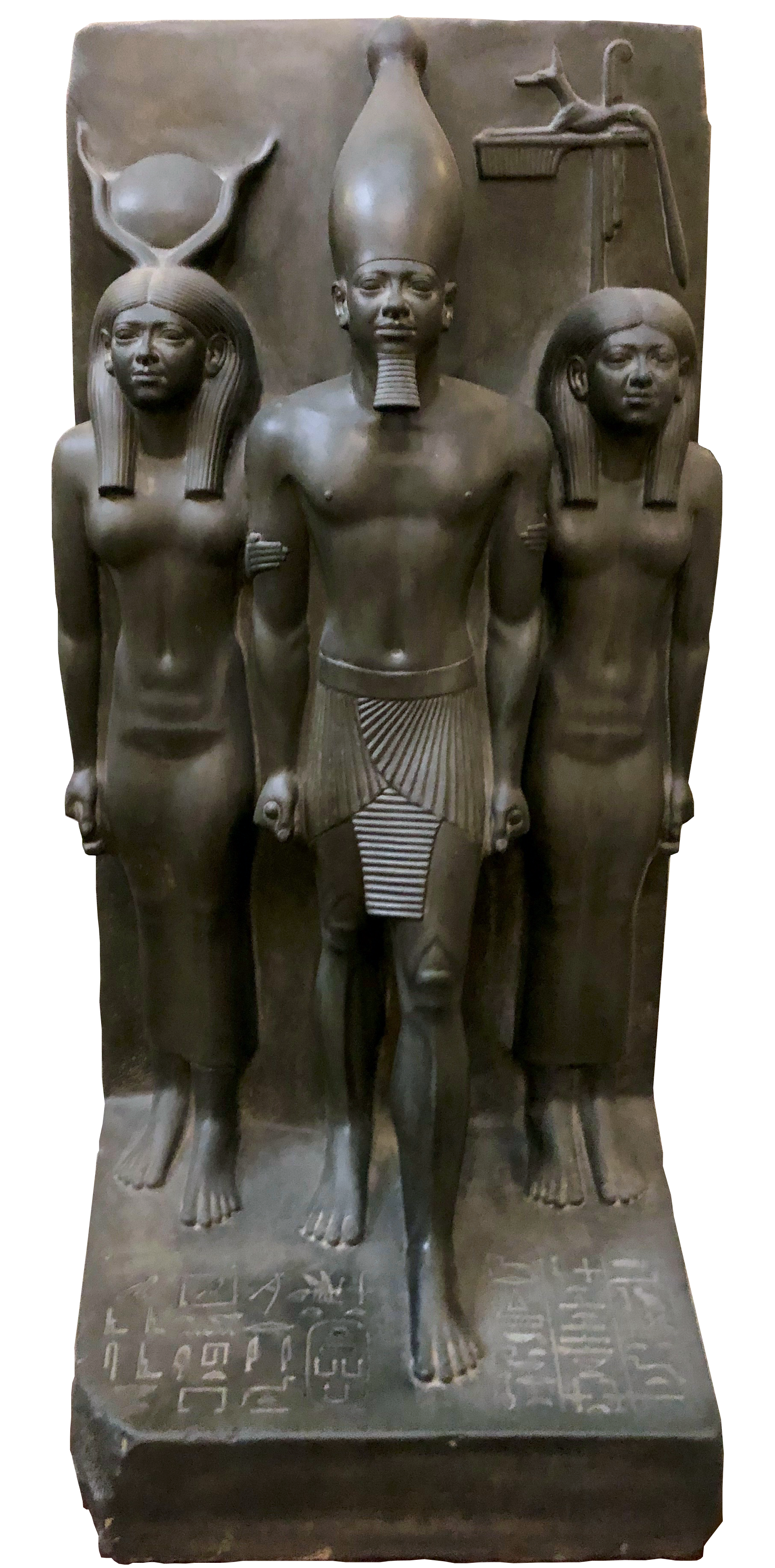
Menkaure flanked by Hathor (left) and nome goddess (Egyptian Museum, Cairo)
In the southwest corner of the structure, the team discovered a magnificent cache of statuary carved in a smooth-grained dark stone called greywacke or schist. There were a number of triad statues—each showing 3 figures; the king, the fundamentally important goddess Hathor, and the personification of a nome (a geographic designation, similar to the modern idea of a region, district, or county). Hathor was worshipped in the pyramid temple complexes along with the supreme sun god Re and the god Horus, who was represented by the living king. The goddess’s name is actually ‘Hwt-hor’, which means “The House of Horus”, and she was connected to the wife of the living king and the mother of the future king. Hathor was also a fierce protector who guarded her father Re; as an “Eye of Re” (the title assigned to a group of dangerous goddesses), she could embody the intense heat of the sun and use that blazing fire to destroy his enemies.
There were 4 complete triads, one incomplete, and at least one other in a fragmentary condition. The precise meaning of these triads is uncertain. Reisner believed that there was one for each ancient Egyptian nome, meaning there would have originally been more than thirty of them. More recent scholarship, however, suggests that there were originally 8 triads, each connected with a major site associated with the cult of Hathor. Hathor’s prominence in the triads (she actually takes the central position in one of the images) and her singular importance to kingship lends weight to this theory.
In addition to the triads, Reisner’s team also revealed the extraordinary dyad statue of Menkaure and a queen that is breathtakingly singular.
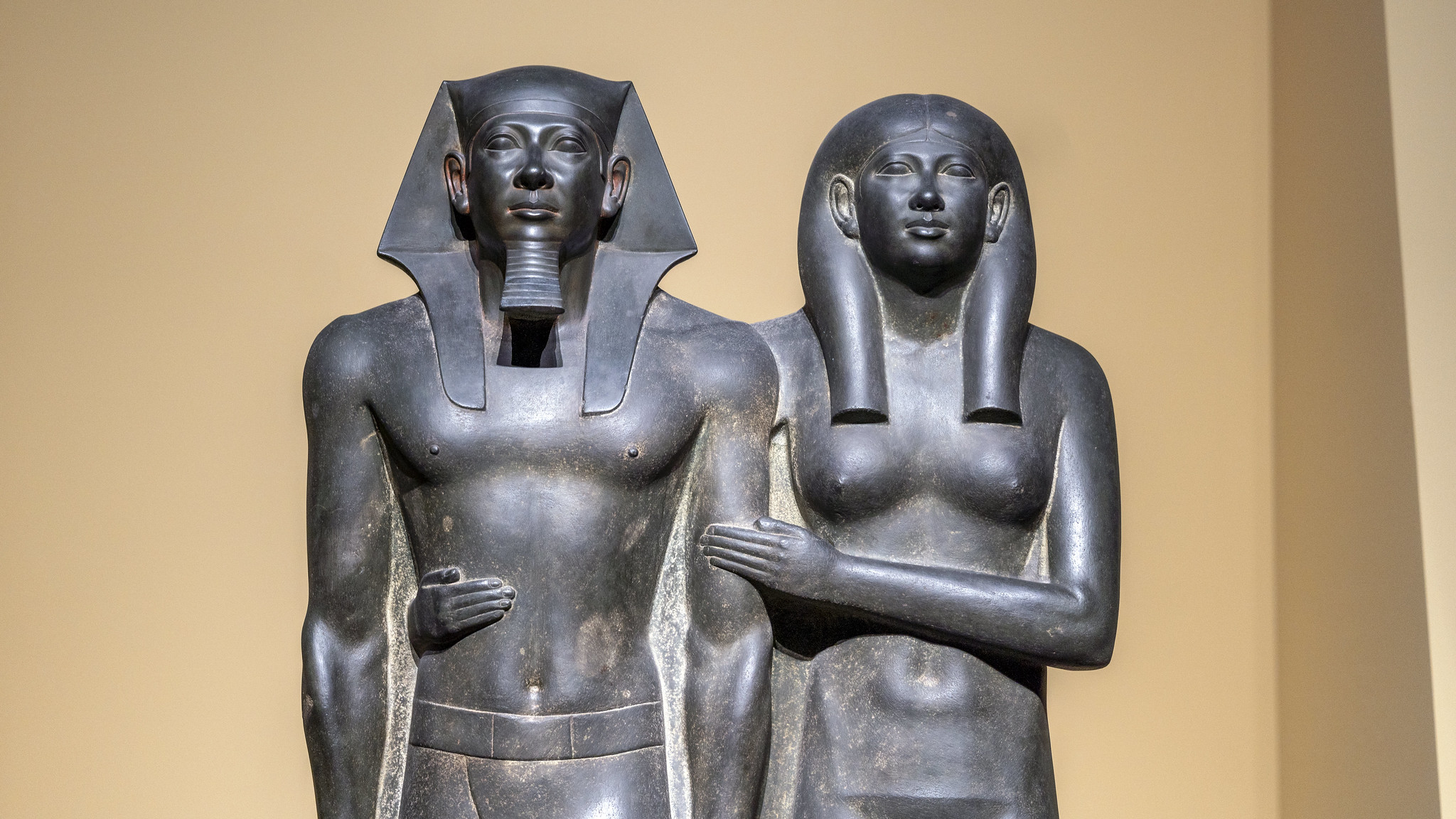
Heads and torsos (detail), King Menkaure (Mycerinus) and queen, 2490–2472 B.C.E., greywacke, 142.2 x 57.1 x 55.2 cm (Museum of Fine Arts, Boston, photo: Steven Zucker, CC BY-NC-SA 2.0)
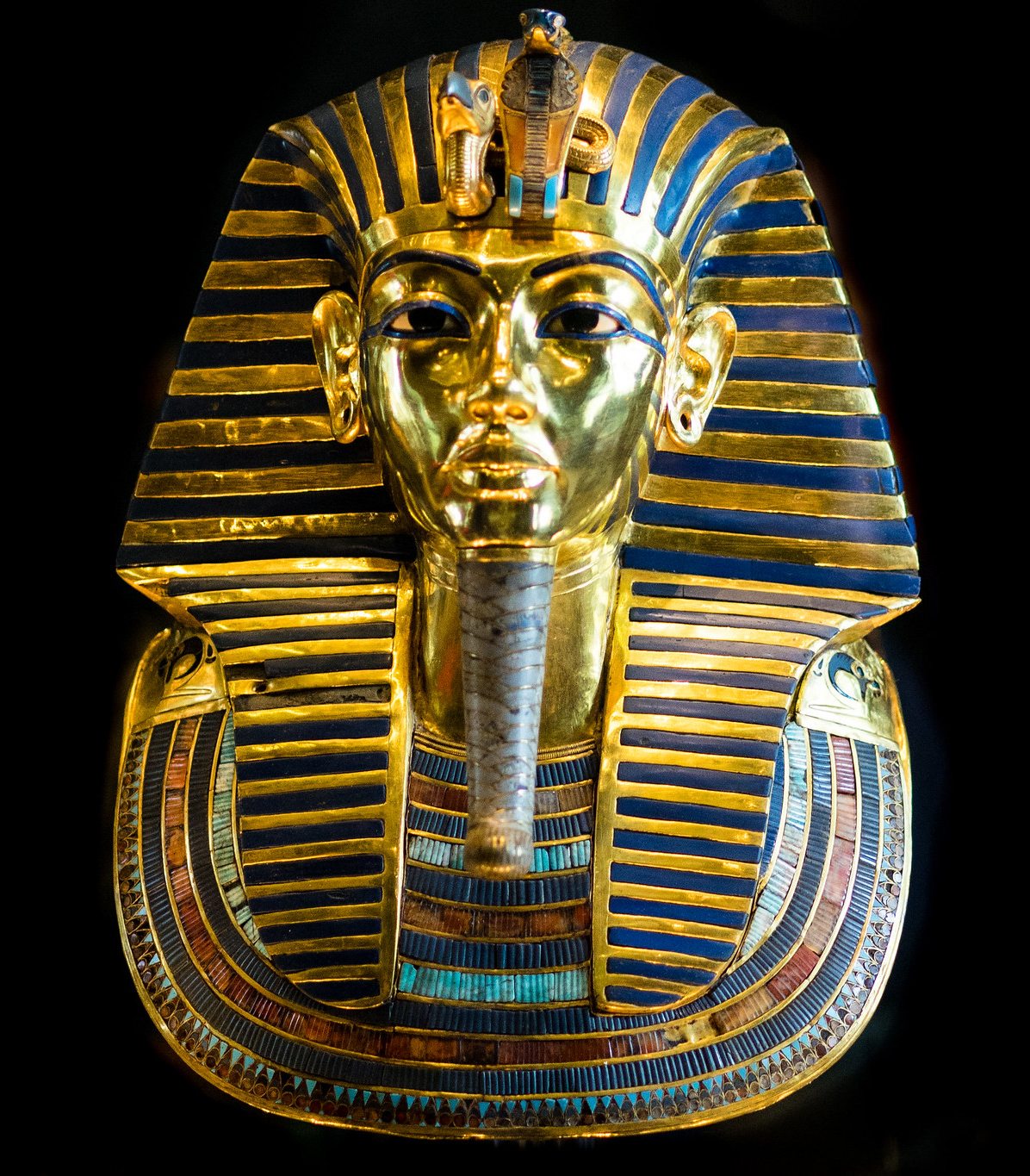
Death Mask from innermost coffin, Tutankhamun’s tomb, New Kingdom, 18th Dynasty, c. 1323 B.C.E., gold with inlay of enamel and semiprecious stones (Egyptian Museum, Cairo, photo: Mark Fischer, CC BY-SA 2.0)
The two figures stand side-by-side on a simple, squared base and are supported by a shared back pillar. They both face to the front, although Menkaure’s head is noticeably turned to his right—this image was likely originally positioned within an architectural niche, making it appear as though they were emerging from the structure.
The broad-shouldered, youthful body of the king is covered only with a traditional short pleated kilt, known as a shendjet, and his head sports the primary pharaonic insignia of the iconic striped nemes headdress (so well known from the mask of Tutankhamun) and an artificial royal beard. In his clenched fists, held straight down at his sides, Menkaure grasps ritual cloth rolls. His body is straight, strong, and eternally youthful with no signs of age. His facial features are remarkably individualized with prominent eyes, a fleshy nose, rounded cheeks, and full mouth with protruding lower lip.
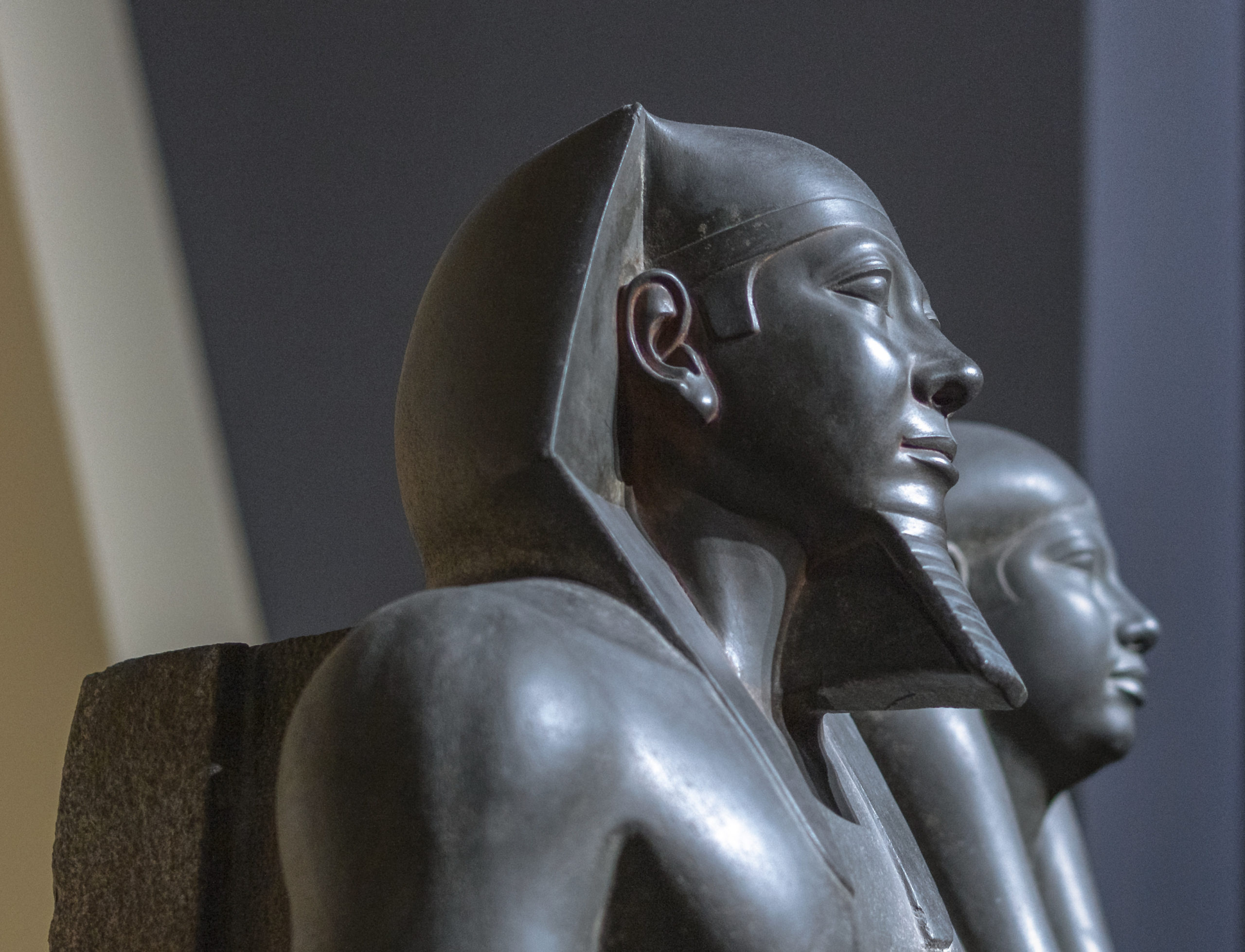
Heads (detail), King Menkaure (Mycerinus) and queen, 2490–2472 B.C.E., greywacke, 142.2 x 57.1 x 55.2 cm (Museum of Fine Arts, Boston, photo: Steven Zucker, CC BY-NC-SA 2.0)
Menkaure’s queen provides the perfect female counterpart to his youthful masculine virility. Sensuously modeled with a beautifully proportioned body emphasized by a clinging garment, she articulates ideal mature feminine beauty. There is a sense of the individual in both faces. Neither Menkaure nor his queen are depicted in the purely idealized manner that was the norm for royal images. Instead, through the overlay of royal formality we see the depiction of a living person filling the role of pharaoh and the personal features of a particular individual in the representation of his queen.
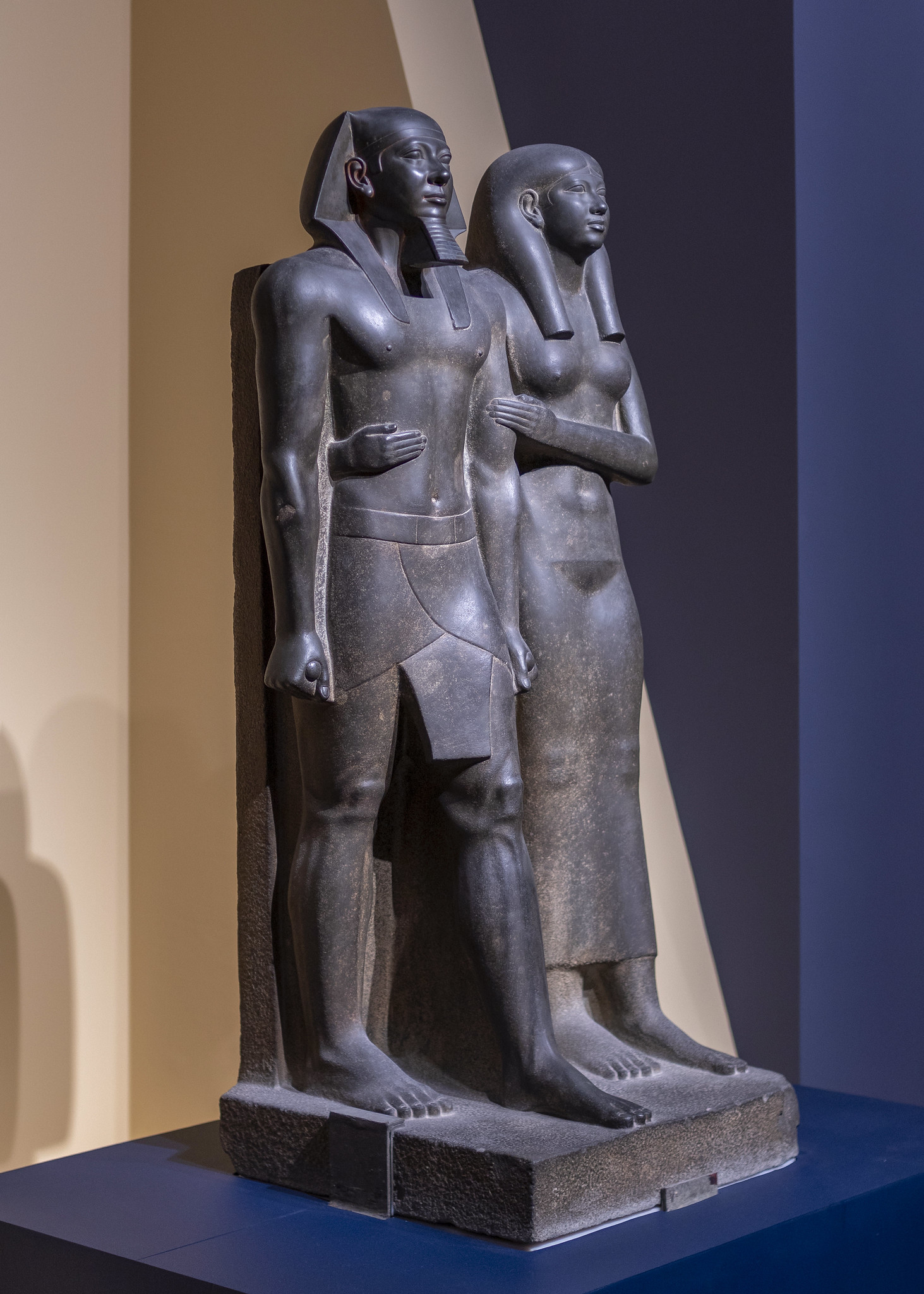
King Menkaure (Mycerinus) and queen, 2490–2472 B.C.E., greywacke, 142.2 x 57.1 x 55.2 cm (Museum of Fine Arts, Boston, photo: Steven Zucker, CC BY-NC-SA 2.0)
Menkaure and his queen stride forward with their left feet—this is entirely expected for the king, as males in Egyptian sculpture almost always do so, but it is unusual for the female since they are generally depicted with feet together. They both look beyond the present and into timeless eternity, their otherworldly visage displaying no human emotion whatsoever.
The dyad was never finished—the area around the lower legs has not received a final polish, and there is no inscription. However, despite this incomplete state, the image was erected in the temple and was brightly painted; there are traces of red around the king’s ears and mouth and yellow on the queen’s face. The presence of paint atop the smooth, dark greywacke on a statue of the deceased king that was originally erected in his memorial temple courtyard brings an interesting suggestion—that the paint may have been intended to wear away through exposure and, over time, reveal the immortal, black-fleshed “Osiris” Menkaure (for more information on the symbolic associations of Egyptian materials, see Materials and techniques in ancient Egyptian art).
Unusual for a pharaoh’s image, the king has no protective cobra (known as a uraeus) perched on his brow. This notable absence has led to the suggestion that both the king’s nemes and the queen’s wig were originally covered in a sheath of precious metal and that the ubiquitous cobra would have been part of that addition.
Based on comparison with other images, there is no doubt that this sculpture shows Menkaure, but the identity of the queen is a different matter. She is clearly a royal female. She stands at nearly equal height with the king and, of the two of them, she is the one who is entirely frontal. In fact, it may be that this dyad is focused on the queen as its central figure rather than Menkaure. The prominence of the royal female—at equal height and frontal—in addition to the protective gesture she extends has suggested that, rather than one of Menkaure’s wives, this is actually his queen-mother. The function of the sculpture in any case was to ensure rebirth for the king in the Afterlife.