This mausoleum for Emperor Constantine’s daughter transforms ancient Roman imagery into an early Christian context.
Santa Costanza (Mausoleum of Constantina), 4th century, Via Nomentana, Rome. Speakers: Dr. Beth Harris and Dr. Steven Zucker



Jump To
This mausoleum for Emperor Constantine’s daughter transforms ancient Roman imagery into an early Christian context.
Santa Costanza (Mausoleum of Constantina), 4th century, Via Nomentana, Rome. Speakers: Dr. Beth Harris and Dr. Steven Zucker
0:00:06.8 Dr. Beth Harris: So when we think about Christian churches, we think about essentially two different types of buildings. The one we’re most familiar with is a basilica. The other type is a centrally planned structure, and that’s what we’re in here at Santa Costanza.
0:00:20.4 Dr. Steven Zucker: And it’s important to understand that this building was not built as a church. It was built as a burial place, and it was borrowing the centrally planned architectural system from the ancient Romans and specifically from burial structures.
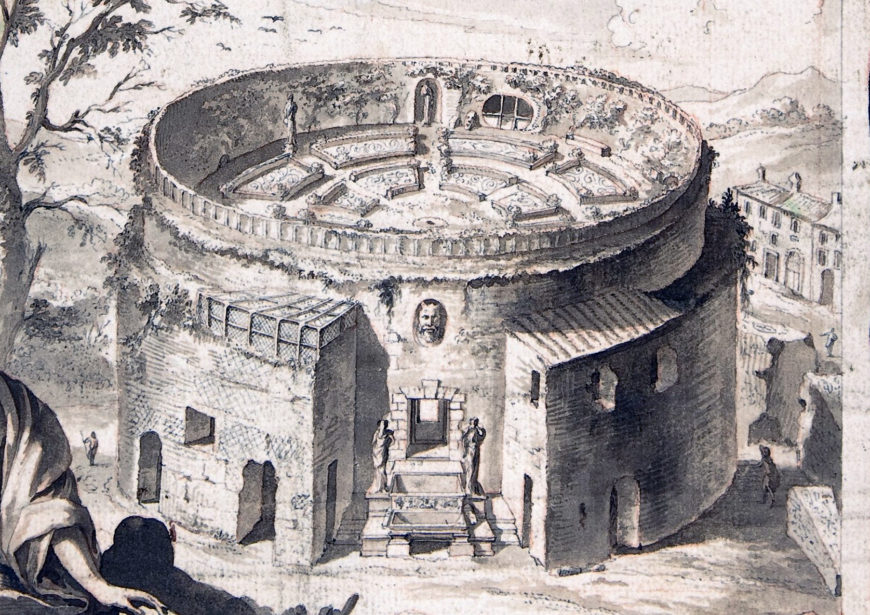
0:00:34.1 Dr. Beth Harris: For example, we could think here in Rome of the Tomb of Hadrian, today known as the Castel Sant’Angelo, or we could even think of the Tomb of Augustus, both round structures. So there is this association between centrally planned structures and burial places.
0:00:49.3 Dr. Steven Zucker: So let’s describe how this space is organized. The tallest part of the building is the central dome. Below the dome is a kind of round barrel supported by a row of double columns.
0:01:00.1 Dr. Beth Harris: There are 12 sets of two columns with Corinthian capitals, each supporting an entablature with a cornice, and we see a clerestory that lets light into the building.
0:01:11.4 Dr. Steven Zucker: There are also smaller windows in the aisle that surrounds all of this. This is an ambulatory, that is, it allows visitors to circumambulate the church to walk around it on the inside. And off the ambulatory are a series of niches.
0:01:26.2 Dr. Beth Harris: The ambulatory itself is constructed as a barrel vault. So these are all forms that were very common in ancient Roman architecture. So even though this is a mausoleum for a Christian that’s very early, all of the forms that we’re seeing here are part of the normal vocabulary of ancient Roman architecture.
0:01:43.3 Dr. Steven Zucker: But what’s happening is that they’re being self-consciously repurposed so that they’re now taking on a Christian connotation and they are divesting themselves of their old pagan connotations.
0:01:54.0 Dr. Beth Harris: And perhaps the transition from pagan Roman forms to early Christian ones is most evident in the mosaics. Ancient Romans used mosaics primarily for the floor, but here we see them used on the ceilings.
0:02:07.8 Dr. Steven Zucker: These mosaics have been restored, but they’re a pretty good indication of what they would have looked like. It is, however, important to remember that the walls, which are now bare Roman brick, would once have been faced with revetment. That is, there would have been multicolored stones that would have lined these walls and they would have been highly polished. It would have been extremely beautiful.
0:02:27.2 Dr. Beth Harris: To get an idea of what that might have looked like, we could think about ancient Roman buildings like the Pantheon, where that marble revetment still exists.
0:02:33.7 Dr. Steven Zucker: And probably the most interesting mosaic shows a bust portrait of the deceased, of the daughter of the Emperor Constantine.
0:02:40.7 Dr. Beth Harris: At least that’s who we think it is, because we do have images of the deceased, for example, in catacombs.
0:02:45.9 Dr. Steven Zucker: What’s most interesting, though, is that she’s surrounded in these beautiful grapevines, this foliage that we associate with the ancient Roman traditions of Bacchus, the ancient god of wine.
0:02:56.9 Dr. Beth Harris: Or images from ancient Rome that refer to fertility and fecundity and prosperity. For example, we could think about the carvings on the outside of the Ara Pacis. And so this looks very much like what we would think of as antique or Roman pagan subject.
0:03:13.3 Dr. Steven Zucker: In fact, among the vines, we can see putti, or cupids, small figures that we would expect to see in ancient Roman imagery.
0:03:20.4 Dr. Beth Harris: And in the corners, we also see putti, who seem to be harvesting the grapes and making wine. And so all of this seems like it has to do with the god of wine. But in Christianity, the wine is the blood of Christ and alludes to his sacrifice, which makes possible our salvation. And remember, this is a space for perhaps someone who died who hoped for salvation through Christ.
0:03:44.0 Dr. Steven Zucker: And so very appropriate. But what we’re seeing then is this very specific transformation of this ancient Roman imagery into a Christian context.
0:03:51.2 Dr. Beth Harris: Well, in fact, the images are the same. And what’s transformed are the meanings ascribed to the images, which is really fascinating. There are also images of fruit and wheat and ideas of the harvest and of plenty and the lushness of paradise.
0:04:07.1 Dr. Steven Zucker: In fact, some of the elements that we see, we’ll also see in the Christian context of the catacombs. For instance, note the peacock, which is a symbol of eternal life.
0:04:15.9 Dr. Beth Harris: Or we see the pomegranate, which is also a symbol of eternal life. Now, this building looks toward other early Christian buildings built at the time of Constantine or supported by Constantine. For example, we could think about the Church of the Holy Sepulchre in Jerusalem.
0:04:30.8 Dr. Steven Zucker: And it’s important to remember that Constantine was also the sponsor of that structure. Of course, Jerusalem and Rome were both within his empire.
0:04:38.0 Dr. Beth Harris: And Constantine needed to create new buildings for this new religion for the Roman Empire. Now, this wasn’t built as a church. It was built as a mausoleum. Nevertheless, this type of centrally planned church will have significant influence in the history of art. We could think, for example, of Bramante’s Tempietto in the Renaissance.
0:04:57.8 Dr. Steven Zucker: But, of course, this building is not looking forward. It’s looking back to buildings like the Pantheon, for example, Hadrian’s great temple to all of the gods in central Rome.
0:05:05.9 Dr. Beth Harris: So there’s a lot of associations here. There’s associations to burial sites of emperors. There’s associations to ancient Roman temples and associations to burial places of martyrs, of saints in the early Christian church.
0:05:19.5 Dr. Steven Zucker: But what’s most fascinating to me is the way in which structure and the decorative program is repurposed in the early years of Christianity before a vocabulary has been standardized. So we have a generation of believers here who are trying to, in a sense, invent what Christian imagery is to look like.
| Title | Santa Costanza (Mausoleum of Constantina) |
| Artist(s) | Unrecorded artist |
| Dates | 4th century C.E. |
| Places | Europe / Southern Europe / Italy |
| Period, Culture, Style | Ancient Roman / Late Roman Empire / Medieval / Early Christian |
| Artwork Type | Architecture / Tomb / Mosaic |
| Material | Stone, Brick |
| Technique |
The Roman Empire on The Metropolitan Museum of Art’s Heilbrunn Timeline of Art History
David J. Stanley, “New Discoveries at Santa Costanza,” Dumbarton Oaks Papers, volume 48 (1994), pp. 257–61.
Kurt Weitzmann, editor, Age of Spirituality: Late Antique and Early Christian Art, Third to Seventh Century (New York: The Metropolitan Museum of Art, 1979).
Loading Flickr images...