Thousands of medieval Christians were baptized in this building, all under a glittering mosaic of Christ’s own baptism.
The Neonian Baptistry, Ravenna, 4th–5th century C.E. Speakers: Dr. Steven Zucker and Dr. Beth Harris



Jump To
Thousands of medieval Christians were baptized in this building, all under a glittering mosaic of Christ’s own baptism.
The Neonian Baptistry, Ravenna, 4th–5th century C.E. Speakers: Dr. Steven Zucker and Dr. Beth Harris
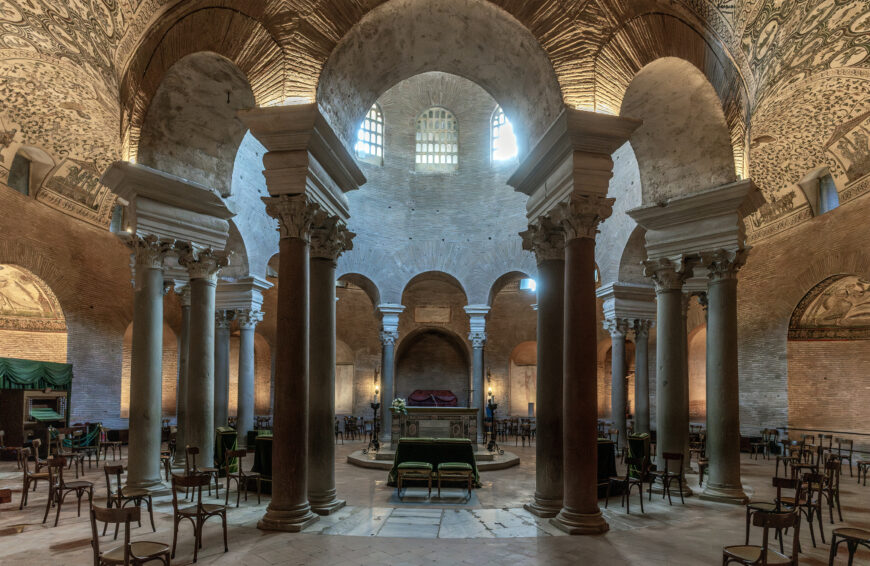
0:00:06.6 Dr. Steven Zucker: We’ve walked into the Neonian Baptistery in the city of Ravenna. This is a building that dates to the 4th century and was then enlarged in the 5th century. It’s such an old example of this important Christian architectural type.
0:00:21.5 Dr. Beth Harris: And it’s called the Neonian Baptistery because of the Bishop Neon. This baptistery is octagonal, like so many early Christian baptisteries, and it sits beside the cathedral of the city. And so this is part of an ecclesiastical complex which was common.
0:00:39.1 Dr. Steven Zucker: And as you walk in, you’re first confronted with a large octagonal basin. And this is where the baptisms would take place. Baptism is one of the seven sacraments of the church, where those that sought to enter the Christian community would be immersed in water, following the example of Christ’s baptism by John the Baptist. Here, the baptism was officiated by the bishop of the city.
0:01:01.3 Dr. Beth Harris: The decoration dates to the 5th century, less than two centuries after Constantine makes it legal to practice Christianity in the Roman Empire. And it’s less than a century since Christianity has become the official religion of the Roman Empire.
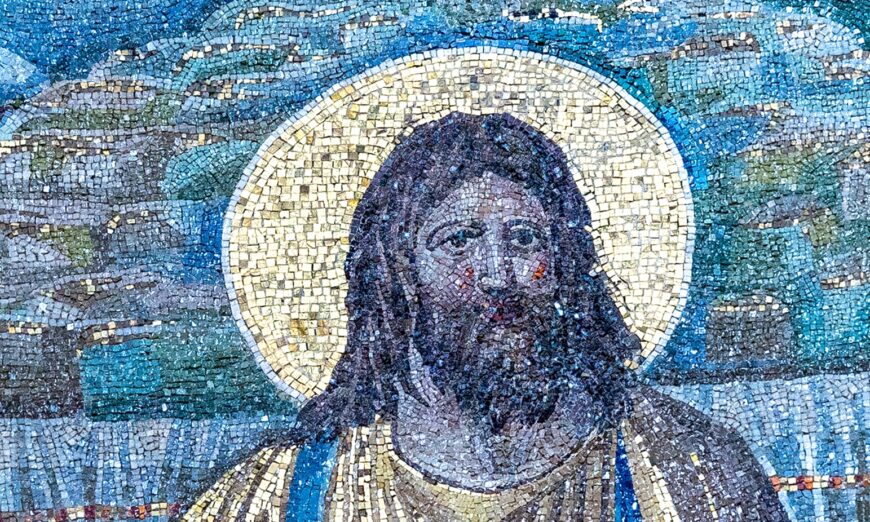
0:01:18.7 Dr. Steven Zucker: But the real star of this building is the ceiling mosaic, portions of which were restored in the 19th century. Most notably, where you see the Holy Spirit, the upper body of John the Baptist, and the head of Christ, all 19th century, but the rest of the program is largely intact.
0:01:34.8 Dr. Beth Harris: So we have that important central scene of Christ himself being baptized, the dove of the Holy Spirit, who appears to Christ. And next to that, a personification of the River Jordan where Christ was baptized. Then we’ve got a second roundel of figures. And here we see the Apostles, each carrying a crown, each one labeled with their names. Above them, a swag of drapery that hangs down, acting like a halo behind their heads. They stand on a green ground with these vegetal candelabra that grow up and separate each Apostle from the other.
0:02:10.4 Dr. Steven Zucker: And I love the fact that they cast shadows, which is not a common thing in early Christian mosaic. And the Apostles are being led alternately by Peter and by Paul. Below that, we have an architectural framework. Each one has alternating either a gospel on top of an altar or an empty throne. The empty throne is surrounded by gardens and the altar is surrounded by empty chairs.
0:02:36.3 Dr. Beth Harris: Art historians disagree about the precise significance of the empty thrones and the empty chairs. Perhaps, they refer to the second coming of Christ. The thrones do have a cross above them. They could also represent the neophytes, those coming to be baptized, joining the Christian community.
0:02:55.0 Dr. Steven Zucker: All of this iconography speaks to the importance and the power of the bishop, who was seen at this point as an inheritor of the authority of the Apostles.
0:03:04.0 Dr. Beth Harris: We have to remember that at this point, it’s primarily adults who are being baptized and not children.
0:03:09.8 Dr. Steven Zucker: Let’s go outside and look at the exterior of the building. We’re on the outside of the Neonian Baptistery, and you can see clearly these old Roman bricks that were reused to construct this building, likely out of buildings that had fallen into disrepair from centuries earlier. And the building rises up a reminder that baptism itself was understood as connected to Christ’s resurrection, and in fact, was performed, ideally, on the eve of Easter.
0:03:38.1 Dr. Beth Harris: The celebration of Easter marks the resurrection of Christ. And just as Christ was reborn, those who were baptized were also seen to be reborn. It’s really interesting to understand this building in the context of early Christianity, at a moment when the vast majority of people have not yet converted. And baptism is the first of the seven sacraments and the one that’s necessary to do before one can participate in the sacrament of the Eucharist. So this sacrament allows one to enter the Christian community, and we can imagine thousands of people in every Christian community who would need to be baptized.
[music]
| Title | Orthodox (Neonian) Baptistry |
| Artist(s) | Unrecorded artist |
| Dates | 4th–5th century C.E. (mosaics 5th century) |
| Places | Europe / Southern Europe / Italy |
| Period, Culture, Style | Medieval / Early Christian |
| Artwork Type | Architecture / Mosaic |
| Material | Brick, Glass |
| Technique |
Maria Cristina Carile, “Forms and Ideas in the Fifth-Century Mediterranean: Bishop Neon and His Mosaics in Ravenna,” Studi sulla circolazione del mosaico in area nord-adriatica, edited by Valentina Cantone with the collaboration of Klára Doležalová (Rome: Viella, 2019), pp. 77–101.
Deborah Mauskopf Deliyannis, Ravenna in Late Antiquity (Cambridge, UK: Cambridge University Press, 2010).
Annabel Jane Wharton, “Ritual and Reconstructed Meaning: The Neonian Baptistery in Ravenna,” The Art Bulletin, volume 69, number 3 (1987), pp. 358–75.
Loading Flickr images...