Filippo Brunelleschi, Dome of the Cathedral of Florence

The Dome of the Florence Cathedral represents the enormous ambition of Brunelleschi and of Florence in the 15th century.

Filippo Brunelleschi, The Dome of Santa Maria del Fiore (Florence Cathedral), 1420–36. Speakers: Dr. Beth Harris and Dr. Steven Zucker

[music]

0:00:06.5 Dr. Steven Zucker: The year was 1417, and the city of Florence had a huge problem. A century earlier, Arnolfo di Cambio had laid the groundwork for an enormous cathedral. The city of Florence wanted to outshine everybody, and so it laid out an enormous footprint.

0:00:23.4 Dr. Beth Harris: Arnolfo’s design called for a giant dome over the east end of the church. And they figured by the time they had to build it, they would figure out how to do it.

0:00:33.0 Dr. Steven Zucker: The Florentines had really backed themselves into a corner. They had an enormous cathedral that needed a dome, and they had no idea how to actually pull that off. And they laid a set of foundations for the dome, knowing that whatever solution they would eventually find, it would require thick walls and piers to support an unfathomably heavy stone vault.

00:00:55.9 Dr. Beth Harris: No one had built anything like this since antiquity, since the Pantheon in Rome. The problem was that the conventional method of building a dome required centering, wooden frames to support the dome as it was raised. One of the problems was that there simply were not enough trees big enough to create that kind of centering.

0:01:17.6 Dr. Steven Zucker: The way that centering was traditionally used is that wooden framework would support the stone vaults until the keystone was put into place, which would stabilize the entire structure, and then the timbers could be removed and the dome would be self-supporting.

0:01:33.3 Dr. Beth Harris: The city-state of Siena had also tried to build an enormous dome and failed.

0:01:38.1 Dr. Steven Zucker: They just could not figure this out until a middle-aged sculptor, goldsmith, and architect, who had actually not built anything substantial in his entire life, came forward with a solution. Brunelleschi said to the councils that were in charge of the building, we can do this without centering. We can build a dome without any kind of internal support. The dome can be self-supporting as it is constructed, and I know this because I’ve studied the Pantheon in Rome.

0:02:09.6 Dr. Beth Harris: Brunelleschi had actually gone to Rome, likely with Donatello, and when he was there, he, of course, visited the Pantheon.

0:02:17.0 Dr. Steven Zucker: But in some ways, the dome in Florence was even more ambitious because instead of being raised on a relatively low barrel, this dome was to be built atop a towering edifice.

0:02:28.4 Dr. Beth Harris: Marvin Trachtenberg puts it this way, “It bordered on a collective insanity, yielding a tide of desperation that eventually would allow the approval of a hair-raising structural solution proposed by a conspicuously untested architect as the unimaginable resolution of an unthinkable problem.” So when Brunelleschi said, I can do all of this without centering, they thought he was joking. And in fact, Vasari recounts how when Brunelleschi walked through the streets of Florence after that, people said, there goes the madman.

0:03:05.4 Dr. Steven Zucker: What Brunelleschi must have realized when he was studying the Pantheon was that domes were conceived of as a series of arches in the round, and therefore they needed a keystone. But the Pantheon is a perfectly hemispherical dome that has no keystone. In fact, at its top, there’s an oculus, that is, there’s a hole. And yet somehow that dome stands up. Now, the Pantheon is made out of concrete, so it was poured, but it was poured in concentric circles as it rose up. And Brunelleschi realized that hemispherical domes function in a self-supporting manner if they’re constructed out of concentric circles, that each level up functions in a sense, as a narrowing oculus, and that the last ring functions to support the rings below it. Was it possible to take that conceptual structure and to apply it to a different type of dome, a dome that is octagonal?

0:04:04.7 Dr. Beth Harris: There are many reasons that the dome stands today.

0:04:08.3 Dr. Steven Zucker: When we look at the dome from the inside, we’re seeing this enormous open space that is unsupported in the center. And when we see the building from the outside, we’re actually seeing a different dome. Brunelleschi designed this as a double shell. Most of the structural work is being done by the interior shell. That shell is significantly thicker than the outer shell, which really just needs to support itself. And there is space between these shells. In fact, you can still buy a ticket and walk up to the lantern at the very top, and the steps that you climb are in between those two shells.

0:04:46.5 Dr. Beth Harris: But there are other things. There’s the herringbone pattern of the bricks, for example, that allowed the bricks to be more stable as the dome rose.

0:04:56.4 Dr. Steven Zucker: Those herringbone courses of brick rise up at a curving diagonal with bricks that are laid vertically, in contrast to the horizontal courses of brick. But I think that even more important than that is the idea that Brunelleschi created masses of bricks held at an angle in wedge shapes that actually scalloped slightly, so that each of these masses of brick masonry would function as wedges that held each other in place as the dome rose and began to incline inward, so that each enormous unit of brick became, in a sense, a kind of stone voussoir wedged into place. And once the ring of those masses were completed, they would be self-sustaining. In other words, just like the Pantheon, each course moving up was self-sustaining. Brunelleschi used wooden scaffolding to help stabilize things at each stage, but there was no internal centering.

0:05:58.5 Dr. Beth Harris: The members of this commission in charge of overseeing the building of the dome were not entirely secure with Brunelleschi’s solution, and they wanted insurance. And this involved using iron to help contain the stone, almost like a girdle around the dome.

0:06:15.6 Dr. Steven Zucker: I think a lot of people think of this iron chain as continuous, as an actual chain. It’s not that. It’s a stone chain. That is, blocks of stone are almost stapled together with staples of iron. It helps to ensure that the lateral thrust that the dome produces, which pushes outward as well as down, is held in place. It must have provided a degree of reassurance to the cathedral committees as the dome rose.

0:06:43.4 Dr. Beth Harris: Not only did he solve how to support the dome as it was raised, he designed a machine that helped to hoist the heavy stones all the way up to the top of the dome as it was being built.

0:06:54.8 Dr. Steven Zucker: One can only imagine the planning that was required to get the materials in place, to hoist them up, and to make sure that the engineering was flawless. What we’re left with is a building that at its base is a beautiful Gothic cathedral. But as we rise up, we begin to see Brunelleschi’s interest in the classical tradition, and we move away from the purely Gothic into the style that we now recognize as the Renaissance.

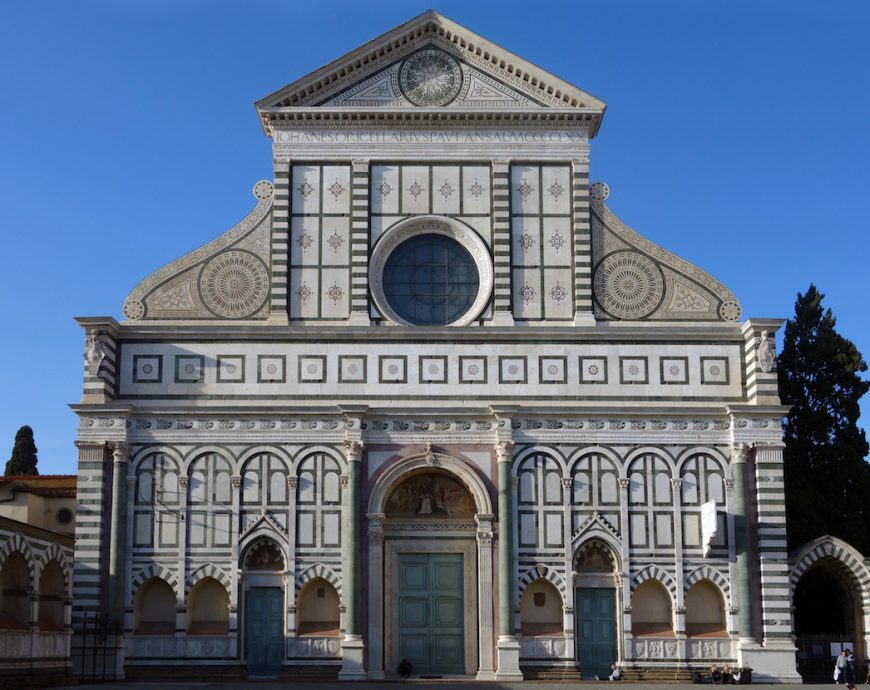
0:07:21.3 Dr. Beth Harris: Most of the time, when we think about Gothic architecture, what comes to mind is a French cathedral surrounded by flying buttresses that allow for enormous amounts of stained glass and light to come in. But Gothic architecture in Italy was decidedly different. What we see in the building today is very much a kind of Tuscan style of Gothic. We see a building made of brick, but faced with different colored marble in these beautiful geometric designs and patterns that activate the surface of the building. This polychromy, this use of different colored stone, recalls ancient Roman architecture.

0:08:01.3 Dr. Steven Zucker: But we can still see some trademark references to the Gothic that we recognize from French and English cathedrals: if we look at the lancet windows, those slender windows. We can see small rose windows. All of this is part of the international Gothic. And it’s probably worth mentioning that past the west side of the cathedral is the baptistery, which the Florentines believed was ancient Roman, even though it wasn’t quite that old. And it uses the same kind of polychromy on its exterior. And so this building is very much recalling that tradition, and in this way the city links itself to this noble ancient tradition.

0:08:38.9 Dr. Beth Harris: Florence was seeing itself at this moment as the new Rome, and so these references to ancient Rome were entirely appropriate. So we have this otherwise Gothic building. But if we look up at the blind tribunes at the base of the dome, we see pairs of attached columns with Corinthian capitals framing round arches with this lovely shell shape inside the niche. We also see a very heavy entablature. These are forms that Brunelleschi is borrowing from classical architecture. He’s reinventing architecture using these classical forms for the new modern Florence.

0:09:21.2 Dr. Steven Zucker: And those classicizing tribunes alternate with more traditional semi-domes that help to stabilize the central dome itself. In fact, just below those semi-domes, you can see enormous buttresses. These are not pierced, so they’re not flying buttresses in the French and English manner, but they are nevertheless doing important work, supporting not only the weight of the dome, but also its lateral thrust.

0:09:45.9 Dr. Beth Harris: Brunelleschi’s blind tribune is such a contrast to what’s around it. Right below the tribune, in fact, we see a landing supported by brackets, and in between the brackets we see pointed arches decorated with a trefoil. This is quintessentially Gothic. But then right above, Brunelleschi is recalling classical antiquity.

0:10:07.9 Dr. Steven Zucker: The building’s scale is so great that even as we sit here in the piazza just behind the cathedral, looking up, it’s almost impossible for me to understand how large it is. I actually have to look at the scale of the people that you can see at the bottom of the lantern, just at the top of the dome, as they’re enjoying incredible views of the city. Only really, they give me a sense of the enormous scale of the structure, of the enormous ambition of this structure, of the enormous ambition of Brunelleschi and of Florence in the 15th century.

Title Dome of the Cathedral of Florence
Artist(s) Filippo Brunelleschi
Dates 1420–36
Places Europe / Southern Europe / Italy
Period, Culture, Style Renaissance / Italian Renaissance
Artwork Type Architecture / Church
Material Stone, Brick, Wood, Iron
Technique

Read more about Brunelleschi’s Dome from the church of Santa Maria del Fiore

Learn more about the Pantheon and its dome in Rome

Marco Bussagli, Mina Gregori and Timothy Verdon, Brunelleschi’s Dome in Florence (Bologna: Scripta Maneant, 2021).

Henry A. Millon, editor, The Renaissance from Brunelleschi to Michelangelo: The Representation of Architecture (New York: Rizzoli, 1997).

Leland M. Roth and Amanda C. Roth Clark, “Renaissance Architecture,” Understanding Architecture: Its Elements, History, and Meaning, 3rd edition (Boulder: Westview Press, 2014), pp. 365–408.

Marvin Trachtenberg, Brunelleschi and the Moment of the Renaissance (Chicago: University of Chicago Press, 2025).

Marvin Trachtenberg, Building-in-time, From Giotto to Alberti and Modern Oblivion (New Haven: Yale University Press, 2010).


Loading Flickr images...

Cite this page as: Dr. Beth Harris and Dr. Steven Zucker, "Filippo Brunelleschi, Dome of the Cathedral of Florence," in Smarthistory, January 16, 2026, accessed January 16, 2026, https://smarthistory.org/brunelleschi-dome-of-the-cathedral-of-florence/.